


























Views
Downloads
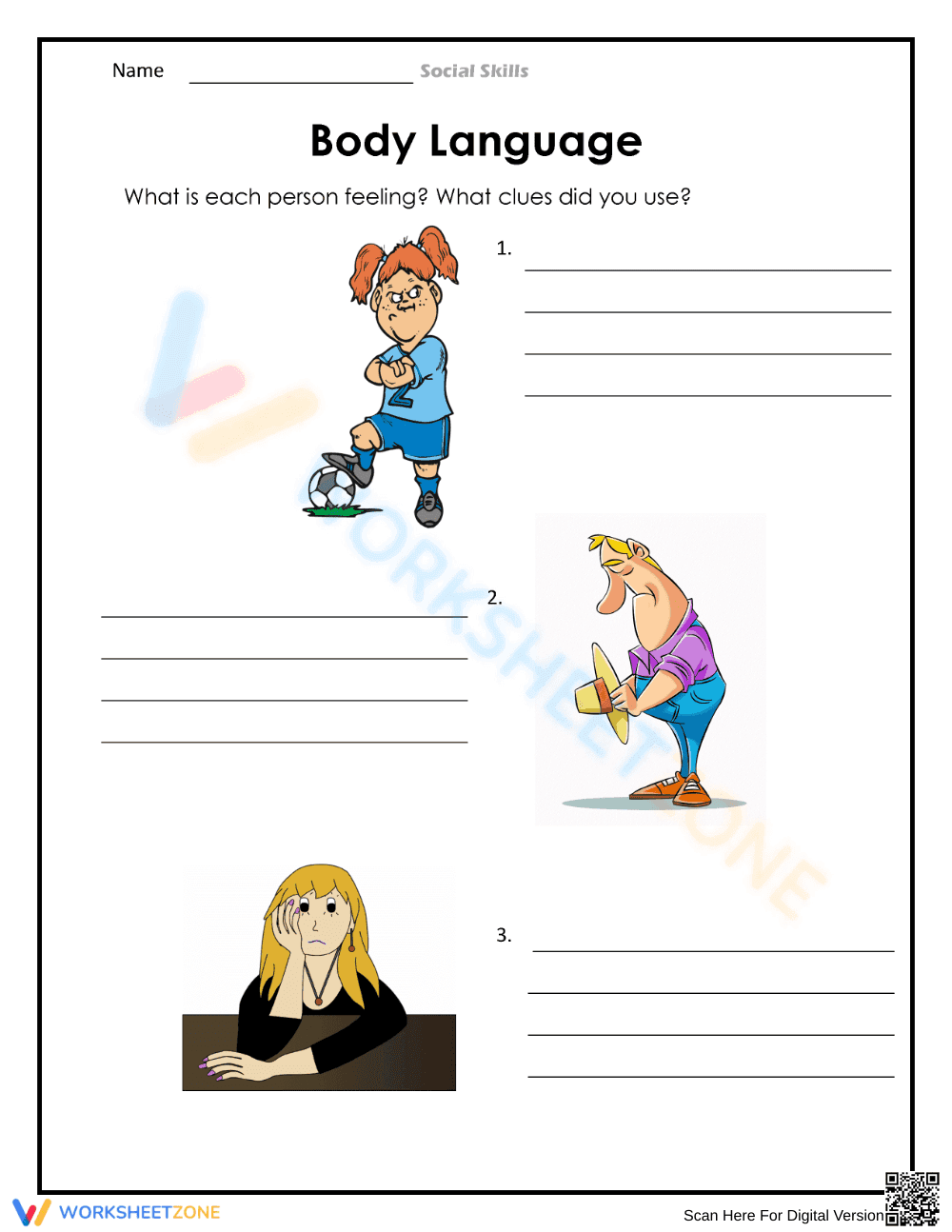

Printable Body Language Worksheet | Grade 6-8
Paste this activity's link or code into your existing LMS (Google Classroom, Canvas, Teams, Schoology, Moodle, etc.).
Students can open and work on the activity right away, with no student login required.
You'll still be able to track student progress and results from your teacher account.
This middle school social skills worksheet helps students interpret nonverbal communication by analyzing visual cues. Students examine three distinct character illustrations to identify the underlying emotions and explain the specific physical evidence that led to their conclusions, building essential interpersonal awareness and empathy.
At a Glance
- Grade: 6 · Subject: Social Skills
- Standard:
CCSS.ELA-LITERACY.SL.6.2— Interpret information presented in diverse media formats- Skill Focus: Interpreting nonverbal cues
- Format: 1 page · 3 problems · No answer key · PDF
- Best For: Independent practice or group discussion
- Time: 10–15 minutes
Inside this single-page resource, educators will find three visual analysis tasks. Each section features an illustration of a character displaying strong body language, like crossed arms or a slumped posture. Alongside each image, students use blank lines to answer two questions: identifying the emotion and citing the specific visual clues used to make that determination. The open-ended format encourages descriptive writing.
Zero-Prep Workflow
This resource requires under two minutes of total teacher prep time.
- Print (1 minute): The single-page layout prints cleanly in color or grayscale.
- Distribute (1 minute): Hand out the sheets as a quick warm-up. Instructions are self-explanatory.
- Review (5 minutes): Facilitate a brief class discussion where students share the clues they noticed.
This activity is highly suitable for emergency sub plans or advisory periods.
Standards Alignment
This activity aligns with CCSS.ELA-LITERACY.SL.6.2, requiring students to interpret information presented in diverse media and formats (e.g., visually, quantitatively, orally) and explain how it contributes to a topic, text, or issue under study. By analyzing visual character cues, students practice extracting meaning from non-textual sources. Both standard codes can be copied directly into lesson plans, IEP goals, or district curriculum mapping tools.
How to Use It
Deploy this worksheet during a social-emotional learning block or as a pre-reading activity before starting a novel. It works well as a 10 to 15-minute morning work assignment. As a formative assessment observation tip, listen to students discuss answers in pairs; note whether they distinguish between an assumption and a concrete visual clue (e.g., "she looks mad" versus "her arms are crossed").
Who It's For
This resource is primarily designed for middle school students in grades 6 through 8, particularly those participating in dedicated social skills groups, advisory classes, or special education programs focusing on pragmatic language. To differentiate for students who struggle with expressive writing, allow them to verbally dictate their observations or provide a word bank of emotion vocabulary. Pair this worksheet with a short video clip played on mute, asking students to apply the same observational skills to moving subjects.
Developing proficiency in nonverbal communication is a critical component of adolescent social development and comprehensive literacy. According to a RAND AIRS 2024 report on social-emotional learning interventions, explicit instruction in recognizing visual cues significantly improves peer interactions and reading comprehension of complex character motivations. By addressing CCSS.ELA-LITERACY.SL.6.2, this activity requires students to interpret information presented in diverse media formats, directly supporting these essential interpersonal skills. When students practice identifying specific physical indicators of emotion—such as posture, facial expressions, and gestures—they build the cognitive framework necessary for empathy and advanced textual analysis. This targeted practice ensures learners can accurately read their environment and respond appropriately, bridging the gap between visual literacy and functional social behavior in the classroom and beyond. Consistent exposure to these observational tasks fosters a more inclusive and communicative school climate.


