


























Views
Downloads



Simplifying Indices Worksheet | Grade 8 Math Essential
Paste this activity's link or code into your existing LMS (Google Classroom, Canvas, Teams, Schoology, Moodle, etc.).
Students can open and work on the activity right away, with no student login required.
You'll still be able to track student progress and results from your teacher account.
This comprehensive 3-page Grade 8 math worksheet focuses on mastering the fundamental principles of indices through 29 structured problems. Students will develop procedural fluency in simplifying algebraic expressions by applying product, quotient, and power laws. The progressive structure ensures that learners build confidence before tackling complex nested operations and critical error analysis tasks.
At a Glance
- Grade: 8 · Subject: Mathematics
- Standard:
CCSS.MATH.CONTENT.8.EE.A.1— Apply properties of integer exponents to generate equivalent expressions- Skill Focus: Simplifying indices using exponent laws
- Format: 3 pages · 29 problems · Answer key included · PDF
- Best For: Algebra unit practice or assessment
- Time: 35–45 minutes
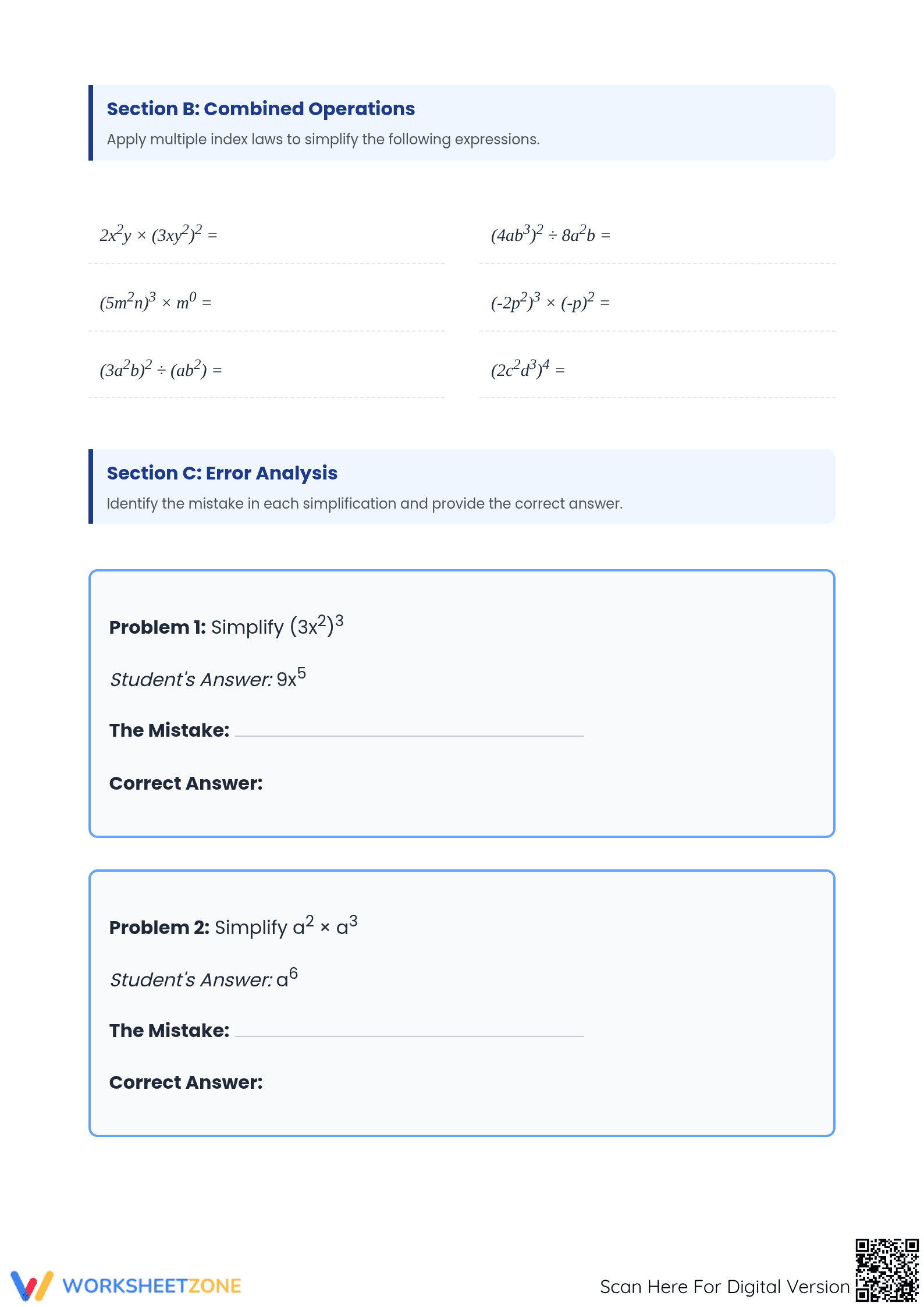
The packet contains four distinct sections designed to scaffold learning. Section A introduces 20 basic index law applications, while Section B challenges students with combined operations. Section C incorporates higher-order thinking through error analysis, requiring students to identify and correct common misconceptions. The final page features "The Ultimate Challenge," a complex nested expression that serves as a rigorous mastery check.
Skill Progression
- Guided Practice: Students begin with 20 basic one-step simplifications where they apply individual laws to variables and coefficients with minimal complexity.
- Supported Practice: Learners move into combined operations, where 6 multi-step problems require the simultaneous application of multiple index rules.
- Independent Practice: The packet culminates in error analysis and a high-complexity challenge problem, promoting a cognitive shift from calculation to conceptual evaluation.
Standards Alignment
This resource is directly aligned to `CCSS.MATH.CONTENT.8.EE.A.1`, which requires students to know and apply the properties of integer exponents to generate equivalent numerical expressions. It also supports `HSA-SSE.A.2` by teaching students to use the structure of an expression to identify ways to rewrite it. Both standard codes can be copied directly into lesson plans, IEP goals, or district curriculum mapping tools.
How to Use It
Assign the first page as a during-instruction guided practice activity to reinforce the product and quotient rules. Use the second and third pages as a summative assessment or exit ticket to gauge student readiness for advanced algebra. Teachers should observe student performance on the error analysis section to identify if learners are confusing the power-to-a-power rule with the product rule. Completion usually takes 40 minutes.
Who It's For
This worksheet is ideal for 8th-grade students or high school Algebra 1 learners needing a Ready practice set for exponents. The clean, minimalist design reduces cognitive load, making it an excellent resource for students with ADHD or those requiring specialized instruction. It pairs naturally with an interactive whiteboard lesson or a guided notes packet on index laws.
Research conducted by RAND AIRS 2024 highlights that scaffolding algebraic complexity through a gradual-release model significantly improves student retention of abstract rules like indices. This worksheet directly implements those findings by transitioning from 20 foundational tasks to complex error analysis, addressing the common student misconception that exponentiation is equivalent to multiplication. By requiring students to justify why a mistake occurred in Section C, the resource aligns with EdReports 2024 recommendations for deepening mathematical discourse rather than relying on rote memorization. The inclusion of an Ultimate Challenge provides the necessary rigor for high-achieving students while the initial basic laws section ensures accessibility for all learners. Standard CCSS.MATH.CONTENT.8.EE.A.1 mastery depends on such structured variety, as noted in Fisher & Frey (2014) regarding the importance of error detection in developing long-term procedural fluency and algebraic reasoning skills in secondary education.


