


























Views
Downloads
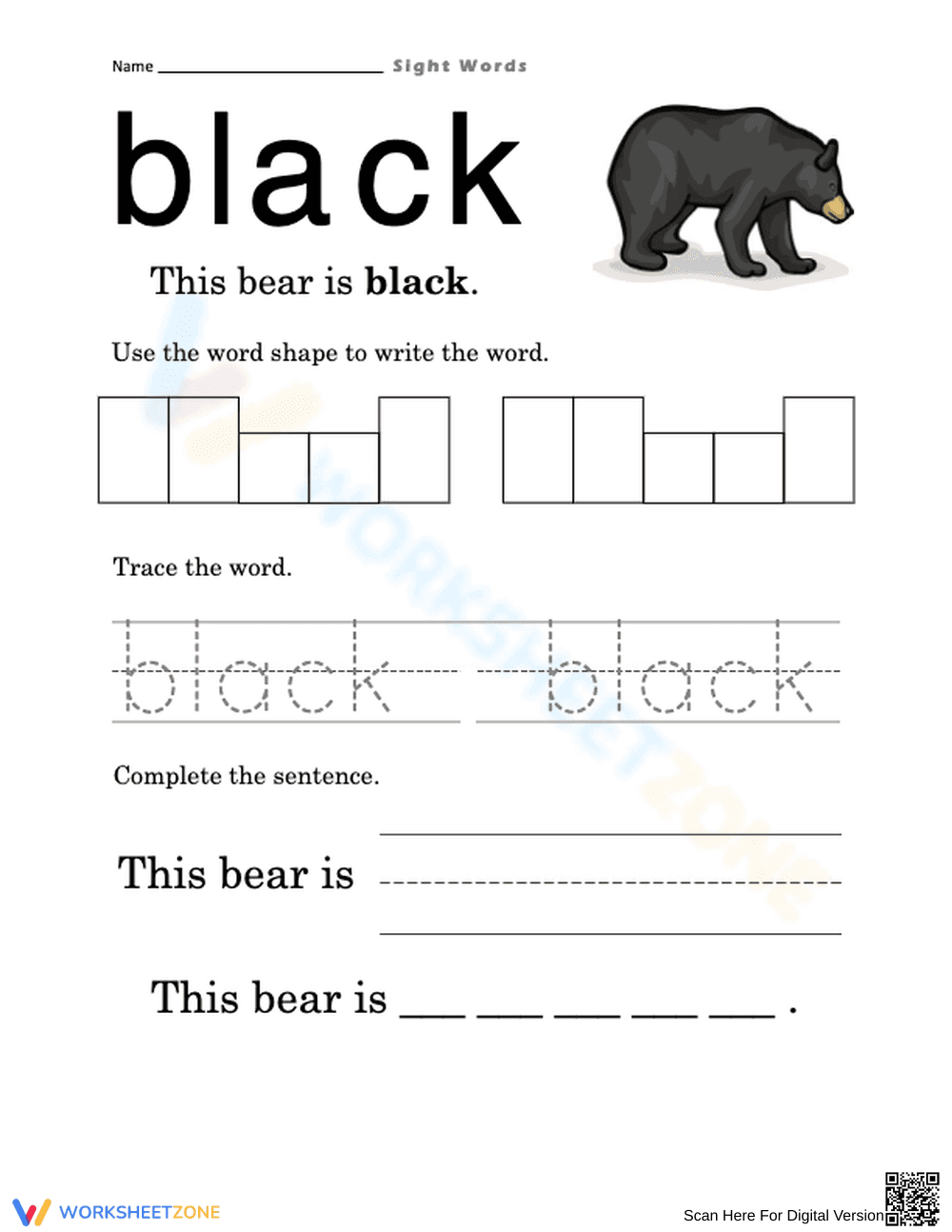

Essential Sight Word "Black" Worksheet | Grade 1 ELA
Paste this activity's link or code into your existing LMS (Google Classroom, Canvas, Teams, Schoology, Moodle, etc.).
Students can open and work on the activity right away, with no student login required.
You'll still be able to track student progress and results from your teacher account.
Help your first-grade students master the high-frequency sight word "black" with this focused, multisensory literacy worksheet. By combining visual word shapes, tactile tracing practice, and contextual sentence completion, this resource ensures students move from recognition to confident usage. This foundational exercise builds the orthographic mapping skills required for early reading fluency and writing success.
At a Glance
- Grade: 1 · Subject: English Language Arts
- Standard:
CCSS.ELA-LITERACY.RF.1.3.G— Recognize and read grade-appropriate irregularly spelled words in text- Skill Focus: Sight Word Recognition ("Black")
- Format: 1 page · 6 tasks · Answer key included · PDF
- Best For: Independent literacy center practice
- Time: 10–15 minutes
What's Inside
This one-page PDF focuses exclusively on the word "black." The layout includes a clear visual anchor with a bear illustration for immediate semantic context. Students engage in word-shape mapping to internalize letter height, followed by tracing lines for fine motor development. Finally, sentence-completion prompts require students to apply the word within a structured frame, reinforcing its role as a descriptive adjective.
Zero-Prep Workflow
- Step 1: Print the single-page document in seconds (zero prep time).
- Step 2: Distribute to students for independent work during a literacy rotation or as a quiet morning transition activity.
- Step 3: Review the completed sentence frames to verify letter formation and spelling accuracy. Its self-explanatory nature makes it a perfect addition to emergency sub plans.
Standards Alignment
This worksheet is aligned to CCSS.ELA-LITERACY.RF.1.3.G, requiring students to recognize and read grade-appropriate irregularly spelled words. By focusing on the specific configuration of the word through tracing, it supports CCSS.ELA-LITERACY.L.1.2.D regarding phonetic spelling conventions. Both standard codes can be copied directly into lesson plans, IEP goals, or district curriculum mapping tools.
How to Use It
Deploy this worksheet during your phonics block after introducing color words on your classroom word wall. It serves as an excellent formative assessment; observe students as they complete the "word shape" boxes to see if they recognize the tall 'b' and 'l' versus short letters. Students typically finish in 12 minutes, making it ideal for literacy stations.
Who It's For
This resource is designed for Grade 1 students, though it is effective for advanced Kindergarteners or English Language Learners building basic vocabulary. The visual bear graphic provides a non-linguistic representation that supports diverse learners. It pairs naturally with a classroom "Color Word" anchor chart or a descriptive writing passage about animals or colors.
Fisher & Frey (2014) emphasize that the gradual release of responsibility is most effective when students move from guided models to independent application. This worksheet utilizes that methodology by providing a clear visual model, followed by scaffolded tracing, and concluding with independent production. Multisensory approaches involving tracing and word-shape mapping help bridge the gap between phonemic awareness and orthographic mapping, a critical milestone for first-grade readers. By engaging both the visual and motor cortex, students are more likely to retain high-frequency words that do not follow standard phonetic rules. This 1-page design minimizes cognitive load by focusing on a single target word, allowing young learners to achieve mastery without distraction. This approach is consistent with NAEP findings regarding the importance of foundational fluency in achieving long-term reading comprehension goals.


