




























Views
Downloads

Printable Bird Identification Worksheet | Grade K-1

Paste this activity's link or code into your existing LMS (Google Classroom, Canvas, Teams, Schoology, Moodle, etc.).
Students can open and work on the activity right away, with no student login required.
You'll still be able to track student progress and results from your teacher account.
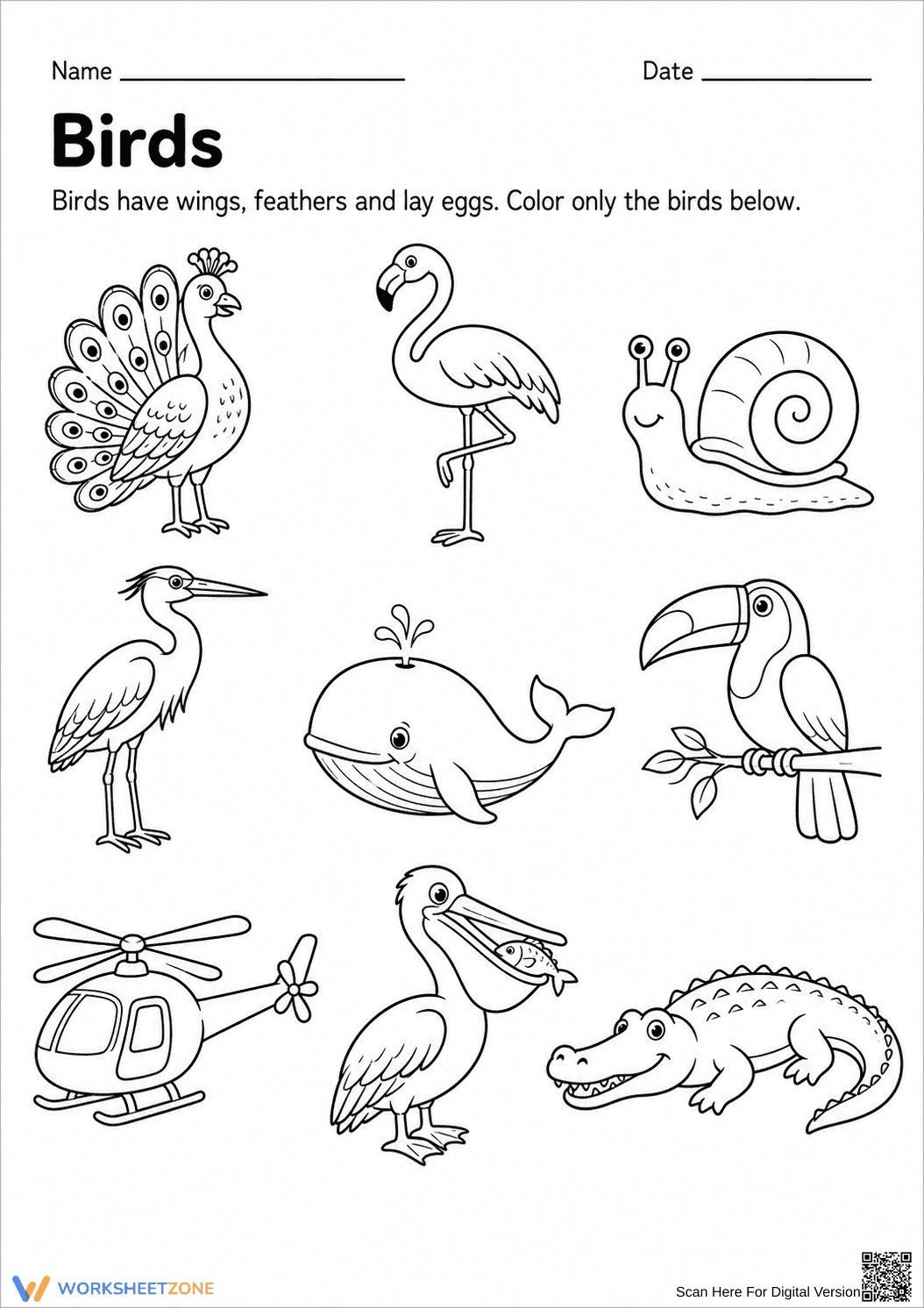
This Grade K-1 bird identification worksheet helps young learners recognize the defining characteristics of avian species. Students evaluate nine different illustrations, coloring only the animals that possess wings and feathers. By distinguishing birds from other animals and objects, children build foundational biological classification skills through direct observation.
At a Glance
- Grade: K–1 · Subject: Science
- Standard:
K-LS1-1— Identify and categorize species groups using observable animal traits- Skill Focus: Bird identification
- Format: 1 page · 9 problems · Answer key included · PDF
- Best For: Zero-prep science centers and morning work
- Time: 10–15 minutes
What's Inside
This single-page resource features nine distinct illustrations ranging from tropical birds like toucans and flamingos to non-avian items like snails, whales, and even a helicopter. Each image is high-contrast and ready for coloring, specifically designed to test the student's ability to apply the provided definition: birds have wings, feathers, and lay eggs. A full answer key is provided for quick review.
Zero-Prep Workflow
This resource is designed for immediate classroom implementation with minimal teacher setup. Print: Generate the single-sheet PDF in under thirty seconds. Distribute: Hand out to students in approximately one minute, requiring only a set of crayons or colored pencils. Review: Checking the finished work as a whole-class activity adds just three minutes to your schedule. With total prep time under two minutes, it serves as an ideal sub plan or quick morning warm-up.
Standards Alignment
Aligned to K-LS1-1, this activity requires students to use observations to identify patterns in animal structures. Specifically, it focuses on the structural features like wings and feathers that define the bird category. Both standard codes can be copied directly into lesson plans, IEP goals, or district curriculum mapping tools.
How to Use It
Use this worksheet as an engaging hook before direct instruction on life science, or as a formative assessment after teaching the traits of living things. While students work, observe if they correctly identify the helicopter and whale as non-birds despite their movement patterns or habitats; this provides a perfect opening for a discussion on mechanical versus biological flight. Expected completion time ranges from ten to fifteen minutes.
Who It's For
This activity is designed for Kindergarten and Grade 1 students who are developing their sorting and categorization abilities. It provides a low-floor, high-ceiling entry point for English Language Learners through clear visual cues and simple instructions. Pair this worksheet with a bird-themed anchor chart or a short read-aloud about local wildlife to deepen the instructional impact and provide additional context.
Research from Fisher & Frey (2014) highlights that visual classification tasks are critical for developing the mental schemas required for scientific inquiry in early childhood. This worksheet addresses the K-LS1-1 standard by asking students to identify and categorize species groups using observable animal traits like wings and feathers. By evaluating nine distinct items, students move beyond simple recognition into active trait analysis. The inclusion of non-living objects like helicopters forces students to distinguish between functional movement and biological structures, reinforcing foundational science concepts. This structured approach to bird identification provides measurable data for teacher observations, supporting the gradual release of responsibility model. Such evidence-based practice ensures that students develop the foundational skills necessary for more complex biological classification in later grades, making it a highly effective addition to any elementary science curriculum.


