


























Views
Downloads
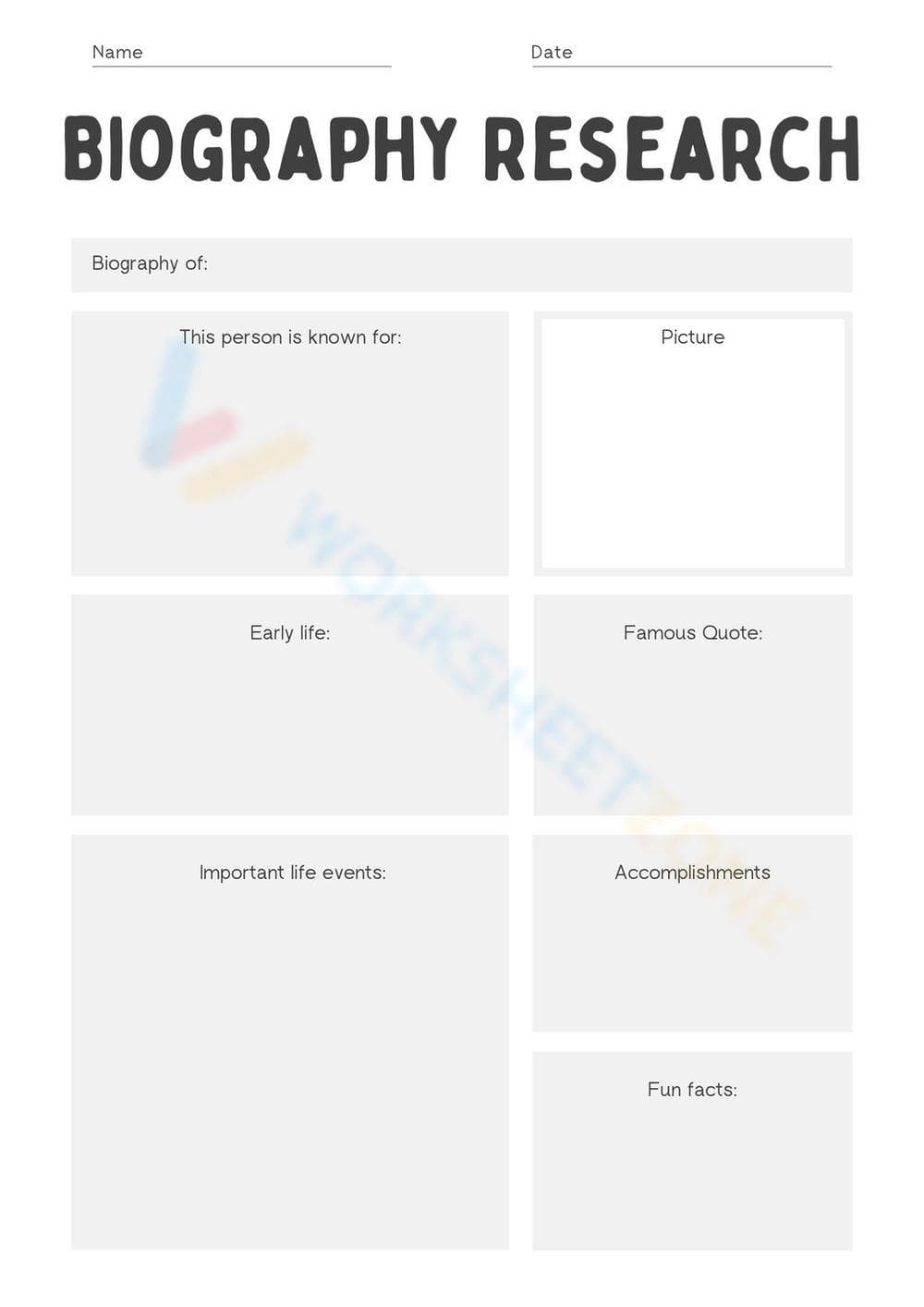

Biography Research Graphic Organizer | Grade 3 Printable
Paste this activity's link or code into your existing LMS (Google Classroom, Canvas, Teams, Schoology, Moodle, etc.).
Students can open and work on the activity right away, with no student login required.
You'll still be able to track student progress and results from your teacher account.
This Grade 3 biography research graphic organizer helps students structure informational writing by categorizing key facts about historical figures. Breaking down complex research into manageable sections lets young writers easily gather and sort evidence before drafting reports.
At a Glance
- Grade: 3 · Subject: ELA
- Standard:
CCSS.ELA-LITERACY.W.3.8— Gather information and sort evidence into provided categories- Skill Focus: Biography Research
- Format: 1 page · 8 fields · No answer key · PDF
- Best For: Pre-writing and independent research
- Time: 20–30 minutes
This single-page graphic organizer features eight sections designed to guide student inquiry. Fields include basic identification, early life, important events, major accomplishments, a famous quote, and fun facts. A space for an illustration supports visual learners. Because this is an open-ended template, an answer key is not included, allowing use with any biographical subject.
This resource is designed for a zero-prep workflow:
- Print (1 minute): Generate copies directly from the PDF.
- Distribute (1 minute): Hand out alongside biography texts or digital devices.
- Review (1 minute): Briefly model how to extract a fact and place it in the correct box.
Total teacher preparation requires under three minutes, making this an excellent activity for emergency sub plans or independent literacy centers.
This worksheet is tightly aligned to CCSS.ELA-LITERACY.W.3.8: "Recall information from experiences or gather information from print and digital sources; take brief notes on sources and sort evidence into provided categories." It also supports foundational reading comprehension by requiring students to identify main ideas and key details in informational texts. Both standard codes can be copied directly into lesson plans, IEP goals, or district curriculum mapping tools.
Teachers can deploy this organizer during the pre-writing phase of an informational essay unit. Students can use it while reading a biography to actively take notes, ensuring they capture essential details before drafting paragraphs. Alternatively, it serves as a standalone assessment during a social studies or history block where students research a specific historical figure. Expect completion to take 20 to 30 minutes depending on reading levels. As a formative assessment tip, observe whether students are copying full sentences or appropriately synthesizing information into brief notes within the provided boxes.
This resource is primarily designed for third-grade students, though it functions well for second-grade enrichment or fourth-grade review. The clear, boxed layout provides built-in scaffolding for students who struggle with executive functioning or organizing their thoughts on blank paper. It pairs perfectly with a direct instruction lesson on identifying reliable sources or a curated collection of grade-level biography picture books.
Effective informational writing requires structured note-taking strategies that reduce cognitive load for young learners. By utilizing this graphic organizer aligned to CCSS.ELA-LITERACY.W.3.8, students practice how to gather information and sort evidence into provided categories. According to Fisher & Frey (2014), providing explicit frameworks for organizing textual evidence significantly improves students' ability to synthesize information and produce coherent informative texts. Graphic organizers act as a critical bridge between reading comprehension and written expression, allowing students to visually map out relationships between discrete facts. This specific layout ensures that learners do not become overwhelmed by large blocks of text, instead focusing their attention on extracting targeted data such as accomplishments and chronological life events. Implementing this structured approach fosters greater independence in research tasks and builds foundational skills necessary for advanced academic writing in upper elementary grades.


