


























Views
Downloads

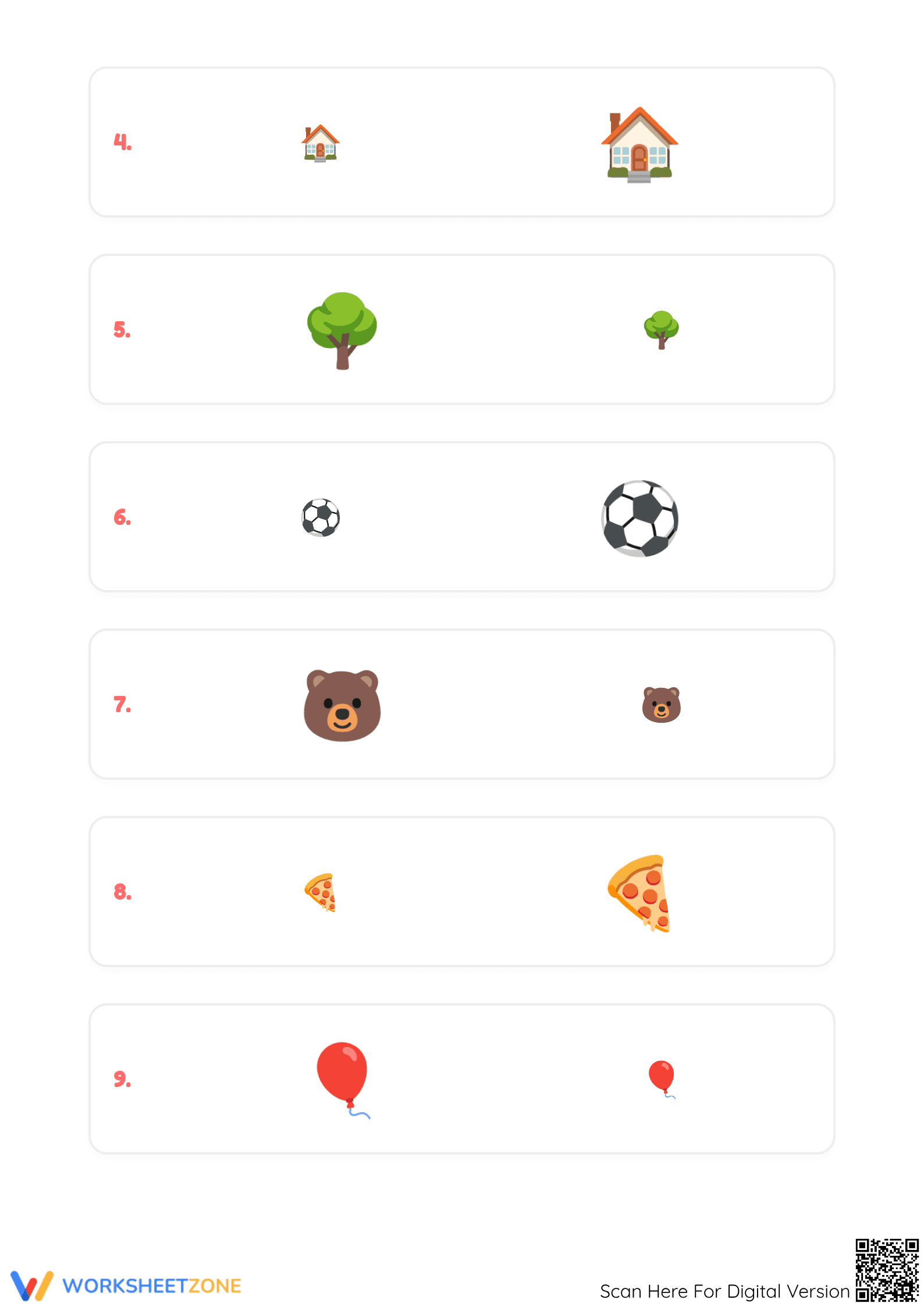



Printable Big and Small Comparison Worksheet | Grade K Math
Paste this activity's link or code into your existing LMS (Google Classroom, Canvas, Teams, Schoology, Moodle, etc.).
Students can open and work on the activity right away, with no student login required.
You'll still be able to track student progress and results from your teacher account.
Mastering Size Comparison for Early Learners
This Grade K measurement worksheet provides early learners with structured practice in identifying and comparing the relative sizes of various objects. By focusing on the foundational concepts of "big" and "small," the activities help students develop the visual discrimination skills necessary for more complex geometric and mathematical reasoning. Students engage with recognizable illustrations to ensure the concepts are concrete and accessible for Kindergarten and Grade 1 learners.
At a Glance
- Grade: Kindergarten · Subject: Math
- Standard:
CCSS.MATH.CONTENT.K.MD.A.2— Directly compare two objects with a measurable attribute in common to see which has more- Skill Focus: Relative size comparison (Big vs. Small)
- Format: 5 pages · 22 problems · Answer key included · PDF
- Best For: Initial introduction to measurement and comparative language
- Time: 15–20 minutes
What's Inside
This comprehensive 5-page PDF contains 22 discrete comparison tasks featuring clear, engaging illustrations of animals, plants, and everyday objects. Each page is designed with high visual support and minimal text to accommodate emergent readers. The package includes a full-color answer key for rapid checking and is formatted for immediate classroom or home use with no additional setup required.
Skill Progression
- Guided Practice: The initial pages feature side-by-side comparisons of identical objects in different scales (e.g., big and small elephants) to establish the conceptual baseline.
- Supported Practice: Middle sections introduce 6-8 tasks per page, requiring students to circle or check the correct size category from a varied set of illustrations.
- Independent Practice: The final pages challenge students to discriminate between multiple objects of varying sizes without direct prompts, solidifying their understanding of comparative attributes.
This resource follows a gradual-release model, moving from high-scaffold visual cues to independent identification of size attributes.
Standards Alignment
This worksheet is primarily aligned to CCSS.MATH.CONTENT.K.MD.A.2: "Directly compare two objects with a measurable attribute in common, to see which object has 'more of'/'less of' the attribute, and describe the difference." This resource specifically targets the attribute of size (length/area). This standard code can be copied directly into lesson plans, IEP goals, or district curriculum mapping tools.
How to Use It
This resource is best utilized during the "Explore" or "Practice" phase of a measurement unit. For an effective formative assessment, observe students as they complete the first page; if they struggle to distinguish the objects, provide physical manipulatives (like blocks or buttons) to bridge the gap from concrete to representational. The worksheet typically takes 15–20 minutes to complete, making it ideal for independent morning work or a dedicated math center rotation.
Who It's For
Designed for Kindergarten students and Grade 1 learners requiring remediation, this worksheet is also suitable for English Language Learners (ELLs) due to its heavy reliance on visual context. It pairs naturally with a classroom anchor chart on comparative words or a read-aloud session of size-themed informational texts to reinforce the vocabulary in multiple modalities.
According to the NAEP 2024 framework for early childhood mathematics, the ability to recognize and describe measurable attributes like size is a critical precursor to understanding the number system and spatial reasoning. This Grade K big and small worksheet addresses the foundational skill of relative size comparison, aligned with CCSS.MATH.CONTENT.K.MD.A.2. By engaging in these 22 structured tasks, students build the prerequisite visual discrimination skills identified by Fisher & Frey (2014) as essential for early literacy and numeracy. The high-contrast illustrations and repetitive task structure support cognitive load management for young learners, ensuring that the focus remains on the mathematical attribute being measured. This resource provides the necessary scaffolding to transition students from intuitive comparisons to formal descriptive mathematical language.


