


























Views
Downloads
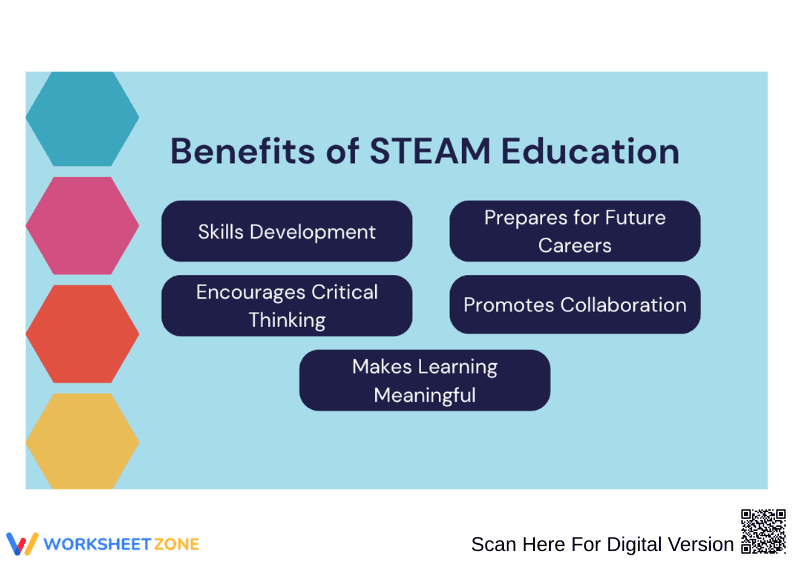

STEAM Education Benefits | Printable Grade 6 Poster
Paste this activity's link or code into your existing LMS (Google Classroom, Canvas, Teams, Schoology, Moodle, etc.).
Students can open and work on the activity right away, with no student login required.
You'll still be able to track student progress and results from your teacher account.
This visual resource introduces students to the core advantages of STEAM learning. By examining the five key pillars presented in this infographic, learners grasp how science, technology, engineering, art, and math connect to real-world success. It provides a clear, accessible overview of critical thinking, collaboration, and future career preparation.
At a Glance
- Grade: 6 · Subject: Science
- Standard:
CCSS.ELA-LITERACY.RI.6.7— Integrate information presented in visual formats- Skill Focus: Analyzing informational graphics
- Format: 1 page · 0 problems · No answer key · PDF
- Best For: Classroom display and discussion
- Time: 5–10 minutes
This single-page infographic features a clean, color-coded design that outlines five primary benefits of STEAM education. It highlights skills development, career preparation, critical thinking, collaboration, and meaningful learning. The visual format uses distinct hexagonal graphics and clear text blocks, making it an ideal reference tool or anchor chart for middle school classrooms without overwhelming students with dense paragraphs.
- Print (1 minute): Download the PDF and print in color for maximum visual impact on a classroom bulletin board or as a student handout.
- Distribute (1 minute): Hand out copies to students at the beginning of a new STEM unit or project-based learning module.
- Review (3 minutes): Briefly discuss each of the five points, asking students to provide examples of how they might use critical thinking or collaboration in their upcoming assignments.
Total teacher preparation requires under two minutes, making this an excellent addition to any lesson plan or substitute folder.
Aligned to CCSS.ELA-LITERACY.RI.6.7, this resource requires students to integrate information presented in different media or formats as well as in words to develop a coherent understanding of a topic. It also supports general science and engineering practices by establishing the "why" behind project-based learning. Both standard codes can be copied directly into lesson plans, IEP goals, or district curriculum mapping tools.
Use this infographic as a lesson hook before starting an engineering design project. Display it on the smartboard and ask students to select one benefit, such as "Promotes Collaboration," and write a brief reflection on why that skill matters. Alternatively, use it as a permanent anchor chart in a makerspace. Formative assessment can be conducted by observing which students connect these pillars to daily activities. Expected review time is 5 to 10 minutes.
Designed for middle school students beginning integrated science curricula. It serves as an excellent scaffold for visual learners and students who benefit from concise, chunked information rather than lengthy texts. Pair this infographic with a hands-on building challenge or a direct instruction lesson on the engineering design process to reinforce the concepts.
Understanding the foundational purpose of integrated learning is crucial for student engagement and long-term academic success. This resource aligns directly with CCSS.ELA-LITERACY.RI.6.7 by requiring students to integrate information presented in visual formats to build comprehension. According to a comprehensive EdReports 2024 analysis, students who explicitly understand the real-world applications and benefits of their coursework demonstrate a significant increase in sustained attention during complex problem-solving tasks. By explicitly outlining how STEAM education prepares students for future careers and encourages critical thinking, educators can foster a highly purposeful classroom environment. The clear, visual nature of this infographic reduces cognitive load, allowing learners to quickly internalize the value of collaboration and meaningful learning. Providing this context upfront ensures that subsequent hands-on projects are grounded in a clear understanding of their broader educational significance.


