


























Views
Downloads

Before and After Alphabet Practice | Essential Preschool ELA
Paste this activity's link or code into your existing LMS (Google Classroom, Canvas, Teams, Schoology, Moodle, etc.).
Students can open and work on the activity right away, with no student login required.
You'll still be able to track student progress and results from your teacher account.
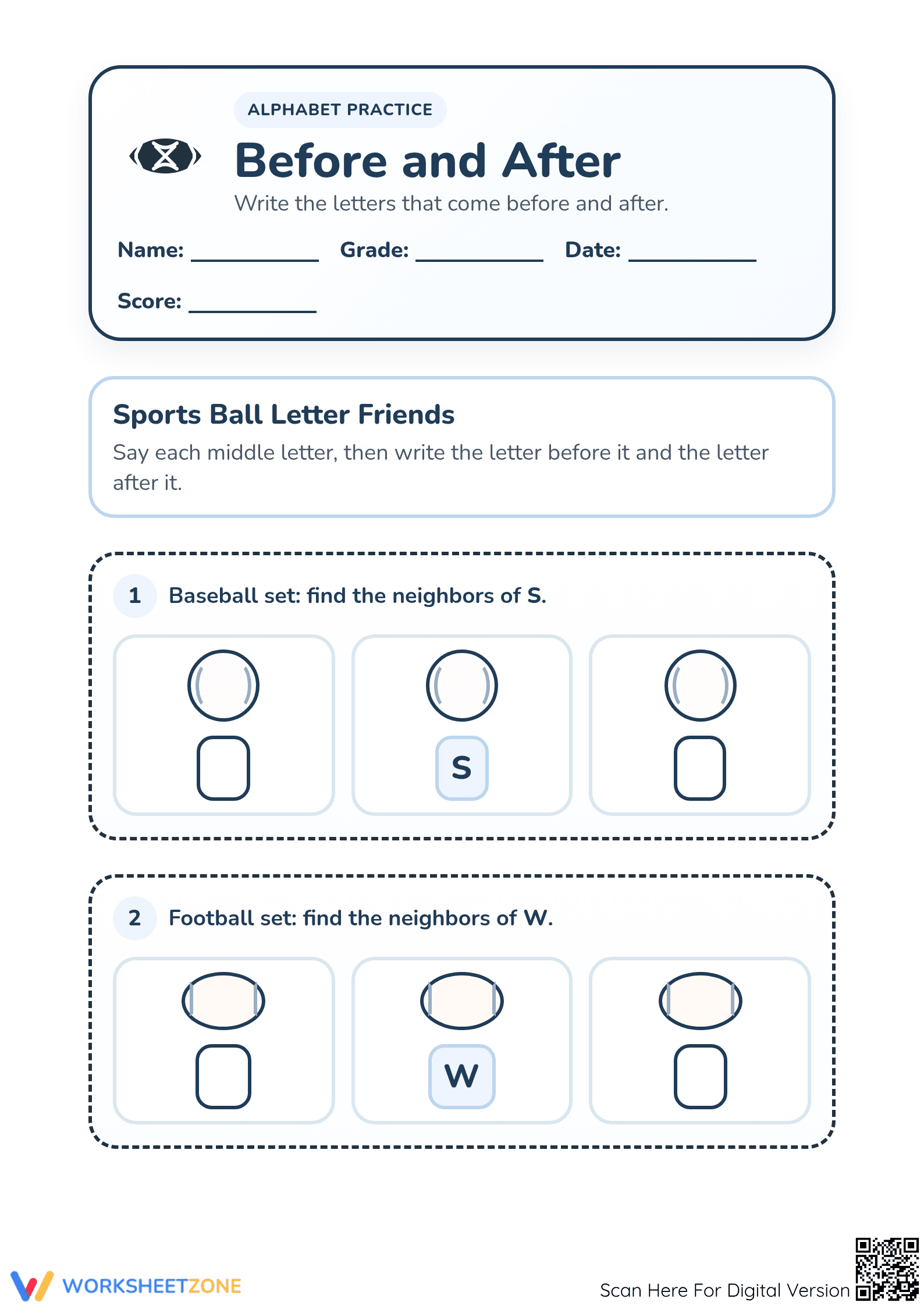
This "Before and After" alphabetical order worksheet helps preschool students master the sequence of letters through engaging sports-themed tasks. By identifying the "neighbors" of specific letters, children build foundational literacy skills and letter recognition essential for reading readiness. This printable resource ensures students can confidently sequence the alphabet in a structured, visual format.
At a Glance
- Grade: Preschool · Subject: English Language Arts
- Standard:
CCSS.ELA-LITERACY.RF.K.1.D— Recognize and name all upper and lowercase letters of the alphabet- Skill Focus: Alphabetical order and letter sequencing
- Format: 3 pages · 8 problems · Answer key included · PDF
- Best For: Early literacy centers and letter recognition
- Time: 15–20 minutes
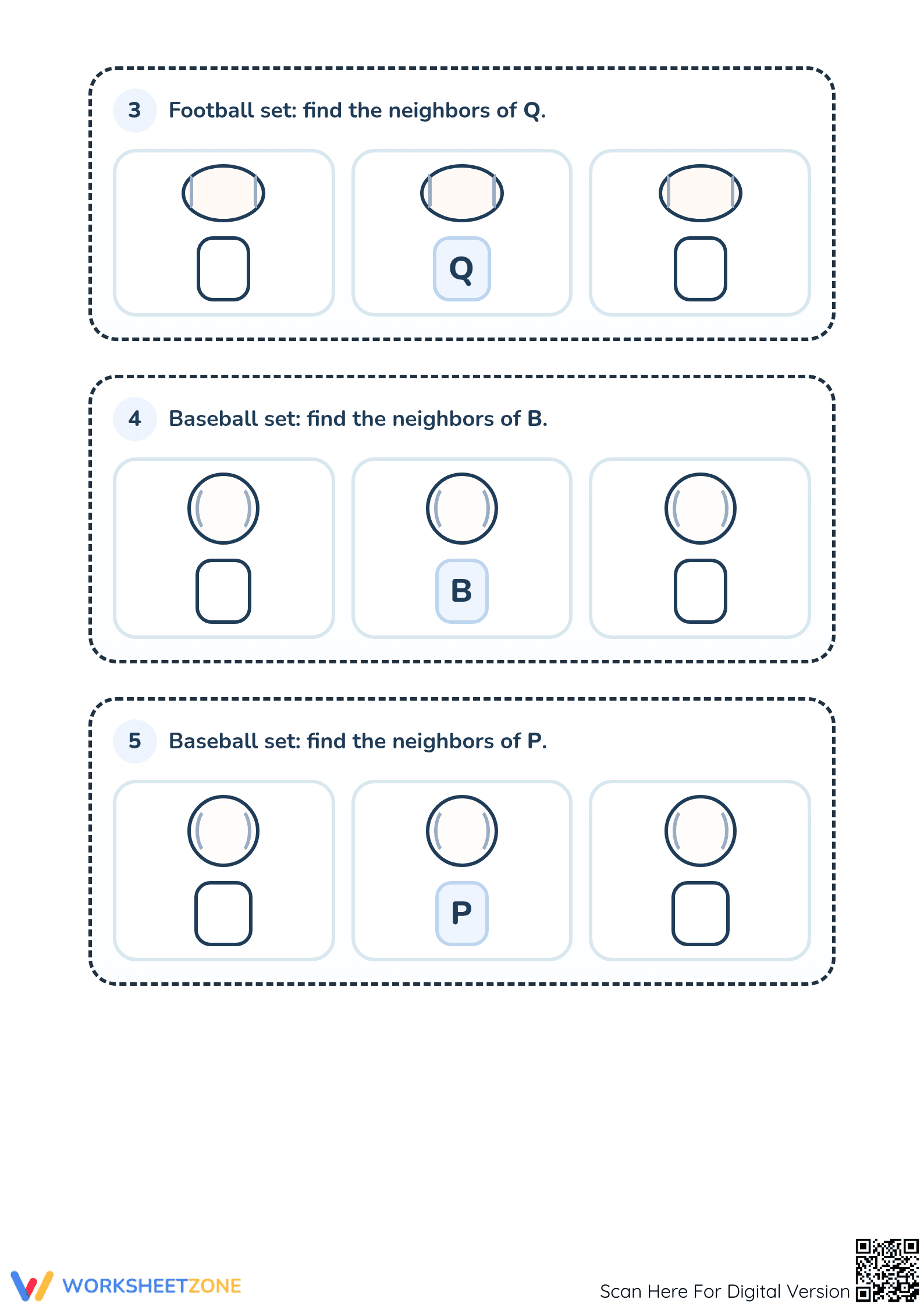
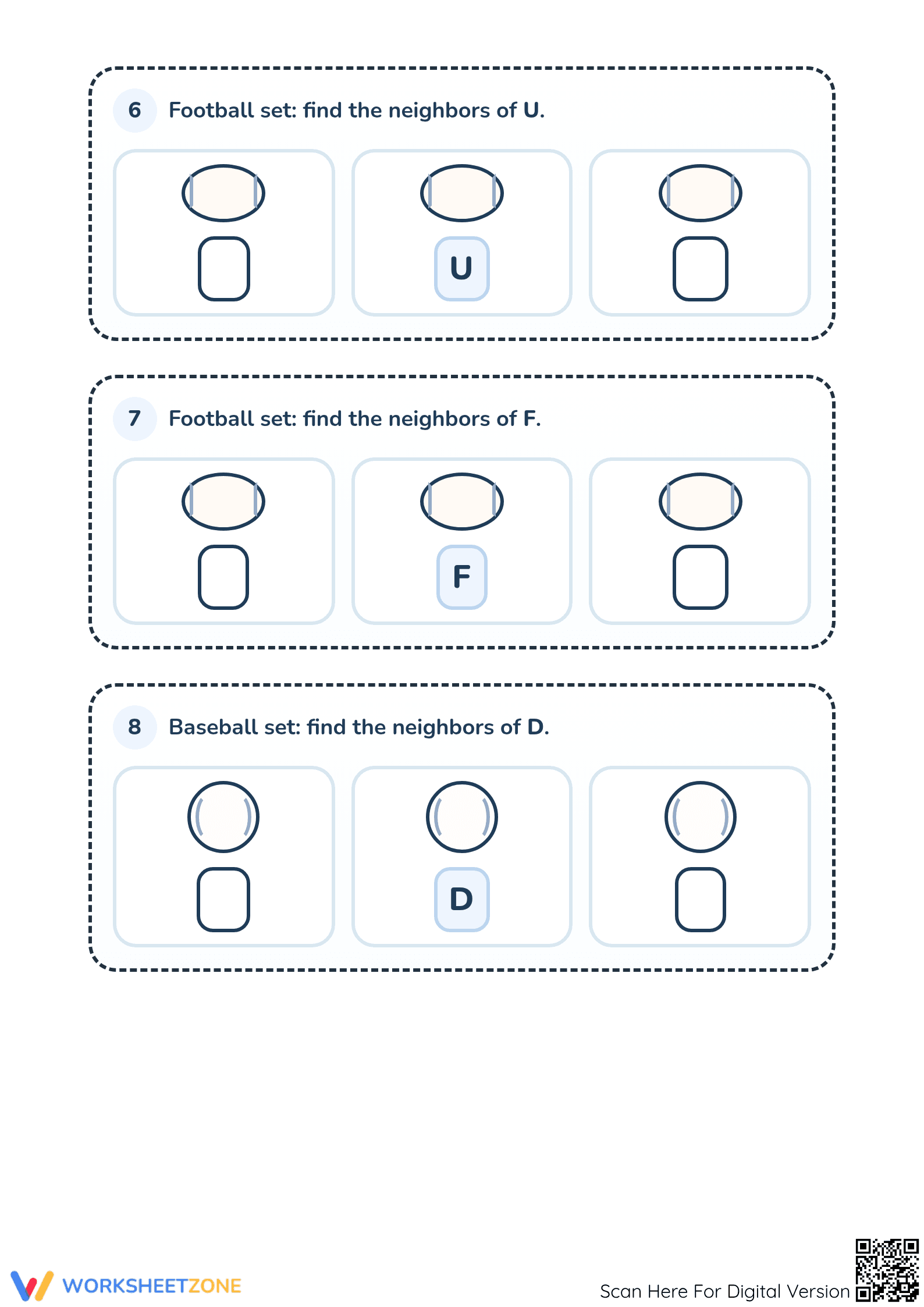
This three-page PDF collection features eight distinct "Sports Ball Letter Friends" activities. Each task presents a central letter (like S, W, or Q) within a baseball or football theme, challenging students to write the letters that come immediately before and after. The large, clear font and spacious writing boxes are designed for developing fine motor skills, and a complete answer key is provided for quick verification.
Skill Progression
- Guided Practice: The worksheet begins with highly recognizable letters and clear thematic cues to anchor the student's focus on the "before" and "after" concept using initial problems on page one.
- Supported Practice: Mid-worksheet tasks introduce more challenging letter placements, encouraging students to recall the alphabet song or refer to an anchor chart while completing five additional problems.
- Independent Practice: The final page requires students to apply their sequencing knowledge to three distinct sets with minimal teacher prompting, solidifying their grasp of alphabetical position.
This gradual-release approach moves students from "I Do" modeling to "You Do" independent mastery.
Standards Alignment
The primary focus is CCSS.ELA-LITERACY.RF.K.1.D, which requires students to recognize and name all upper and lowercase letters. By placing letters in their correct sequential context, students demonstrate deep recognition beyond rote memorization. This standard code can be copied directly into lesson plans, IEP goals, or district curriculum mapping tools.
How to Use It
Use this worksheet as a "cool-down" activity after singing the alphabet song or during small-group literacy rotations. For formative assessment, observe if students need to recite the entire alphabet from the beginning to find a "neighbor" or if they can identify the sequence locally; this transition marks a key milestone in phonological awareness. Completion typically takes 15 minutes.
Who It's For
This resource is ideal for preschool and early kindergarten students who are beginning to recognize letter shapes and sequences. It serves as an excellent companion to sandpaper letters or magnetic alphabet tiles, providing a pencil-and-paper transition for students ready to practice their letter formation within a specific academic constraint.
Research by Fisher & Frey (2014) emphasizes that "alphabetical fluency"—the ability to recognize letters and their relative positions—is a primary predictor of early reading success. This worksheet targets the specific cognitive load associated with letter sequencing, moving beyond simple identification to relational understanding. By asking students to identify "neighbors," the task encourages the retrieval of letter strings, which strengthens the neural pathways associated with lexical access. Standardized practice in alphabetical order, such as that aligned with CCSS.ELA-LITERACY.RF.K.1.D, provides the scaffolding necessary for students to eventually access dictionaries, indexes, and digital libraries. This 3-page set of 8 problems ensures that preschool learners engage with the alphabet in a meaningful, structured way that mirrors high-quality instructional recommendations found in the RAND AIRS 2024 report on foundational literacy.


