


























Views
Downloads


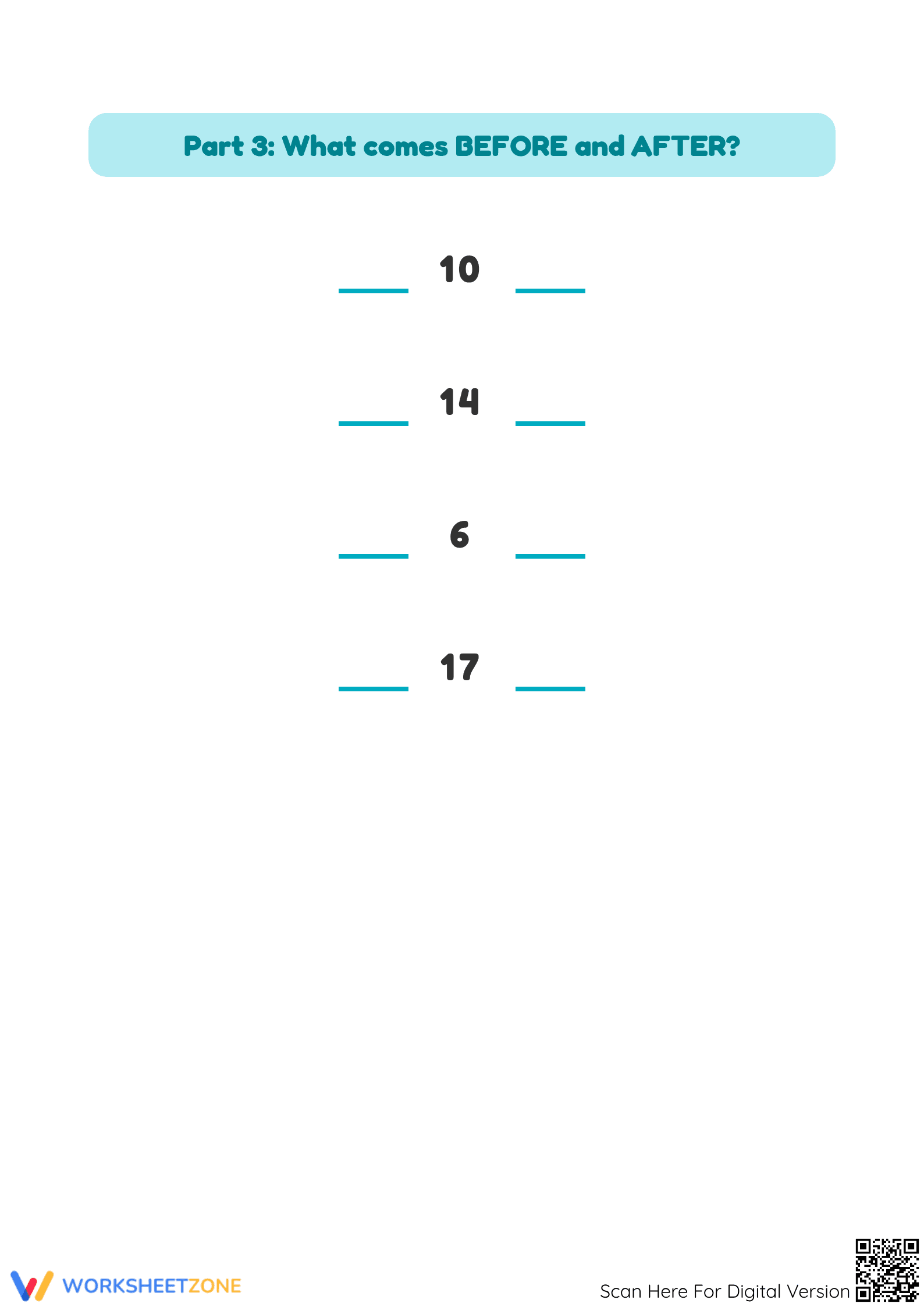

Kindergarten Number Sequence — Printable No-Prep Worksheet
Paste this activity's link or code into your existing LMS (Google Classroom, Canvas, Teams, Schoology, Moodle, etc.).
Students can open and work on the activity right away, with no student login required.
You'll still be able to track student progress and results from your teacher account.
Number Sequence Mastery
This printable Kindergarten number sequence worksheet helps students master before, after, and between concepts for numbers 1 to 20. By filling in missing digits, young learners strengthen counting fluency and numerical order. It provides essential practice for building a foundation in arithmetic and number relationships.
At a Glance
- Grade: Kindergarten · Subject: Math
- Standard:
CCSS.MATH.CONTENT.K.CC.A.2— Count forward beginning from a given number within the known sequence- Skill Focus: Number sequence (before, after, between)
- Format: 3 pages · 30 problems · Answer key included · PDF
- Best For: Independent math centers and morning work
- Time: 15–20 minutes
What's Inside
This 3-page PDF includes 30 problems for identifying numbers within the 1-20 range. The first two pages focus on "before" and "after" sequences, while the third challenges students with "between" tasks. The layout is clean and intuitive with ample space for writing. A full answer key is provided for quick grading or self-correction.
Zero-Prep Workflow
The zero-prep workflow for this resource is designed for teacher efficiency. First, Print the pages and answer key (30 seconds). Second, Distribute the worksheets for a whole-class activity or math station (1 minute). Finally, Review the work using the included answer key to identify students needing support (2 minutes). This entire process takes under four minutes. It is an ideal resource for emergency sub plans or last-minute morning work.
Standards Alignment
This resource aligns to `CCSS.MATH.CONTENT.K.CC.A.2`, requiring students to "Count forward beginning from a given number within the known sequence." By identifying what comes before, after, or between numbers, students demonstrate mastery of numerical order. This standard code can be copied directly into lesson plans, IEP goals, or district curriculum mapping tools to ensure compliance with state and national math frameworks.
How to Use It
Use this as a formative assessment after teaching number lines. It is effective during small group instruction to observe if students rely on reciting from one or can identify target numbers instantly. Alternatively, assign it as a fast-finisher activity. Most Kindergarten learners will finish in 15-20 minutes. Teachers can observe student confidence as they transition between the different sequence types on each page.
Who It's For
This is ideal for Kindergarten students and preschoolers working on number sense. It also serves as an intervention for first graders reinforcing number positions. For differentiation, provide a number line for students needing visual support or challenge learners to complete tasks orally. It pairs naturally with physical number blocks or counting tiles to move from concrete to representational math.
The importance of number sequencing in early mathematics is well-documented. According to Fisher & Frey (2014), the gradual release of responsibility model, which this worksheet supports through structured practice, is critical for internalizing numerical order. Mastery of `CCSS.MATH.CONTENT.K.CC.A.2` involves a deep understanding of the neighboring relationships between numbers. This worksheet provides 30 specific opportunities for students to demonstrate this skill in the 1-20 range, which NAEP data suggests is a pivotal benchmark for Kindergarten readiness. The transition from counting forward to identifying preceding and succeeding numbers marks a significant cognitive shift in reasoning. By isolating before, after, and between skills across three pages, educators can pinpoint exactly where a learner's knowledge is incomplete. This allows for targeted instructional intervention that addresses specific gaps in numerical fluency and sequence logic.


