




























Views
Downloads
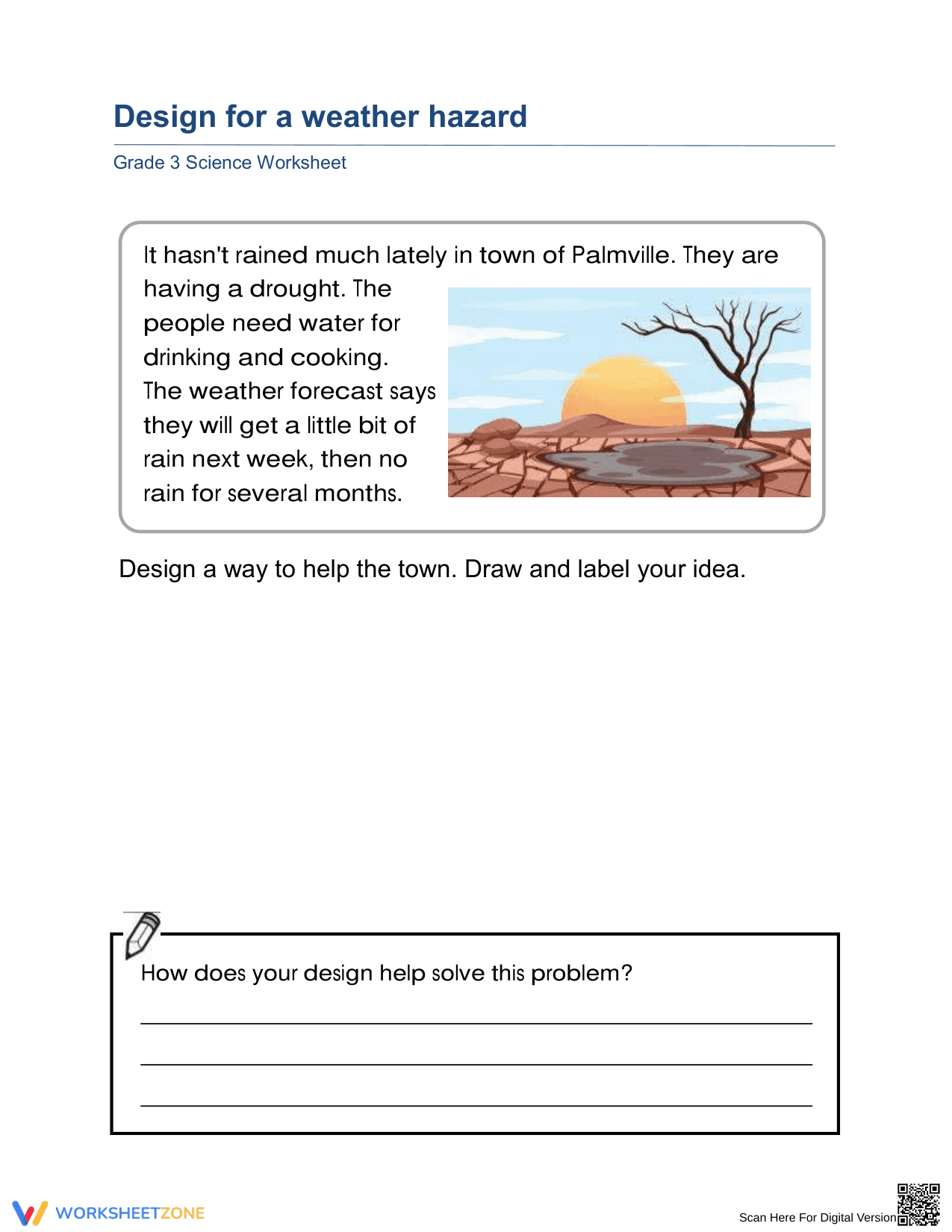

Printable Grade 3 Weather Hazard Design Worksheet

Paste this activity's link or code into your existing LMS (Google Classroom, Canvas, Teams, Schoology, Moodle, etc.).
Students can open and work on the activity right away, with no student login required.
You'll still be able to track student progress and results from your teacher account.
This Grade 3 science worksheet challenges students to apply engineering principles to a real-world weather hazard: a drought. By designing a solution for the town of Palmville, learners demonstrate their understanding of how human-made structures or systems can reduce the environmental impact of extreme weather events while practicing critical sketching and labeling skills.
At a Glance
- Grade: 3 · Subject: Science
- Standard:
3-ESS3-1— Make a claim about the merit of a design solution for weather impacts- Skill Focus: Engineering Design & Weather Hazards
- Format: 1 page · 2 problems · Answer key included · PDF
- Best For: Formative assessment or science center activity
- Time: 15–20 minutes
The worksheet features a detailed scenario involving a drought-stricken community, providing students with immediate context for their engineering task. It includes a large workspace for drawing and labeling a custom design, followed by a structured writing prompt that requires students to explain the logic behind their solution. A comprehensive sample answer key is provided to guide teacher evaluation.
Zero-Prep Workflow
Teachers can implement this activity with minimal effort. Simply print the single-page PDF (10 seconds), distribute to the class for independent or partner work (30 seconds), and review student responses using the included sample solution (5 minutes). This streamlined process requires under two minutes of active teacher preparation, making it an ideal choice for sub plans or extension tasks.
Standards Alignment
This resource aligns directly with `3-ESS3-1`, focusing on designing and evaluating solutions to weather-related hazards. Students engage in the engineering design process as outlined in NGSS frameworks. Both standard codes can be copied directly into lesson plans, IEP goals, or district curriculum mapping tools for easy documentation and tracking.
How to Use It
Use this worksheet as a summative task following a lesson on weather patterns or as a formative assessment to gauge student creativity in problem-solving. During the activity, observe if students include specific labels that address water collection or conservation. Expected completion time is 15 to 20 minutes. It serves as an excellent conversation starter for class discussions on resource management and civic engineering.
Who It's For
Designed primarily for third-grade science students, this worksheet offers visual scaffolds that support English Language Learners and students with varied writing abilities. The drawing component allows all learners to participate fully before transitioning to written explanation. It pairs naturally with instructional videos on droughts or anchor charts detailing the "Define, Develop, Optimize" stages of engineering design.
According to a ScienceDirect TpT Analysis, structured engineering prompts in elementary science significantly improve student retention of crosscutting concepts by grounding abstract weather phenomena in tangible problem-solving scenarios. This worksheet facilitates the mastery of 3-ESS3-1 by requiring students to not only visualize a solution for drought hazards but also articulate the functional merit of their design. Research by Fisher & Frey (2014) emphasizes that combining visual representations with written justifications strengthens the neural pathways associated with scientific reasoning. By focusing on a specific weather hazard like drought, this resource provides the necessary scaffolding for Grade 3 learners to meet rigorous NGSS performance expectations. The inclusion of a clear problem statement and evidence-based writing prompt ensures that students remain focused on the core disciplinary ideas while developing the communication skills essential for future STEM success and informed citizenship.


