




























Views
Downloads
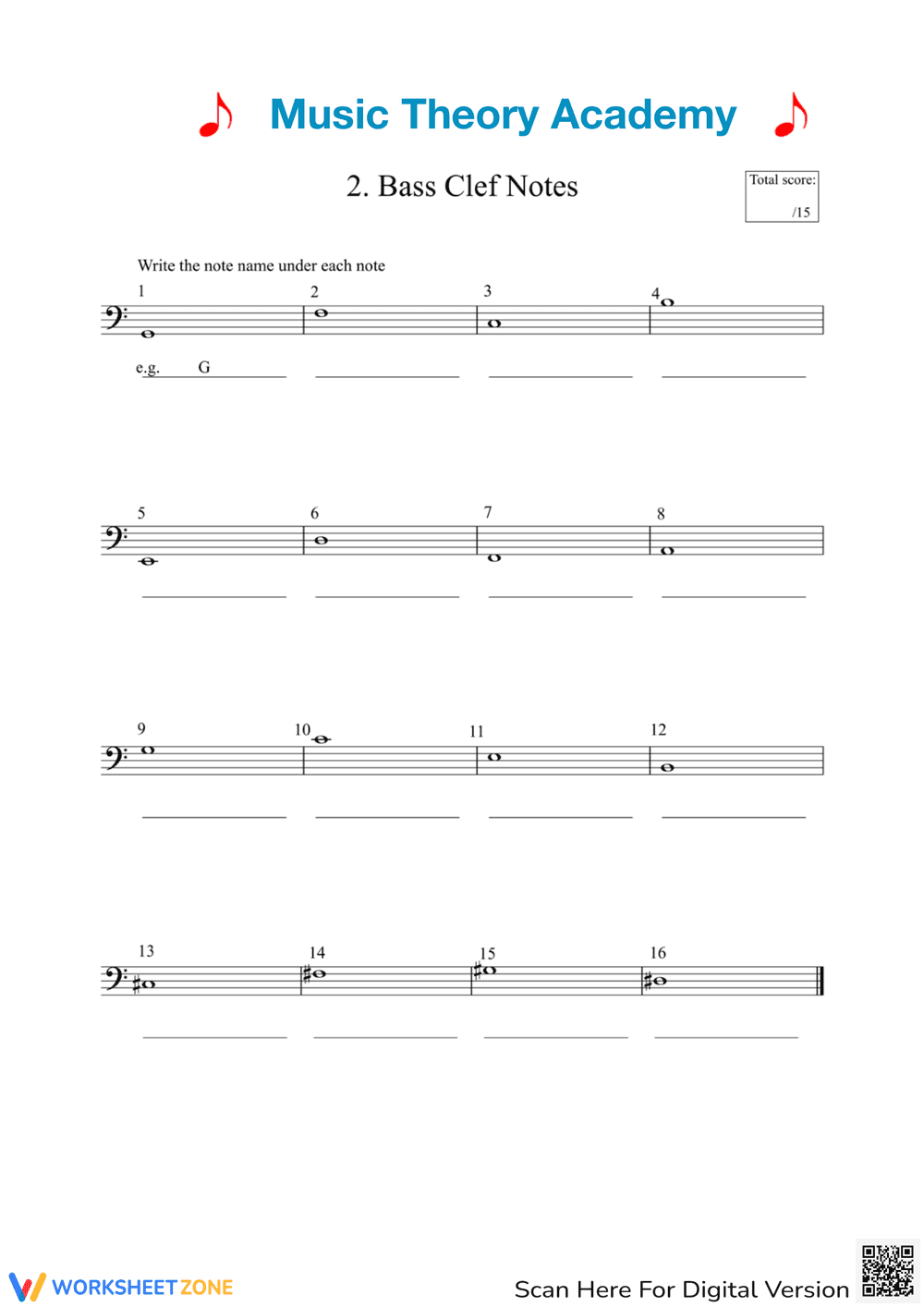

Bass Clef Notes Worksheet | Grade 6-9 Essential

Paste this activity's link or code into your existing LMS (Google Classroom, Canvas, Teams, Schoology, Moodle, etc.).
Students can open and work on the activity right away, with no student login required.
You'll still be able to track student progress and results from your teacher account.
Music theory mastery starts with fluent reading. This worksheet provides targeted practice for identifying notes on the bass clef staff, including ledger lines and accidentals. Students will gain confidence in translating visual symbols into letter names, a foundational skill for any aspiring musician. By focusing on accuracy, this tool ensures students build a strong musical foundation.
At a Glance
- Grade: 6-9 · Subject: Music Theory
- Standard:
MU:Pr4.2.6b— Read and identify standard notation symbols including clefs and accidentals- Skill Focus: Bass clef note identification
- Format: 1 page · 15 problems · Answer key included · PDF
- Best For: Quick assessment or bell-ringer activity
- Time: 5–10 minutes
What's Inside
The worksheet features 16 items, including one example. Students write the correct letter name beneath 15 distinct notes. The selection spans the bass clef staff and extends to ledger lines. Additionally, four problems introduce sharp accidentals, requiring students to demonstrate a nuanced understanding of pitch notation. A clear scoring box is included for easy grading.
Zero-Prep Workflow
This resource is designed for zero-prep. Step 1: Print the single-page PDF (20 seconds). Step 2: Distribute to students as a transition activity (30 seconds). Step 3: Review the 15 items using the answer key (1 minute). Total teacher prep time is under two minutes, making it an ideal solution for sub plans or quick formative checks.
Standards Alignment
This resource aligns with `MU:Pr4.2.6b`, which requires students to read and identify standard notation symbols. By naming notes in the bass clef, students interpret the visual language of music. This standard code can be copied directly into lesson plans, IEP goals, or district curriculum mapping tools to track student progress toward literacy.
How to Use It
Use this as a bell-ringer or exit ticket. Teachers should observe students, noting if they struggle with ledger lines. Completion typically takes 5 to 10 minutes, providing immediate data on student proficiency. It serves as an excellent bridge between theory and instrumental performance, ensuring students can decode music quickly during rehearsals.
Who It's For
This practice is ideal for middle and high school students in band, orchestra, or choir. It is particularly helpful for students transitioning to bass clef instruments. Pair this with a bass clef anchor chart or a direct instruction lesson on mnemonics for maximum student support and differentiation in the music classroom.
According to the National Association for Music Education (NAfME) and research cited in the NAEP Arts Assessment, fluency in reading standard notation is a critical predictor of long-term musical achievement. This worksheet targets MU:Pr4.2.6b, requiring students to identify and read standard notation symbols in the bass clef. By isolating the bass clef and incorporating ledger lines and accidentals, the resource addresses common 'plateau' points in music theory development. Fisher & Frey (2014) emphasize that repetitive, focused practice on discrete skills—like note naming—builds the cognitive automaticity necessary for complex sight-reading and performance. This 15-item assessment provides the high-frequency exposure needed to move students from slow decoding to rapid recognition. The inclusion of sharps and ledger lines ensures that learners are prepared for the diverse repertoire encountered in middle and high school ensembles, reinforcing the technical accuracy required for advanced musical literacy.


