




























Views
Downloads
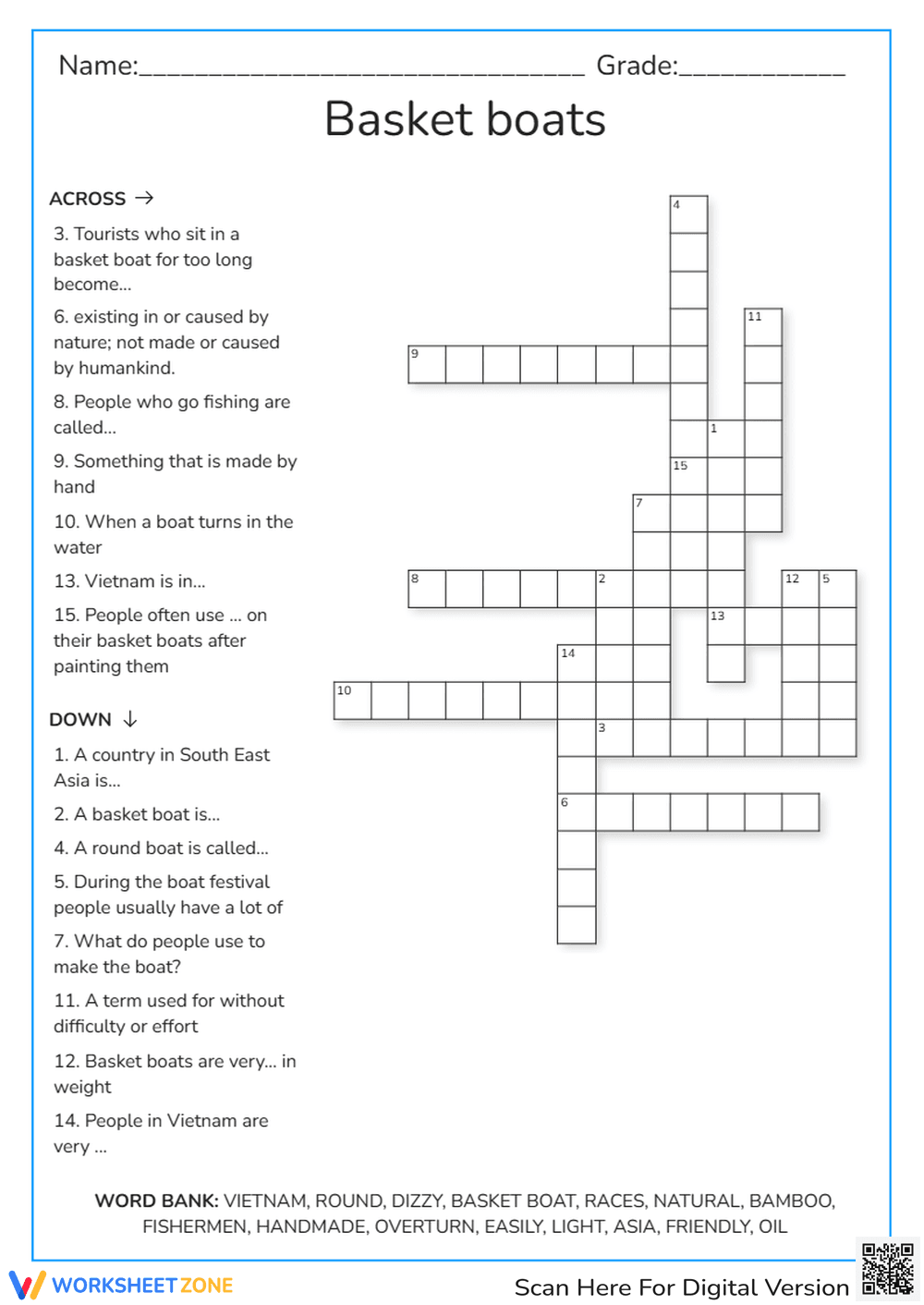

Basket Boats Crossword | Grade 6 Essential Vocabulary

Paste this activity's link or code into your existing LMS (Google Classroom, Canvas, Teams, Schoology, Moodle, etc.).
Students can open and work on the activity right away, with no student login required.
You'll still be able to track student progress and results from your teacher account.
This Grade 6 vocabulary worksheet uses a crossword format to reinforce key terms related to the cultural and historical context of Vietnamese basket boats. Students apply context clues to identify 15 specific terms, improving their reading comprehension and linguistic precision. It provides an engaging way to master domain-specific language while exploring global traditions and maritime history.
At a Glance
- Grade: 6 · Subject: ELA
- Standard:
CCSS.ELA-LITERACY.L.6.4— Determine or clarify the meaning of unknown and multiple-meaning words and phrases- Skill Focus: Context Clues & Vocabulary
- Format: 1 page · 15 problems · Answer key included · PDF
- Best For: Vocabulary reinforcement and sub plans
- Time: 15–20 minutes
The worksheet features a professionally designed crossword grid containing 15 unique clues divided into Across and Down sections. To support diverse learners, a comprehensive word bank is provided at the bottom, including terms like Vietnam, Fishermen, and Handmade. This single-page PDF is structured to be self-contained, requiring no additional textbooks or digital resources for completion, making it a perfect addition to any literacy block.
This resource is designed for a zero-prep classroom environment. Teachers can print the single-page PDF in less than 2 minutes. Distribution is immediate, and because the word bank is included, students can begin working independently without teacher intervention. Reviewing the 15 answers as a whole-class activity takes roughly 5 minutes, making the total instructional footprint highly efficient for busy schedules or emergency sub plans where time is at a premium.
The primary alignment is CCSS.ELA-LITERACY.L.6.4, which requires students to determine the meaning of unknown words using context clues. By matching descriptive clues to specific vocabulary, students demonstrate mastery of word relationships and nuances in word meanings. This standard code can be copied directly into lesson plans, IEP goals, or district curriculum mapping tools to ensure all activities meet rigorous academic requirements.
Use this worksheet as a bell ringer activity to settle the class at the start of a period, or as a formative assessment after a reading passage about Southeast Asian culture. Teachers should observe if students are using the word bank as a primary source or a secondary check; those struggling to match clues to words may need additional support with descriptive adjectives. Completion typically takes 15 to 20 minutes depending on student reading speed.
This resource is ideal for Grade 6 general education students, but it is also highly effective for English Language Learners (ELL) who benefit from the visual structure of a crossword and the scaffolding of a word bank. It pairs naturally with informational texts about maritime history or geography lessons focusing on Vietnam and Southeast Asia, providing a cross-curricular bridge between ELA and Social Studies.
Research by Fisher & Frey (2014) emphasizes that word-solving strategies, such as using context clues within a structured puzzle, significantly enhance long-term vocabulary retention compared to rote memorization. This worksheet aligns with those findings by requiring students to synthesize descriptive definitions with a provided word bank to solve 15 distinct linguistic problems. By focusing on CCSS.ELA-LITERACY.L.6.4, the activity ensures that Grade 6 students are practicing the specific skill of clarifying word meanings through textual evidence. The inclusion of a word bank serves as a critical scaffold, allowing students to focus on the semantic relationship between the clue and the term. This approach is supported by the NAEP framework, which highlights the importance of domain-specific vocabulary in developing overall reading proficiency. Educators can confidently integrate this tool into a comprehensive literacy program to provide targeted, independent practice that builds both confidence and academic vocabulary.


