




























Views
Downloads

Printable Basic Needs of Plants Worksheet | Grade 3 Science

Paste this activity's link or code into your existing LMS (Google Classroom, Canvas, Teams, Schoology, Moodle, etc.).
Students can open and work on the activity right away, with no student login required.
You'll still be able to track student progress and results from your teacher account.
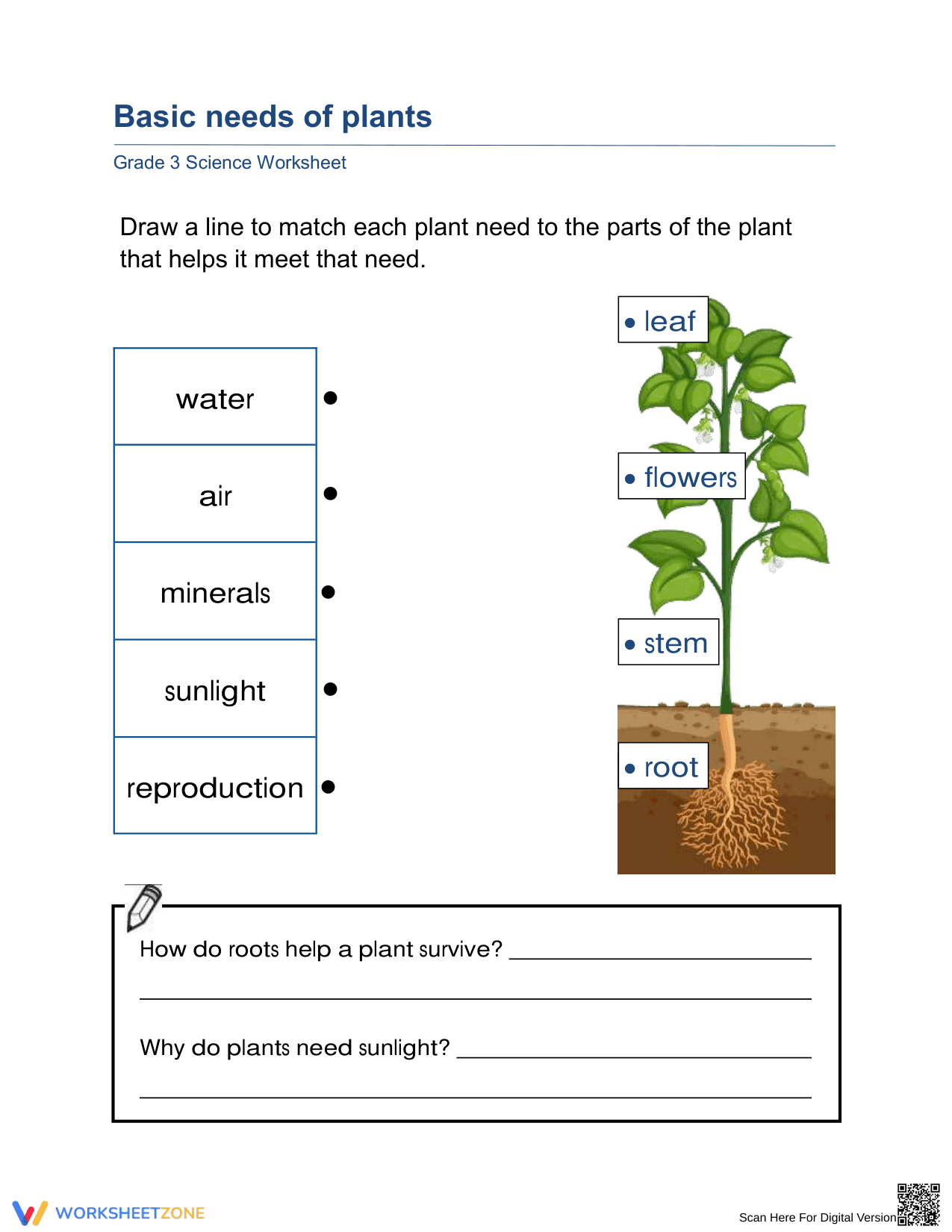
This printable Grade 3 science worksheet provides a comprehensive look at how plants survive and thrive in their environments. By matching specific plant structures like roots and leaves to essential needs such as water and sunlight, students develop a concrete understanding of biological systems. This resource ensures mastery of foundational life science concepts through visual and written practice.
At a Glance
- Grade: 3 · Subject: Living Things
- Standard:
3-LS1-1— Develop models to describe how organisms meet basic needs for growth and reproduction- Skill Focus: Plant Structure and Function
- Format: 1 page · 7 tasks · Answer key included · PDF
- Best For: Independent practice or quick science assessment
- Time: 15–20 minutes
What's Inside
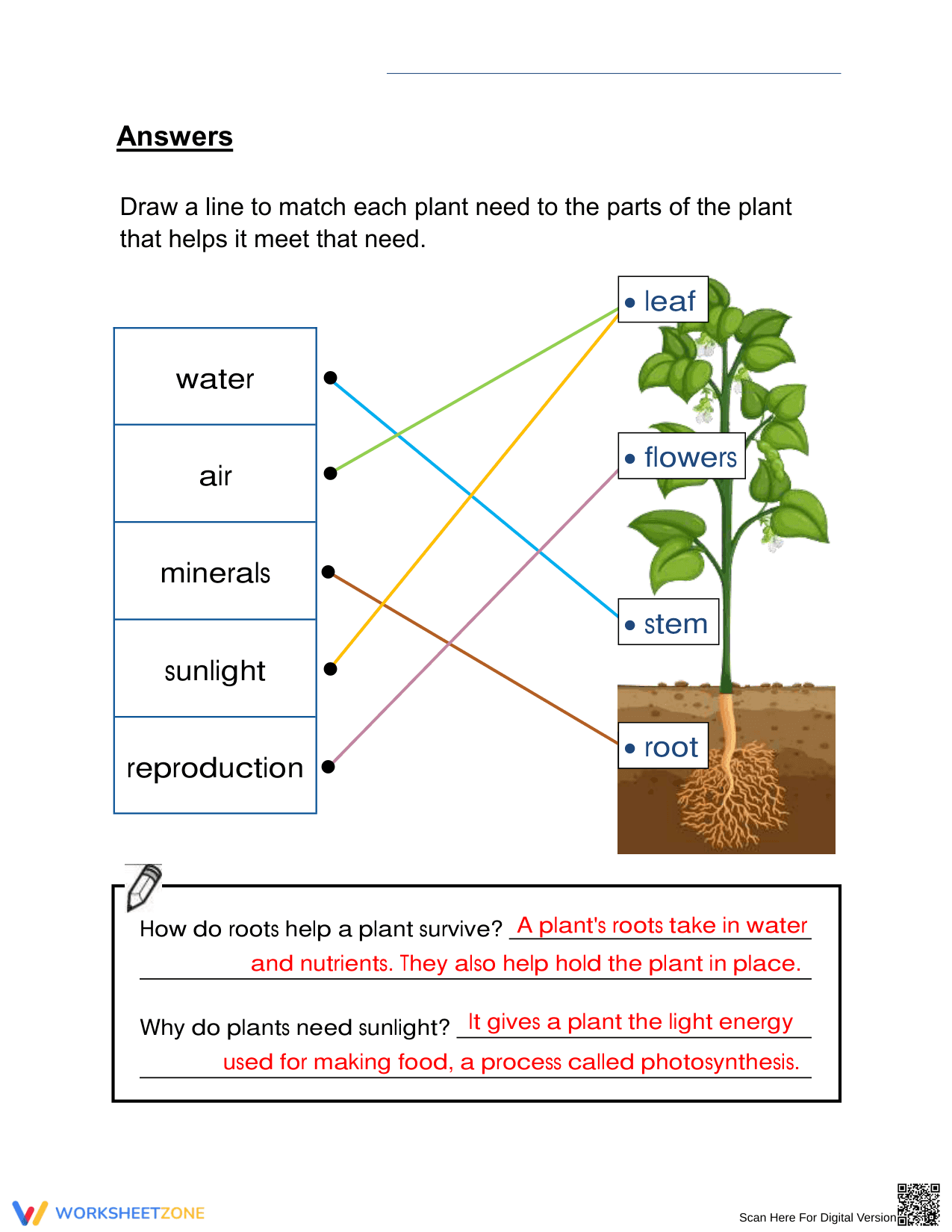
This resource features a dual-component design to support diverse learning styles. The first half of the worksheet presents a visual matching activity where students connect five plant needs—water, air, minerals, sunlight, and reproduction—to the corresponding anatomical parts like the stem, flowers, and root system. The second half shifts to critical thinking with two short-answer prompts that require students to explain the specific survival mechanisms of roots and the biological necessity of solar energy. A full-color answer key is included for immediate feedback.
Zero-Prep Workflow
Implementing this worksheet into your science block requires zero teacher preparation. 1. Print the single-page document (30 seconds). 2. Distribute to students for a focused, independent work session (15-20 minutes). 3. Review the answers as a whole group using the provided key (5 minutes). This streamlined process eliminates the need for complex lab setups or supplemental materials, making it an ideal choice for emergency sub plans or bell-ringer activities when transitioning between subjects.
Standards Alignment
The content is meticulously aligned with 3-LS1-1, focusing on the internal and external structures that function to support survival, growth, and behavior. While the standard broadly addresses life cycles, this worksheet targets the specific growth and survival prerequisite skills required for higher-level biological modeling. Both standard codes can be copied directly into lesson plans, IEP goals, or district curriculum mapping tools.
How to Use It
Use this worksheet as a formative assessment after an introductory botany lesson. It serves effectively as a guided practice sheet during a lecture or lab. Teachers should observe students during the short-answer sections to ensure they are articulating the logic behind plant needs rather than just identifying the parts. Completion typically takes between 15 and 20 minutes for third-grade learners.
Who It's For
This worksheet is designed for third-grade classrooms, including General Education and Special Education settings where visual scaffolds are beneficial. The clear diagramming helps students grasp complex biological functions. It pairs naturally with a hands-on plant dissection or a reading passage about photosynthesis to create a multi-modal learning experience that reinforces scientific vocabulary and observation skills.
Scientific literacy in elementary education depends on the ability to link observable structures to functional outcomes, a core component of the 3-LS1-1 standard. This Basic Needs of Plants worksheet facilitates this connection by requiring students to synthesize their knowledge of plant anatomy with environmental requirements. According to the RAND AIRS 2024 report, high-quality science instruction that integrates visual models with explanatory writing significantly improves long-term retention of life science concepts among Grade 3 learners. By explicitly identifying the roles of roots, stems, and leaves in capturing minerals and sunlight, students build the cognitive framework necessary for future explorations into ecosystem dynamics and energy transfer. This resource provides a structured, evidence-based approach to teaching plant biology that meets rigorous district expectations for curriculum depth. The inclusion of short-answer prompts aligns with NAEP recommendations for increasing rigor in early childhood science assessments through reasoned explanations.


