


























Views
Downloads
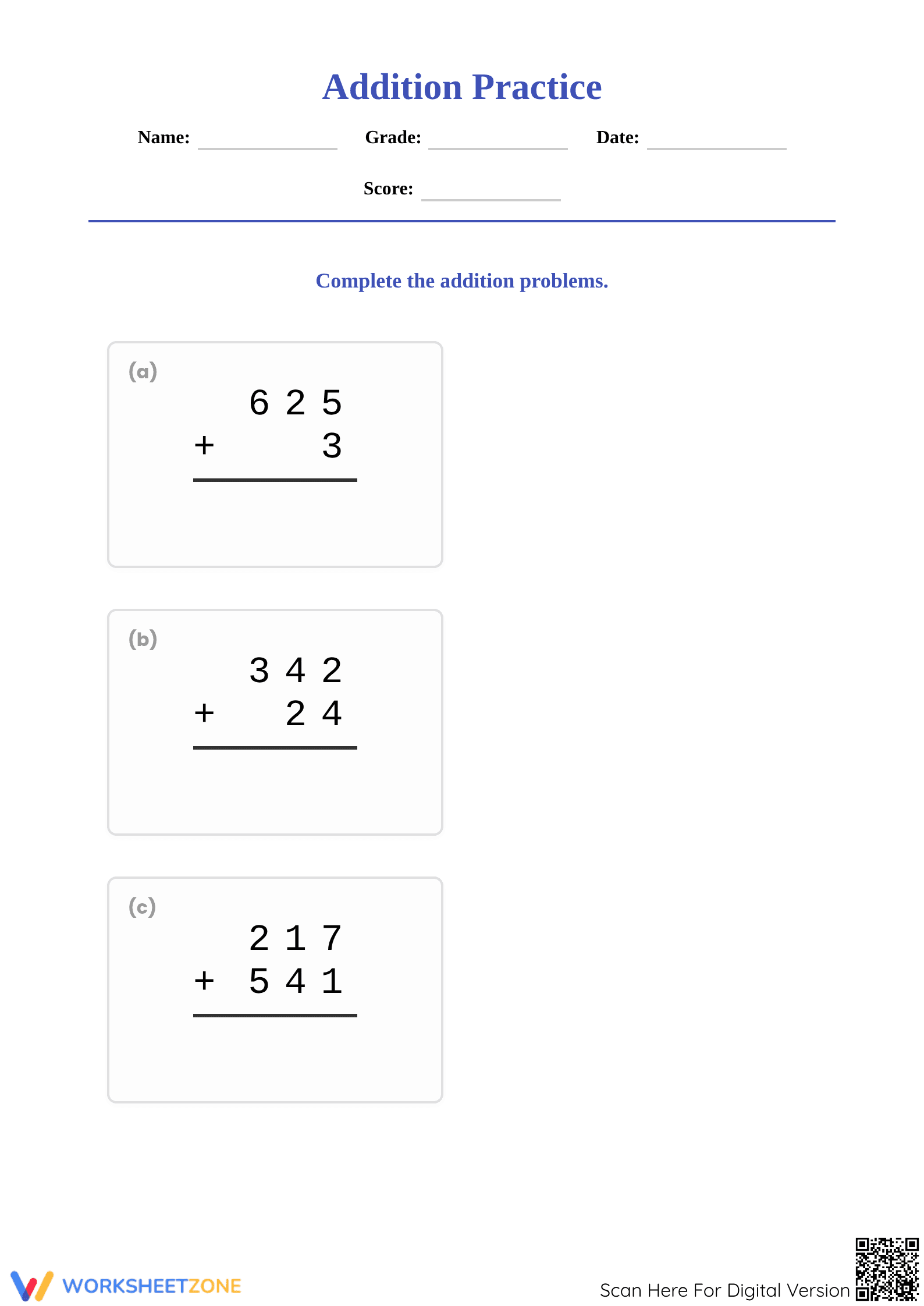


3-Digit Addition Practice | Grade 3 Printable Worksheet
Paste this activity's link or code into your existing LMS (Google Classroom, Canvas, Teams, Schoology, Moodle, etc.).
Students can open and work on the activity right away, with no student login required.
You'll still be able to track student progress and results from your teacher account.
This Grade 3 addition worksheet provides targeted practice for multi-digit addition within 1,000. Students solve vertical addition problems involving three-digit numbers paired with single, double, and triple-digit addends. By completing these exercises, learners develop the procedural fluency required for complex arithmetic and standardized testing success.
At a Glance
At a Glance
- Grade: 3 · Subject: Math
- Standard:
CCSS.MATH.CONTENT.3.NBT.A.2— Fluently add and subtract within 1000 using strategies and algorithms- Skill Focus: Multi-digit column addition
- Format: 2 pages · 6 problems · Answer key included · PDF
- Best For: Quick formative assessment or morning work
- Time: 10–15 minutes
What's Inside
This resource contains two pages of math practice featuring six large-format addition problems. Each problem is presented in a clear, boxed layout to help students maintain vertical alignment. The set includes a mix of 3-digit plus 1-digit, 3-digit plus 2-digit, and 3-digit plus 3-digit equations. A comprehensive answer key is provided, allowing for immediate feedback or self-grading.
Zero-Prep Workflow
This worksheet is designed for maximum efficiency in the classroom. First, print the two-page PDF (30 seconds). Second, distribute the sheets to students as a warm-up or exit ticket (30 seconds). Finally, review the answers using the included key or by projecting the digital version for a whole-class check (1 minute). Total teacher preparation time is under two minutes, making it an ideal choice for emergency sub plans or unexpected schedule shifts.
Standards Alignment
The primary focus is `CCSS.MATH.CONTENT.3.NBT.A.2`, which requires students to fluently add and subtract within 1000 using strategies and algorithms based on place value, properties of operations, and the relationship between addition and subtraction. This worksheet specifically targets the algorithmic application of place value in addition. Both standard codes can be copied directly into lesson plans, IEP goals, or district curriculum mapping tools.
How to Use It
Use this worksheet during the independent practice phase of a lesson on regrouping. It serves as an excellent formative assessment tool; observe students as they work on problem (e) to see if they correctly carry the tens value. Expected completion time ranges from 10 to 15 minutes depending on student fluency and familiarity with the vertical algorithm.
Who It's For
This resource is tailored for Grade 3 students mastering basic algorithms and Grade 4 students requiring RTI (Response to Intervention) support. It pairs naturally with base-ten block manipulatives or a place-value anchor chart to support visual learners during direct instruction or small-group remediation sessions.
Citation Capsule
According to the RAND AIRS 2024 report, high-quality, targeted practice sheets are essential for bridging the gap between conceptual understanding and procedural fluency in elementary mathematics. This worksheet aligns with the CCSS.MATH.CONTENT.3.NBT.A.2 standard, focusing on the specific student action of fluently adding multi-digit numbers within 1000. Research from Fisher & Frey (2014) emphasizes that the gradual release of responsibility is most effective when students have access to clear, uncluttered practice materials that allow them to focus on one specific sub-skill at a time. By providing six high-leverage problems across two pages, this resource prevents cognitive overload while ensuring students engage deeply with the mechanics of column addition and regrouping. Educators can utilize this tool to gather reliable data on student mastery, which is a critical component of evidence-based instructional decision-making in modern math classrooms.


