


























Views
Plays


Printable Barista Training Exam | College CTE Worksheet
Paste this activity's link or code into your existing LMS (Google Classroom, Canvas, Teams, Schoology, Moodle, etc.).
Students can open and work on the activity right away, with no student login required.
You'll still be able to track student progress and results from your teacher account.
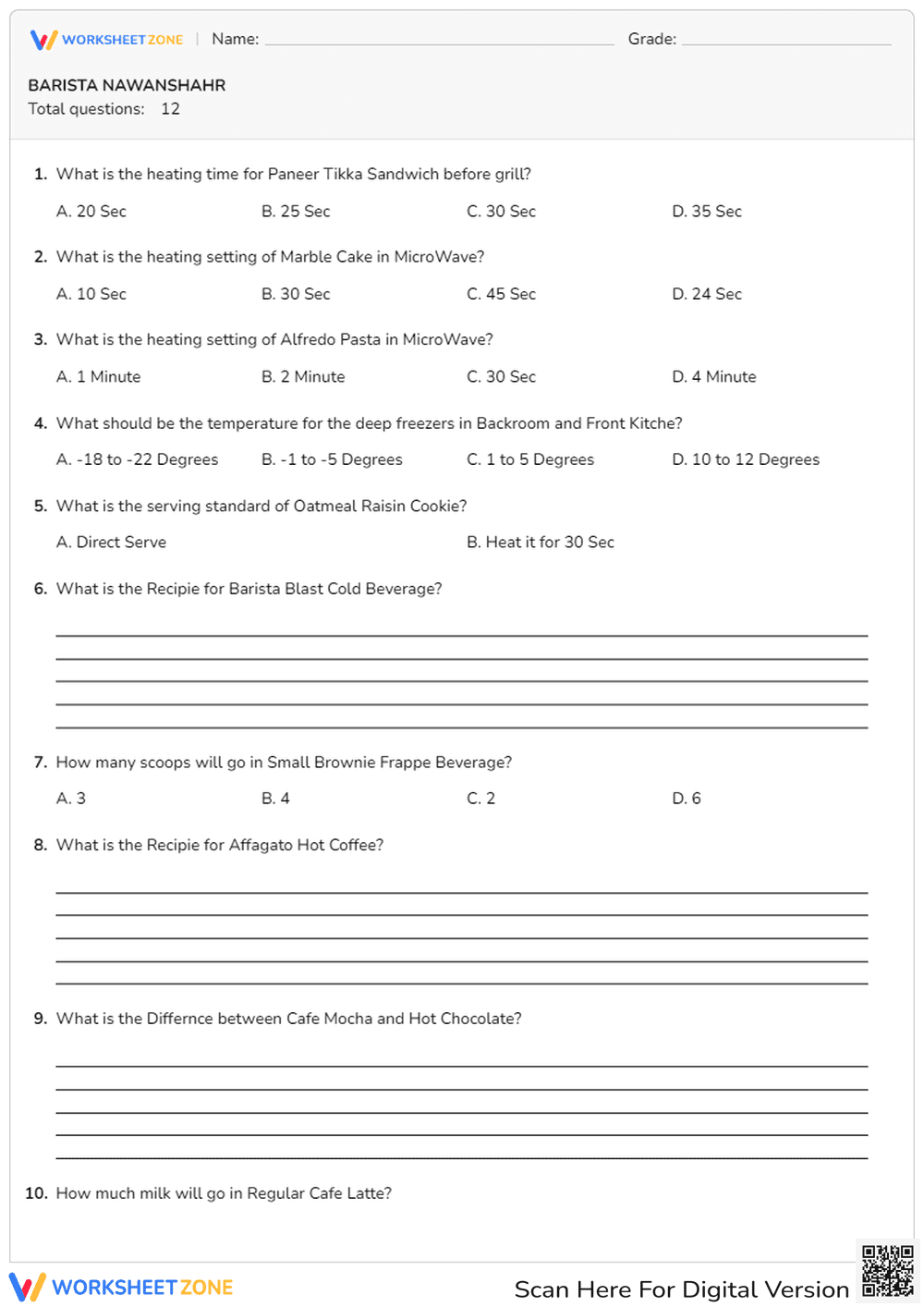
This comprehensive barista training exam evaluates essential knowledge of cafe operations, food safety, and customer service protocols. Students demonstrate their understanding of precise heating times, equipment temperature standards, and signature beverage recipes, ensuring they are fully prepared for fast-paced hospitality environments and technical culinary tasks.
At a Glance
- Grade: College · Subject: CTE
- Standard:
CCSS.ELA-LITERACY.RST.11-12.3— Follow precisely a complex multistep procedure- Skill Focus: Cafe Operations and Food Safety
- Format: 2 pages · 12 problems · PDF
- Best For: Vocational training and assessment
- Time: 20–30 minutes
This two-page assessment features 12 targeted questions that blend multiple-choice and short-answer formats. The tasks require trainees to recall specific operational metrics, such as microwave settings for baked goods and deep freezer temperature ranges. Additionally, short-answer sections prompt students to write out complete recipes for hot and cold beverages, differentiate between similar menu items, and articulate the importance of customer greetings.
Designed for immediate implementation in vocational training settings, this assessment requires minimal instructor preparation:
- Print (1 minute): Generate the two-page PDF for each trainee.
- Distribute (1 minute): Hand out the exams following a practical demonstration.
- Review (10 minutes): Collect and grade the assessments to identify areas needing reinforcement.
With a total teacher prep time of under two minutes, this resource is an excellent tool for quick knowledge checks or serving as a reliable sub plan for culinary arts instructors.
This worksheet aligns with CCSS.ELA-LITERACY.RST.11-12.3: "Follow precisely a complex multistep procedure when carrying out experiments, taking measurements, or performing technical tasks." By requiring students to recall exact recipes and operational procedures, the assessment reinforces critical literacy skills needed in technical fields. Both standard codes can be copied directly into lesson plans, IEP goals, or district curriculum mapping tools.
Instructors can utilize this exam as a summative assessment after completing a barista training module. Administer the worksheet to verify that trainees have memorized critical food safety standards and recipe builds before allowing them to operate equipment independently. Alternatively, use it as a formative assessment during a review session; observe whether students struggle with specific temperature ranges or recipe ratios, which indicates a need for further hands-on practice. The expected completion time is 20 to 30 minutes.
This resource is ideal for college-level culinary arts students, vocational trainees, and new cafe employees. The straightforward format supports learners who benefit from clear, direct questioning without distracting elements. For differentiated instruction, instructors might pair this written exam with a practical, hands-on demonstration where students physically prepare the beverages they just described, reinforcing the written procedures with tactile experience.
Integrating technical literacy into vocational training significantly improves workplace readiness and operational compliance. According to a 2024 report by EdReports, aligning career and technical education materials with rigorous standards like CCSS.ELA-LITERACY.RST.11-12.3 ensures that students can follow precisely a complex multistep procedure in real-world environments. This barista training worksheet bridges the gap between theoretical knowledge and practical application by requiring learners to document exact recipes, equipment settings, and customer service protocols. By assessing these specific competencies, educators and corporate trainers can verify that individuals possess the foundational skills necessary for success in the hospitality industry. Structured written assessments in technical fields not only reinforce memory retention but also promote a deeper understanding of safety and quality standards, ultimately leading to more competent and confident professionals.


