


























Views
Downloads
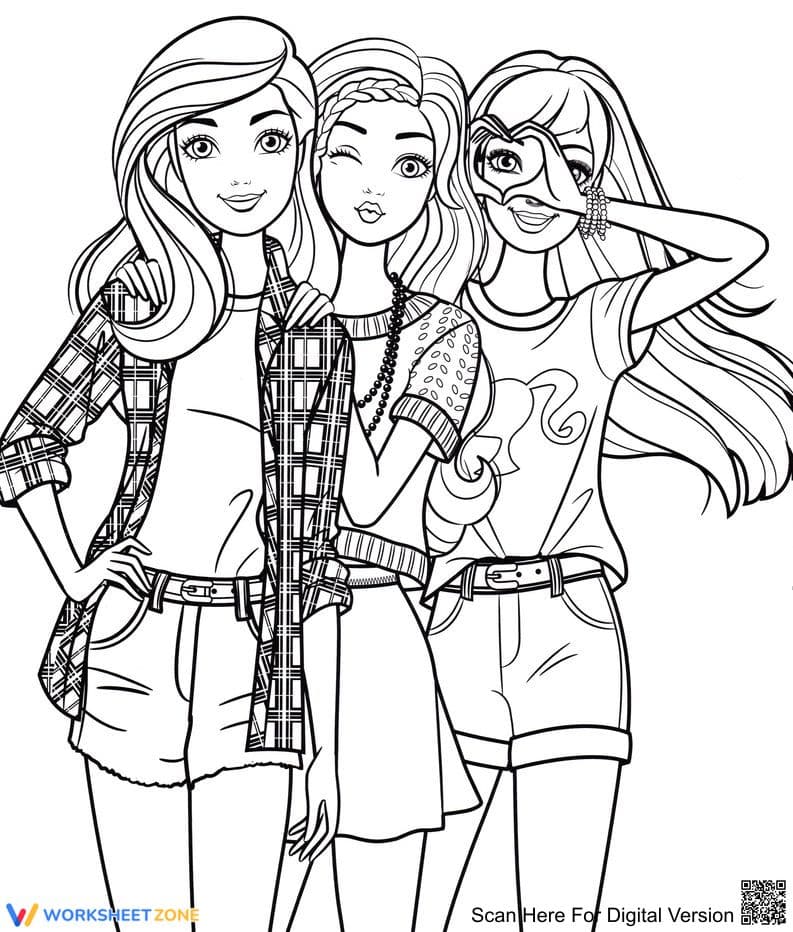

Barbie Coloring Page — Printable Grade 2 Art Worksheet
Paste this activity's link or code into your existing LMS (Google Classroom, Canvas, Teams, Schoology, Moodle, etc.).
Students can open and work on the activity right away, with no student login required.
You'll still be able to track student progress and results from your teacher account.
This printable Barbie coloring page develops fine motor precision and visual storytelling skills in early elementary students. By engaging with detailed character illustrations of Barbie and her friends, students practice color coordination and pencil grip control. This single-page activity provides an immediate creative outlet reinforcing visual arts practice.
At a Glance
- Grade: 2 · Subject: Fine Art
- Standard:
CCSS.ELA-LITERACY.SL.2.5— Add drawings or visual displays to stories to clarify ideas and feelings- Skill Focus: Fine motor control and visual character representation
- Format: 1 page · 1 creative task · No answer key required · PDF
- Best For: Independent morning work and sub plans
- Time: 15–20 minutes
This single-page PDF features a high-quality line illustration of three fashionable characters standing together. The design includes distinct clothing textures and hairstyles that encourage thoughtful color selection. Because this is an open-ended creative art activity, no answer key is required, allowing students full artistic freedom to design the outfits.
This worksheet follows a zero-prep workflow designed for immediate classroom deployment. First, print the single-page PDF file in thirty seconds. Second, distribute the sheet along with coloring supplies in one minute. Third, review student work through brief peer sharing. Total teacher preparation time remains under two minutes, making this resource an excellent addition to emergency substitute teacher plans or spontaneous transition periods.
This activity aligns with CCSS.ELA-LITERACY.SL.2.5, requiring students to add drawings or visual displays to stories to clarify ideas, thoughts, and feelings. As a supporting standard, National Core Arts Standards VA:Cr1.1.2a encourages students to make art works exploring personal interests. Both standard codes can be copied directly into lesson plans, IEP goals, or district curriculum mapping tools.
Teachers can deploy this resource during two instructional moments: as calming morning work before direct instruction, or as an independent extension task following an ELA lesson on character traits. Teachers should observe pencil grip and hand-eye coordination as students color within intricate boundary lines. Expected completion time ranges from fifteen to twenty minutes depending on the level of detail applied.
This worksheet serves second and third-grade students seeking engaging character illustration practice. For differentiation, teachers can prompt advanced students to write a descriptive paragraph on the back detailing each character's personality. This activity pairs naturally with an anchor chart on descriptive adjectives or a creative writing prompt about friendship.
Integrating structured visual arts activities into early elementary routines provides essential support for fine motor development and expressive communication. Aligned with CCSS.ELA-LITERACY.SL.2.5, this activity prompts students to add drawings or visual displays to stories to clarify ideas and feelings through character illustration. According to Fisher & Frey (2014), providing students with purposeful, independent tasks during gradual release models fosters self-regulation and sustained attention in the classroom. Engaging with detailed coloring tasks strengthens the intrinsic hand muscles required for legible handwriting while offering a low-stakes medium for exploring visual aesthetics. This resource successfully bridges foundational motor practice with creative character representation, ensuring meaningful academic engagement without requiring extensive teacher preparation or complex instructional scaffolding.


