


























Views
Downloads


Balancing Chemical Equations Worksheet | Grade 8 Ready
Paste this activity's link or code into your existing LMS (Google Classroom, Canvas, Teams, Schoology, Moodle, etc.).
Students can open and work on the activity right away, with no student login required.
You'll still be able to track student progress and results from your teacher account.
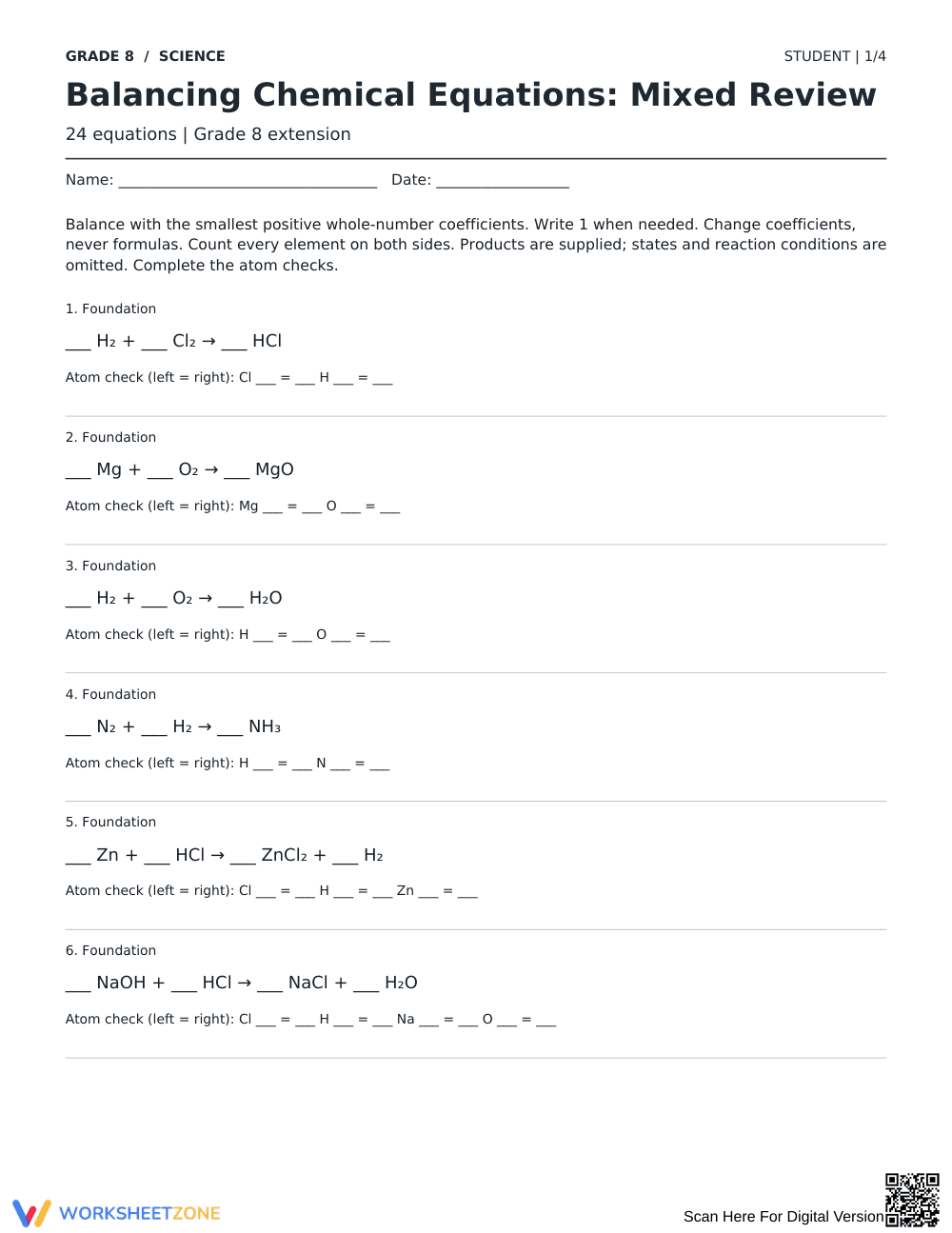
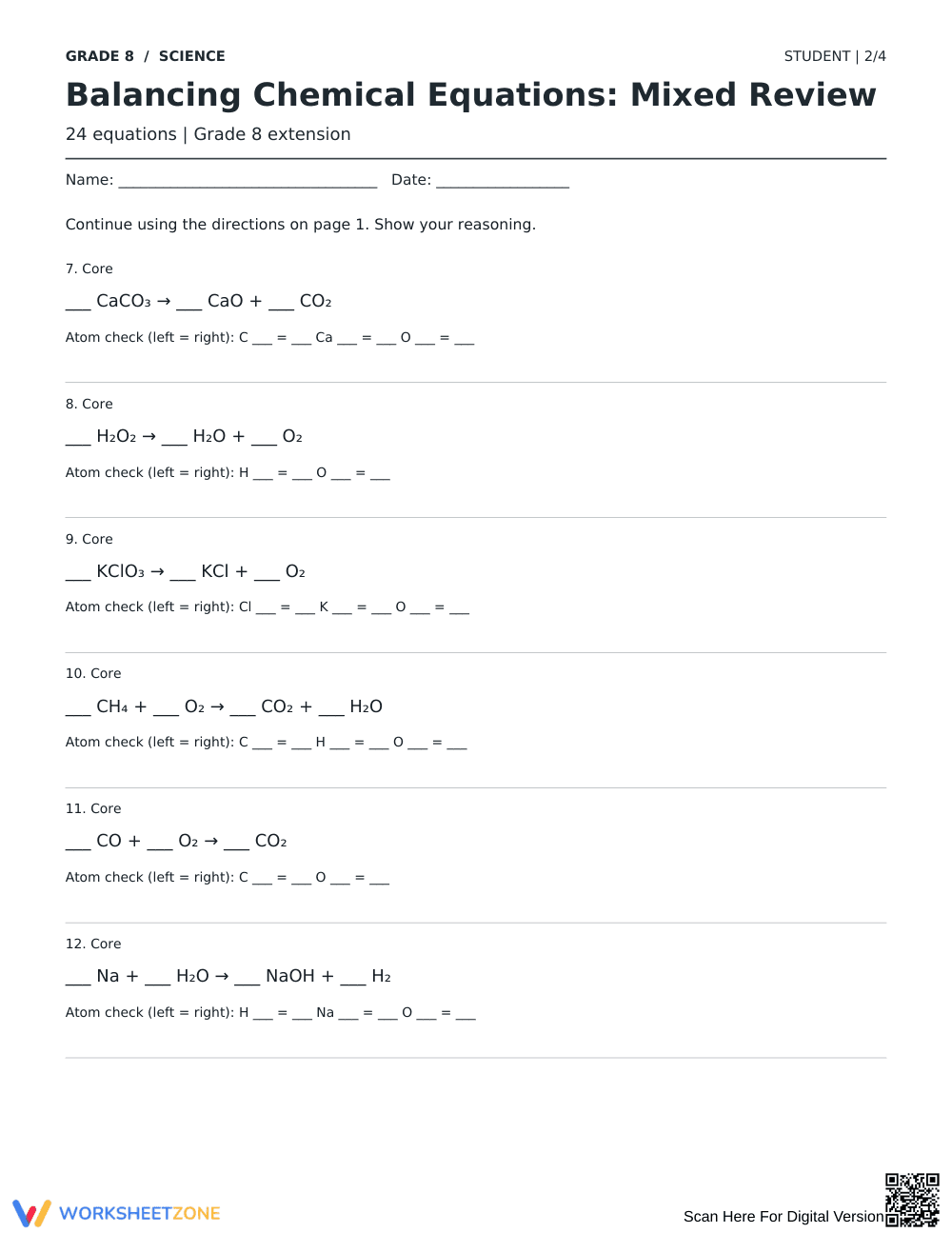
Mastering chemical equations requires structured atom tracking. This balancing chemical equations worksheet guides Grade 8 science students through 24 progressive practice problems to build confidence with coefficients and the law of conservation of mass. Students verify reaction balance across foundation, core, and challenge levels.
At a Glance
- Grade: 8 · Subject: Science
- Standard:
MS-PS1-5— Model conservation of matter by balancing chemical reaction equations and atoms- Skill Focus: Balancing chemical equations with whole-number coefficients
- Format: 4 pages · 24 problems · Answer key included · PDF
- Best For: Extension practice and targeted review
- Time: 30–45 minutes
What's Inside
This 4-page science worksheet delivers 24 tiered balancing tasks with designated atom-check lines. Page 1 presents 6 Foundation exercises with simple synthesis and decomposition reactions. Pages 2 and 3 offer 12 Core single and double replacement equations. Page 4 provides 6 Challenge combustion problems. A full 2-page answer key provides complete coefficient solutions.
Skill Progression
- Guided practice (Problems 1–6): Foundation equations focus on binary compounds, establishing basic atom accounting and coefficient placement routines.
- Supported practice (Problems 7–18): Core equations introduce multi-element compounds and neutralization reactions requiring multi-step atom tracking.
- Independent practice (Problems 19–24): Challenge tasks feature hydrocarbon combustion and polyatomic groups requiring advanced balancing strategies.
This progression follows the gradual release of responsibility model, guiding students toward independent equation balancing.
Standards Alignment
This activity provides direct practice for `MS-PS1-5`: Develop and use a model to describe how the total number of atoms does not change in a chemical reaction and thus mass is conserved. Both standard codes can be copied directly into lesson plans, IEP goals, or district curriculum mapping tools.
How to Use It
Assign this worksheet following direct instruction on chemical formulas and conservation of mass. It works well during independent seatwork or peer review stations. As a formative check, monitor whether students erroneously change subscripts rather than adjusting coefficients. Expected student completion time is 30 to 45 minutes.
Who It's For
This resource serves Grade 8 physical science classes and introductory chemistry courses. Teachers can assign Foundation items to emerging learners while directing advanced students to Challenge problems. Pair this worksheet with hands-on atom modeling kits or digital simulations to reinforce particle-level concepts before paper practice.
According to research on scaffolded science instruction by Fisher & Frey (2014), structured atom accounting provides the essential cognitive scaffolding students require when translating conceptual conservation principles into formal chemical notation. This Grade 8 science worksheet targets standard MS-PS1-5 by systematically guiding students through 24 balanced chemical reactions divided into Foundation, Core, and Challenge tiers. By requiring explicit atom checks on both reactant and product sides, each task reinforces the principle that mass is conserved because no atoms are created or destroyed during a chemical change. The division between single-element reactions, ionic replacements, and hydrocarbon combustion allows educators to pinpoint specific procedural misunderstandings, such as subscript confusion or coefficient distribution errors. This instructional design ensures learners transition from basic counting to fluent symbolic balancing, establishing foundational analytical skills required for high school chemistry coursework.


