


























Views
Downloads


Balancing Chemical Equations Worksheet | Grade 8 Ready
Paste this activity's link or code into your existing LMS (Google Classroom, Canvas, Teams, Schoology, Moodle, etc.).
Students can open and work on the activity right away, with no student login required.
You'll still be able to track student progress and results from your teacher account.
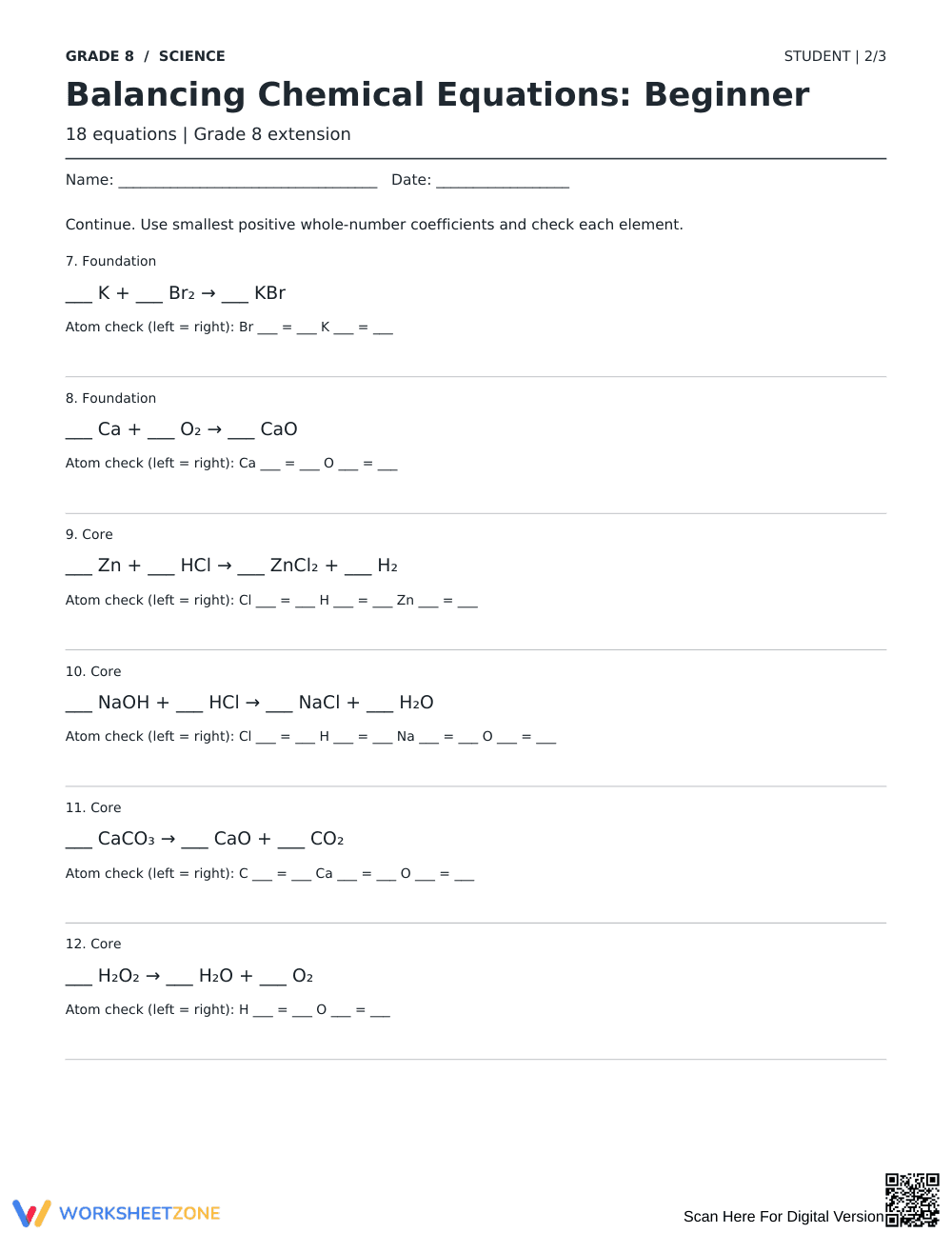
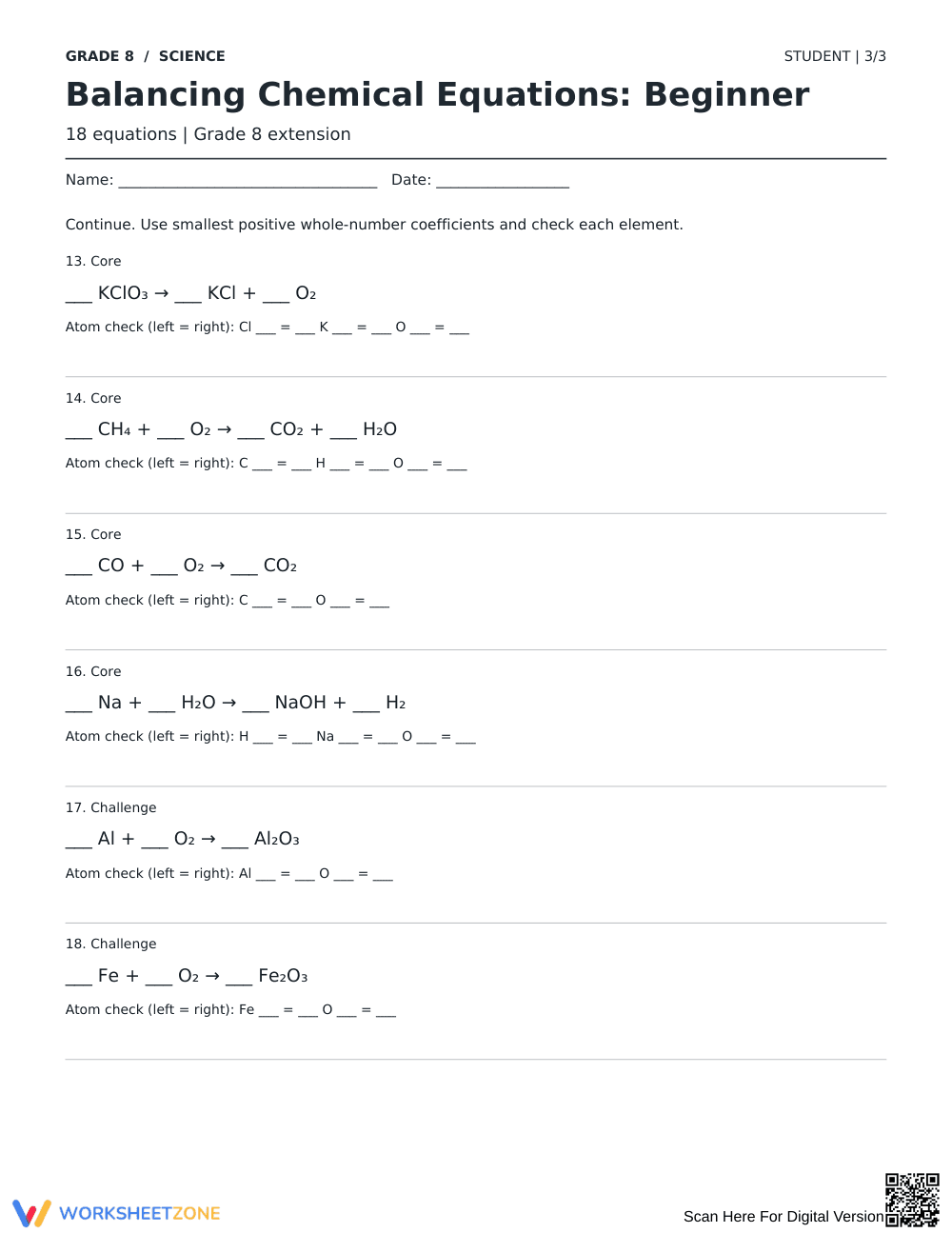
This Grade 8 balancing chemical equations worksheet provides students with targeted practice modeling the law of conservation of matter. Through eighteen scaffolded chemical reactions, learners master writing whole-number coefficients and verifying that atom counts remain equal before and after reactions, building a strong conceptual bridge between physical models and symbolic chemistry.
At a Glance
- Grade: 8 · Subject: Science
- Standard:
MS-PS1-5— Model conservation of matter by verifying equal atom counts in reactions- Skill Focus: Balancing chemical equations with coefficients
- Format: 3 pages · 18 problems · Answer key included · PDF
- Best For: Independent practice and chemistry unit extensions
- Time: 30–45 minutes
This three-page printable resource includes 18 carefully sequenced equation-balancing tasks, an introductory worked example, and a complete two-page teacher answer key with coefficient solutions and full atom count proofs. Each item features an integrated element-by-element accounting line, prompting students to audit reactant and product quantities systematically.
- Guided practice (Items 1–8): Foundation exercises focusing on simple synthesis and binary decomposition reactions with clear single-element balancing steps.
- Supported practice (Items 9–16): Core equations introducing replacement reactions, multi-element compounds, and water-producing neutralizations that require multi-step tracking.
- Independent practice (Items 17–18): Challenge problems involving transition metals and odd-to-even oxygen balancing demanding advanced coefficient manipulation.
This structured gradual-release sequence guides students from basic visual checks to autonomous algebraic verification.
This worksheet aligns directly with `MS-PS1-5`: Develop and use a model to describe how the total number of atoms does not change in a chemical reaction and thus mass is conserved. It also provides an essential foundation for high school standard `HS-PS1-7`. Both standard codes can be copied directly into lesson plans, IEP goals, or district curriculum mapping tools.
Implement this resource during mid-unit direct instruction as a guided check for understanding, or assign it after hands-on molecular model labs for independent application. Formative assessment tip: observe whether students attempt to modify chemical subscripts rather than coefficients during Foundation items. Completion time averages 30 to 45 minutes across class periods.
Designed for Grade 8 physical science students and introductory high school chemistry learners, this activity supports varied paces through visible tier labeling. Pair this printable with physical atom-tile manipulatives or a digital balancing simulation for learners requiring concrete visual reinforcement.
According to research synthesized by Fisher & Frey (2014), instructional frameworks that scaffold complex STEM tasks through explicit guided auditing significantly accelerate conceptual mastery and procedural fluency. This 18-item Grade 8 science worksheet operationalizes standard MS-PS1-5 by guiding students through the process of balancing chemical equations and verifying that the total quantity of each atom type is preserved across physical transformations. By embedding explicit element check lines and restricting modifications strictly to whole-number coefficients, the resource directly reinforces the law of conservation of mass in symbolic notation. Empirical findings demonstrate that systematic, scaffolded chemical equation balancing bridges the gap between concrete particulate models and abstract stoichiometric relationships, equipping middle school learners with essential prerequisites for advanced secondary physical science coursework.


