


























1 / 2
0
Views
0
Downloads

10.0
0
Save
0 Likes
Share
Balancing Chemical Equations
0 Views
0 Downloads
Paste this activity's link or code into your existing LMS (Google Classroom, Canvas, Teams, Schoology, Moodle, etc.).
Students can open and work on the activity right away, with no student login required.
You'll still be able to track student progress and results from your teacher account.
Information
Description
What It Is:
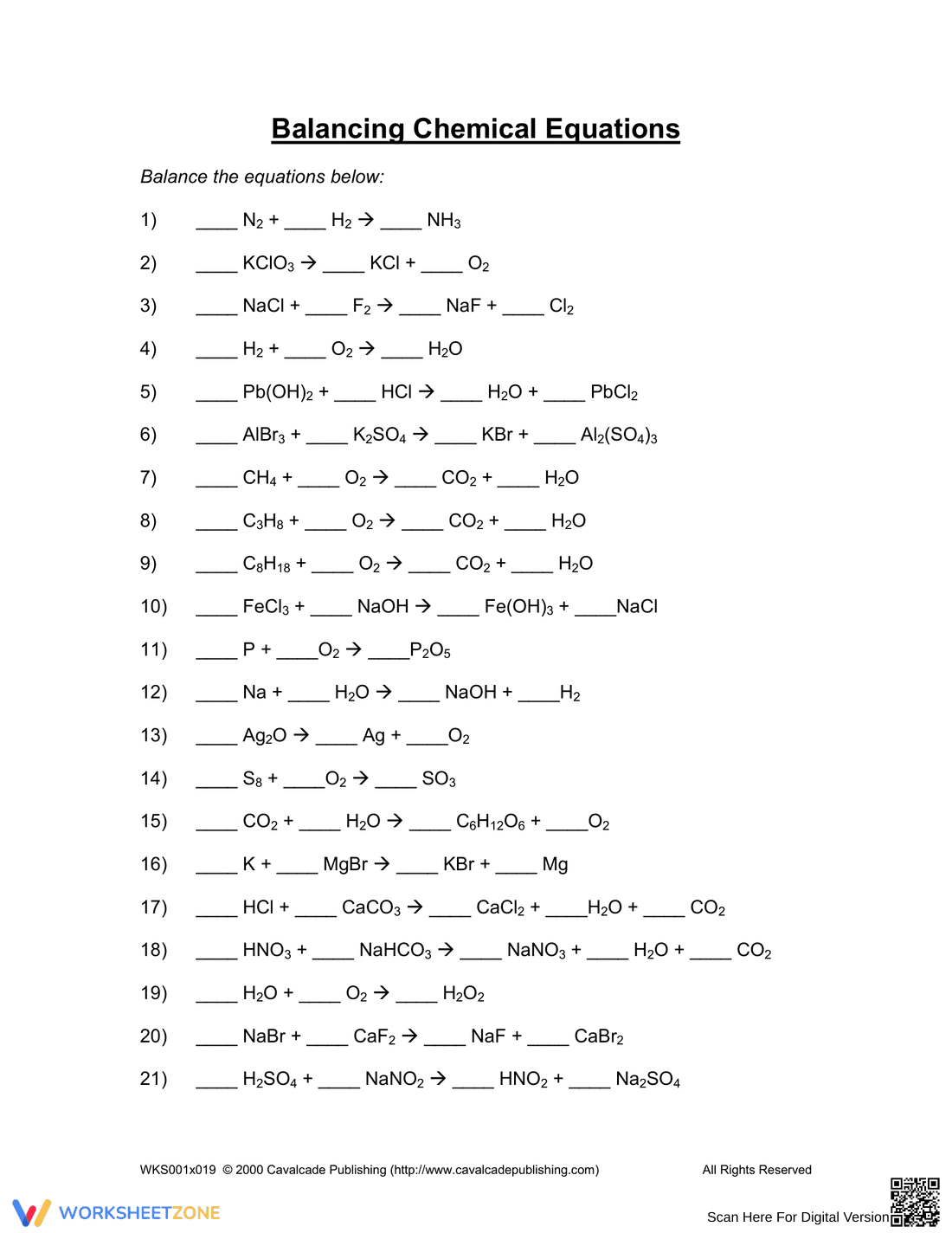
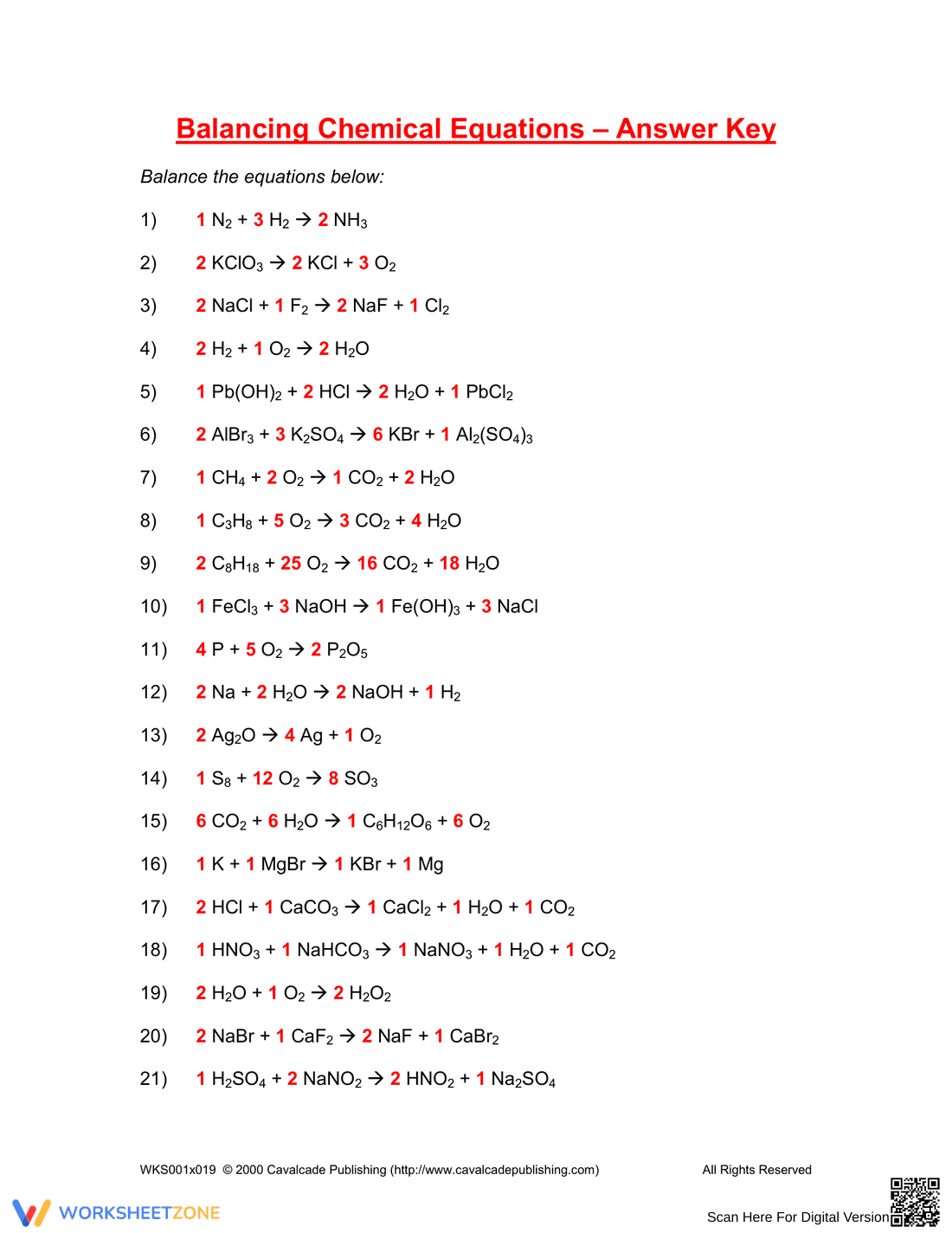
This is a chemistry worksheet focused on balancing chemical equations. The worksheet presents 21 unbalanced chemical equations, including reactions involving compounds like N2, H2, KClO3, NaCl, H2O, Pb(OH)2, AlBr3, CH4, C7H8, C9H18, FeCl3, P, Na, Ag2O, S8, CO2, K, HCl, HNO3, NaBr, and H2SO4. Students need to fill in the blanks with appropriate coefficients to balance each equation.
Grade Level Suitability:
This worksheet is suitable for high school students, typically grades 9-12, studying chemistry. The complexity of the equations and the need to understand stoichiometry make it appropriate for these grade levels.
Why Use It:
This worksheet reinforces the fundamental skill of balancing chemical equations, a crucial concept in chemistry. It helps students understand the law of conservation of mass and develop problem-solving skills in a chemical context. It provides practice in applying stoichiometric principles.
How to Use It:
Students should examine each chemical equation and determine the number of atoms of each element on both the reactant and product sides. They should then systematically adjust the coefficients in front of each compound until the number of atoms of each element is equal on both sides of the equation. The blanks provided are for writing the balanced coefficients.
Target Users:
The target users are high school chemistry students, chemistry teachers looking for practice materials, and homeschool educators teaching chemistry.
This is a chemistry worksheet focused on balancing chemical equations. The worksheet presents 21 unbalanced chemical equations, including reactions involving compounds like N2, H2, KClO3, NaCl, H2O, Pb(OH)2, AlBr3, CH4, C7H8, C9H18, FeCl3, P, Na, Ag2O, S8, CO2, K, HCl, HNO3, NaBr, and H2SO4. Students need to fill in the blanks with appropriate coefficients to balance each equation.
Grade Level Suitability:
This worksheet is suitable for high school students, typically grades 9-12, studying chemistry. The complexity of the equations and the need to understand stoichiometry make it appropriate for these grade levels.
Why Use It:
This worksheet reinforces the fundamental skill of balancing chemical equations, a crucial concept in chemistry. It helps students understand the law of conservation of mass and develop problem-solving skills in a chemical context. It provides practice in applying stoichiometric principles.
How to Use It:
Students should examine each chemical equation and determine the number of atoms of each element on both the reactant and product sides. They should then systematically adjust the coefficients in front of each compound until the number of atoms of each element is equal on both sides of the equation. The blanks provided are for writing the balanced coefficients.
Target Users:
The target users are high school chemistry students, chemistry teachers looking for practice materials, and homeschool educators teaching chemistry.


