


























Views
Downloads
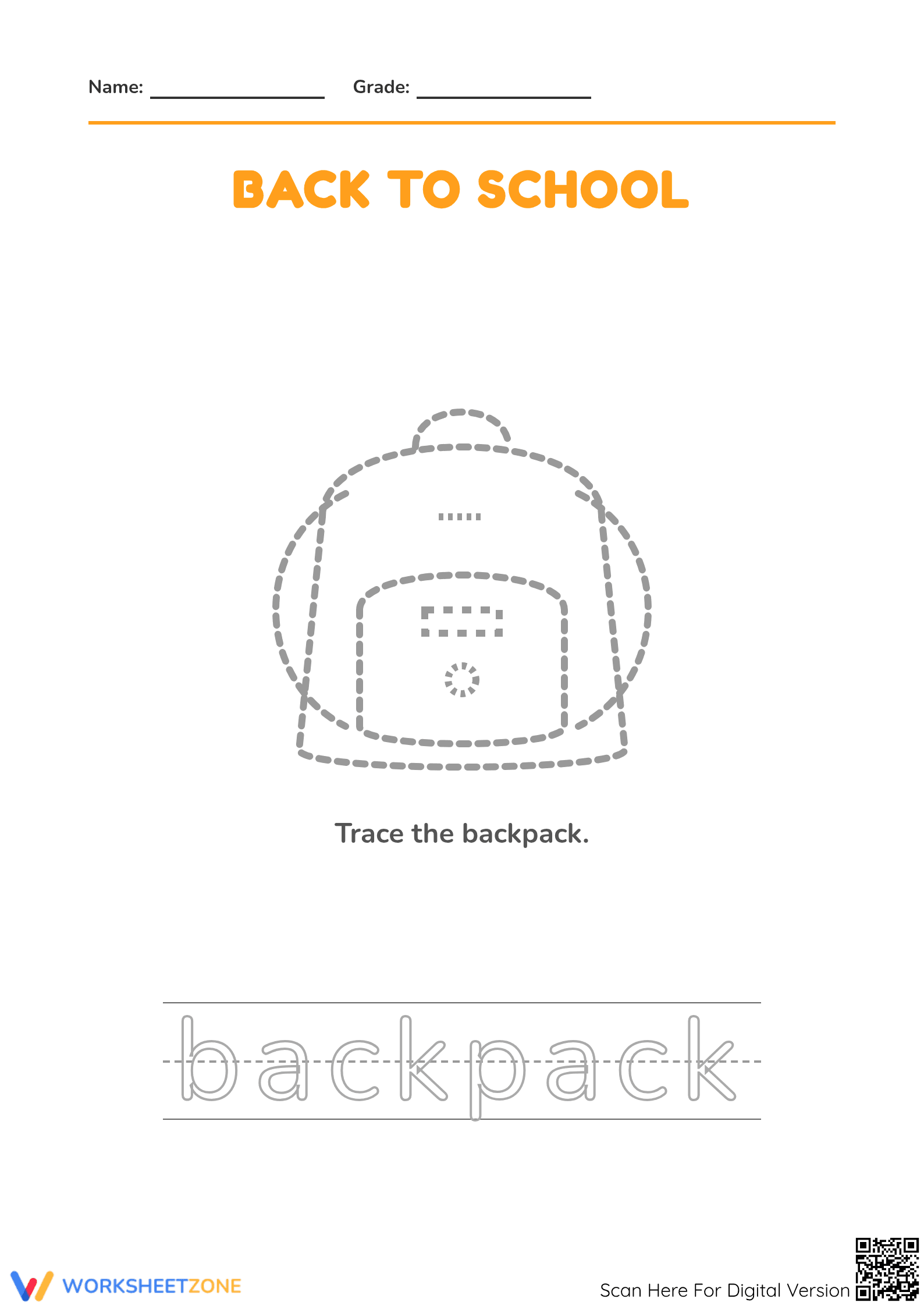

Printable Backpack Tracing Worksheet | Pre-K & K
Paste this activity's link or code into your existing LMS (Google Classroom, Canvas, Teams, Schoology, Moodle, etc.).
Students can open and work on the activity right away, with no student login required.
You'll still be able to track student progress and results from your teacher account.
This foundational handwriting worksheet helps early learners develop essential fine motor control and letter formation skills. By tracing a familiar back-to-school object and its corresponding vocabulary word, young students practice the precise hand movements required for future writing success in an engaging, accessible format.
At a Glance
- Grade: Pre-K & Kindergarten · Subject: Handwriting
- Standard:
CCSS.ELA-LITERACY.L.K.1.A— Print many upper- and lowercase letters- Skill Focus: Fine Motor Tracing
- Format: 1 page · 2 tasks · No answer key needed · PDF
- Best For: Morning work or centers
- Time: 5–10 minutes
This single-page resource features two distinct tracing activities designed for early childhood development. The top half provides a large, dashed outline of a backpack, allowing children to practice continuous line tracing. The bottom half includes the word "backpack" written in dashed, lowercase letters on standard primary handwriting lines, complete with a dashed midline to guide proper letter height.
Zero-Prep Workflow
This resource is designed for immediate classroom implementation with absolutely no teacher preparation required.
- Print (1 minute): Simply generate the PDF and print the required number of copies. The black-and-white design is highly ink-efficient.
- Distribute (1 minute): Hand out the sheets along with pencils, crayons, or markers depending on the desired sensory feedback.
- Review (1 minute): Briefly demonstrate how to follow the dashed lines from left to right before letting students work independently.
Total teacher prep time is under two minutes, making this an excellent option for emergency sub plans or schedule changes.
Standards Alignment
This activity aligns with CCSS.ELA-LITERACY.L.K.1.A: Print many upper- and lowercase letters. By practicing the controlled strokes required to trace the word "backpack," students build the muscle memory necessary for independent letter formation. Both standard codes can be copied directly into lesson plans, IEP goals, or district curriculum mapping tools.
How to Use It
This worksheet serves as an excellent morning work activity during the first few weeks of school. Place it on student desks before the bell rings to establish a calm routine. Alternatively, use it as an independent literacy center station. While students work, teachers can conduct quick formative assessments by observing pencil grip, gently correcting awkward grasps before they become habits. Most students will complete the page within 5 to 10 minutes.
Who It's For
This resource is designed for Preschool and Kindergarten students beginning their formal writing journey. It is also beneficial for occupational therapy sessions or special education students needing targeted fine motor intervention. Pair this tracing sheet with a read-aloud book about the first day of school or a classroom anchor chart identifying common school supplies.
Developing strong fine motor skills through targeted activities like tracing is a critical precursor to fluent handwriting and overall academic achievement in early education. This worksheet directly supports CCSS.ELA-LITERACY.L.K.1.A, helping students print many upper- and lowercase letters by establishing foundational pencil control and stroke sequence. According to a recent ScienceDirect TpT Analysis, early childhood resources that combine visual vocabulary with physical tracing tasks significantly improve both letter recognition and spatial awareness on the page. When young learners practice tracing familiar shapes alongside corresponding text, they build essential neural pathways connecting physical movement to language processing. This simple yet highly effective instructional tool provides the exact type of repetitive, low-stakes practice required to strengthen hand muscles, refine pincer grasps, and prepare early learners for more complex writing assignments as the school year progresses.


