




























Views
Downloads
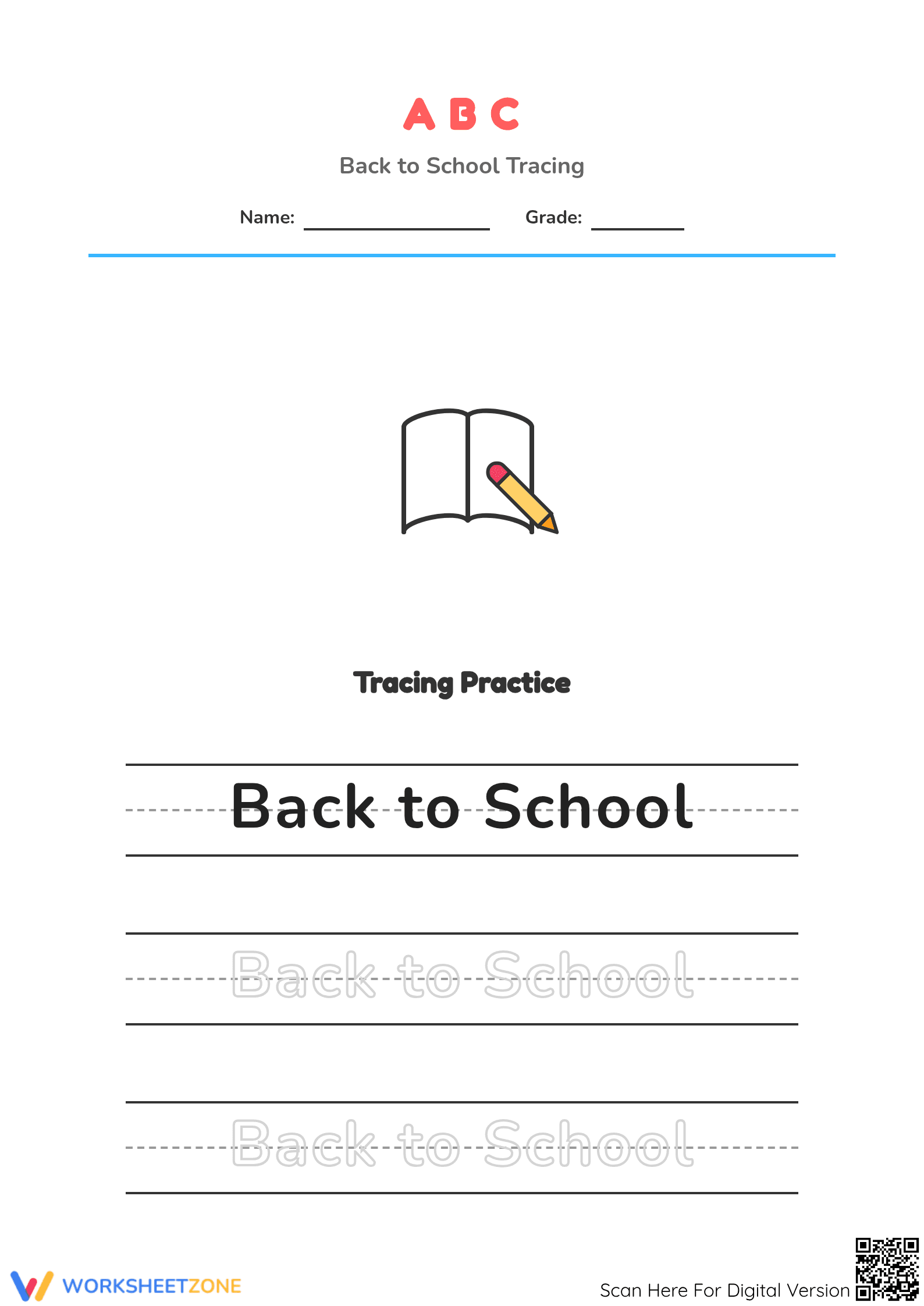


Back to School Tracing Worksheet | Essential Grade K Ready

Paste this activity's link or code into your existing LMS (Google Classroom, Canvas, Teams, Schoology, Moodle, etc.).
Students can open and work on the activity right away, with no student login required.
You'll still be able to track student progress and results from your teacher account.
This Kindergarten handwriting worksheet provides foundational tracing practice to help young learners develop the fine motor control necessary for legible writing. By focusing on high-interest "Back to School" themes, students engage with letter formation in a meaningful context. This resource ensures students gain confidence in their pencil grip and stroke precision before moving to independent writing.
At a Glance
- Grade: Kindergarten · Subject: Handwriting
- Standard:
CCSS.ELA-LITERACY.L.K.1.A— Print many upper- and lowercase letters with proper form- Skill Focus: Fine motor control and letter formation
- Format: 2 pages · 5 practice lines · No answer key needed · PDF
- Best For: First-week morning work or centers
- Time: 10–15 minutes
What's Inside
This 2-page PDF features large, clear dashed-line fonts designed specifically for early childhood learners. The first page focuses on the phrase "Back to School," providing one solid model and two tracing opportunities. The second page introduces the "ABC" sequence, allowing students to practice the first three letters of the alphabet. The layout is clean and distraction-free to help students maintain focus on their strokes.
Zero-Prep Workflow
- Print: Select the 2-page PDF and print enough copies for your class in under 30 seconds.
- Distribute: Hand out the sheets during morning arrival or as a transition activity (approx. 1 minute).
- Review: Walk the room to check for proper pencil grip and stroke direction as students trace (approx. 10 minutes).
This resource is an ideal sub plan addition because it requires no prior instruction or teacher-led modeling to be effective for students.
Standards Alignment
The primary focus is CCSS.ELA-LITERACY.L.K.1.A, which requires students to print many upper- and lowercase letters. By tracing the specific letters in "Back to School" and "ABC," students internalize the vertical and curved strokes required for standard English orthography. Both standard codes can be copied directly into lesson plans, IEP goals, or district curriculum mapping tools.
How to Use It
Use this worksheet as a "Soft Start" activity during the first week of school. As students arrive, having this on their desks provides an immediate, calm task that builds fine motor stamina. Alternatively, use it as a formative assessment tool; observe which students struggle with the curves of specific letters to identify who may need additional support. Completion typically takes 10 to 15 minutes.
Who It's For
This resource is designed for Preschool and Kindergarten students, as well as first graders who require remedial handwriting support. It is effective for learners becoming familiar with the Roman alphabet. Pair this with a "Back to School" read-aloud or an anchor chart showing proper letter-stroke directions for a complete instructional block.
Research by Fisher & Frey (2014) emphasizes the importance of the gradual release of responsibility, even in foundational skills like handwriting. Tracing serves as a critical scaffolded step between observing a teacher model and attempting independent production. This worksheet aligns with evidence-based practices for early literacy by providing a clear visual path for letter formation, which reduces cognitive load for the learner. According to the CCSS.ELA-LITERACY.L.K.1.A standard, mastery of letter printing is a prerequisite for later writing fluency and compositional success. By providing 5 distinct lines of practice across 2 pages, this resource ensures that students receive the repetitive, low-stakes exposure needed to build muscle memory. Educators can confidently integrate this tool into their curriculum, knowing it supports the motor-sensory development required for long-term academic achievement in ELA. This summary confirms the worksheet's utility for meeting core instructional goals in early childhood settings.


