




























Views
Downloads

Back to School I Spy: Shapes | Essential Grade K Math

Paste this activity's link or code into your existing LMS (Google Classroom, Canvas, Teams, Schoology, Moodle, etc.).
Students can open and work on the activity right away, with no student login required.
You'll still be able to track student progress and results from your teacher account.
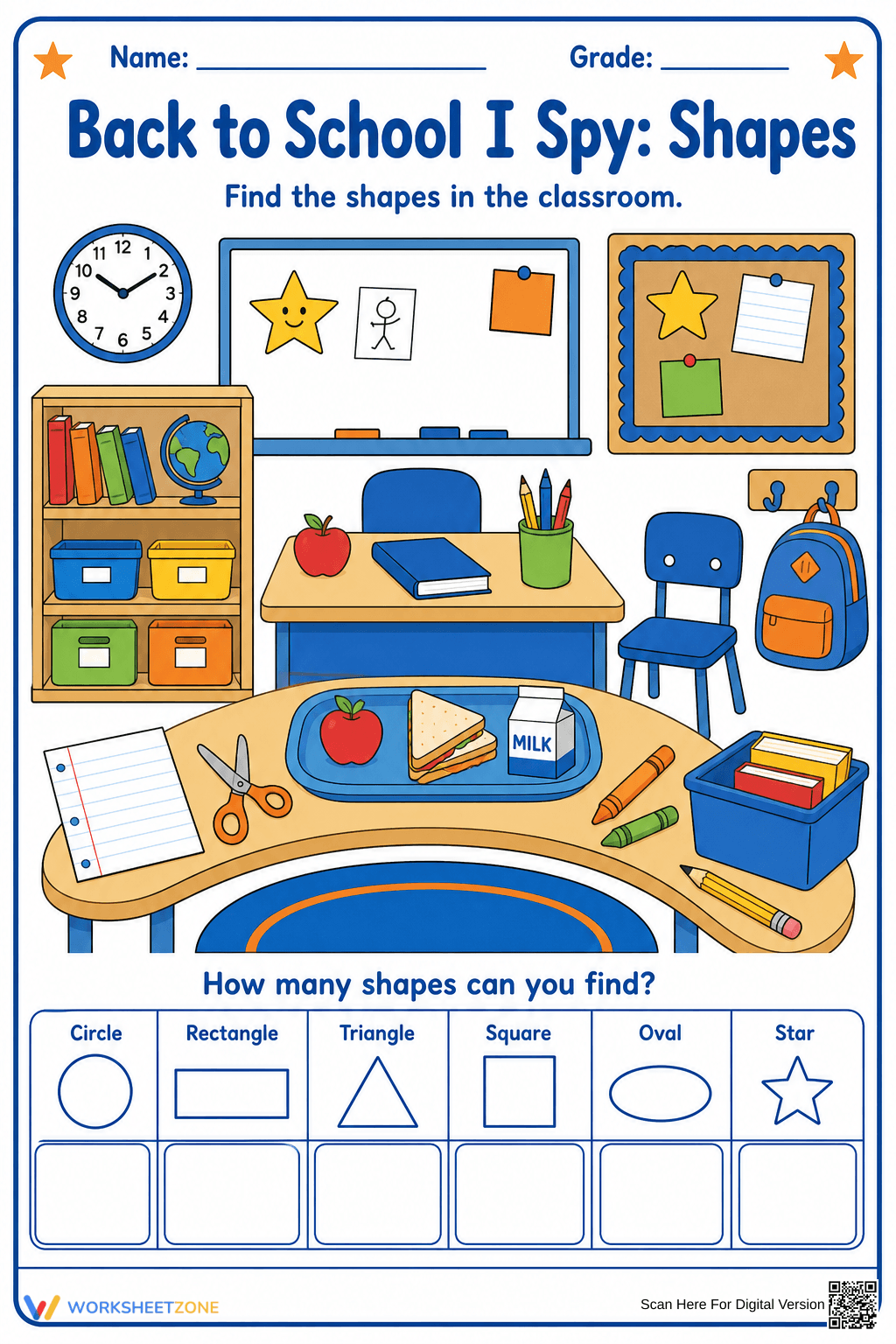
This Grade K geometry worksheet helps young learners master shape recognition through an engaging classroom-themed visual search. Students identify and count circles, rectangles, triangles, squares, ovals, and stars hidden within a familiar school environment. This activity builds foundational spatial reasoning and mathematical vocabulary while reinforcing basic counting skills in a fun, interactive format.
At a Glance
- Grade: K · Subject: Math
- Standard:
CCSS.MATH.CONTENT.K.G.A.2— Correct name shapes regardless of their orientations or overall size- Skill Focus: Shape identification and counting
- Format: 1 page · 6 tasks · Answer key included · PDF
- Best For: Morning work or early finishers
- Time: 10–15 minutes
The worksheet features a vibrant, high-contrast classroom illustration filled with school-themed objects like clocks, books, and lunch trays. Below the main image is a structured counting table containing six distinct shape icons: circle, rectangle, triangle, square, oval, and star. Each icon is paired with a clear label and a dedicated answer box for students to record their findings. The single-page PDF format ensures a clean, focused workspace for early learners.
Teachers can implement this activity with minimal effort. First, print the single-page PDF for each student, which takes less than 30 seconds. Second, distribute the sheets during morning arrival or as a transition activity; the visual nature of the "I Spy" task requires almost no verbal instruction. Finally, review the answers as a whole group to reinforce shape names, totaling less than 2 minutes of teacher preparation time.
This resource is directly aligned with `CCSS.MATH.CONTENT.K.G.A.2`, which requires students to correctly name shapes regardless of their orientations or overall size. By identifying shapes within complex objects—such as a circular clock or a rectangular book—students demonstrate a deep understanding of geometric properties. This standard code can be copied directly into lesson plans, IEP goals, or district curriculum mapping tools.
Use this worksheet as a formative assessment during the first week of school to gauge incoming students' shape recognition abilities. It also functions perfectly as a quiet math center activity where students work independently to find and tally the shapes. Observe if students can distinguish between similar shapes, like squares and rectangles, to identify those needing additional support. Completion typically takes 10 to 15 minutes.
This activity is designed for Pre-K and Kindergarten students who are beginning to explore geometry. It provides excellent support for English Language Learners (ELLs) by pairing visual icons with shape names. This worksheet pairs naturally with a classroom "shape hunt" or a direct instruction lesson using physical manipulatives to bridge the gap between 2D representations and 3D objects.
Research by Fisher & Frey (2014) emphasizes the importance of visual literacy and scaffolded practice in early childhood education. This worksheet utilizes a "search and find" strategy that encourages students to apply geometric knowledge to real-world contexts, a method proven to increase engagement and retention in mathematics. By requiring students to count and record their findings, the activity integrates CCSS.MATH.CONTENT.K.G.A.2 with basic numeracy, supporting the development of dual-processing skills. According to the NAEP framework, early exposure to shape identification in varied orientations is a critical predictor of later success in complex spatial reasoning tasks. This resource provides the structured, low-stakes practice necessary for students to achieve mastery in naming shapes and understanding their properties within a familiar environment.


