


























Views
Plays

Consonant Digraphs Worksheet | Grade 1 Essential
Paste this activity's link or code into your existing LMS (Google Classroom, Canvas, Teams, Schoology, Moodle, etc.).
Students can open and work on the activity right away, with no student login required.
You'll still be able to track student progress and results from your teacher account.
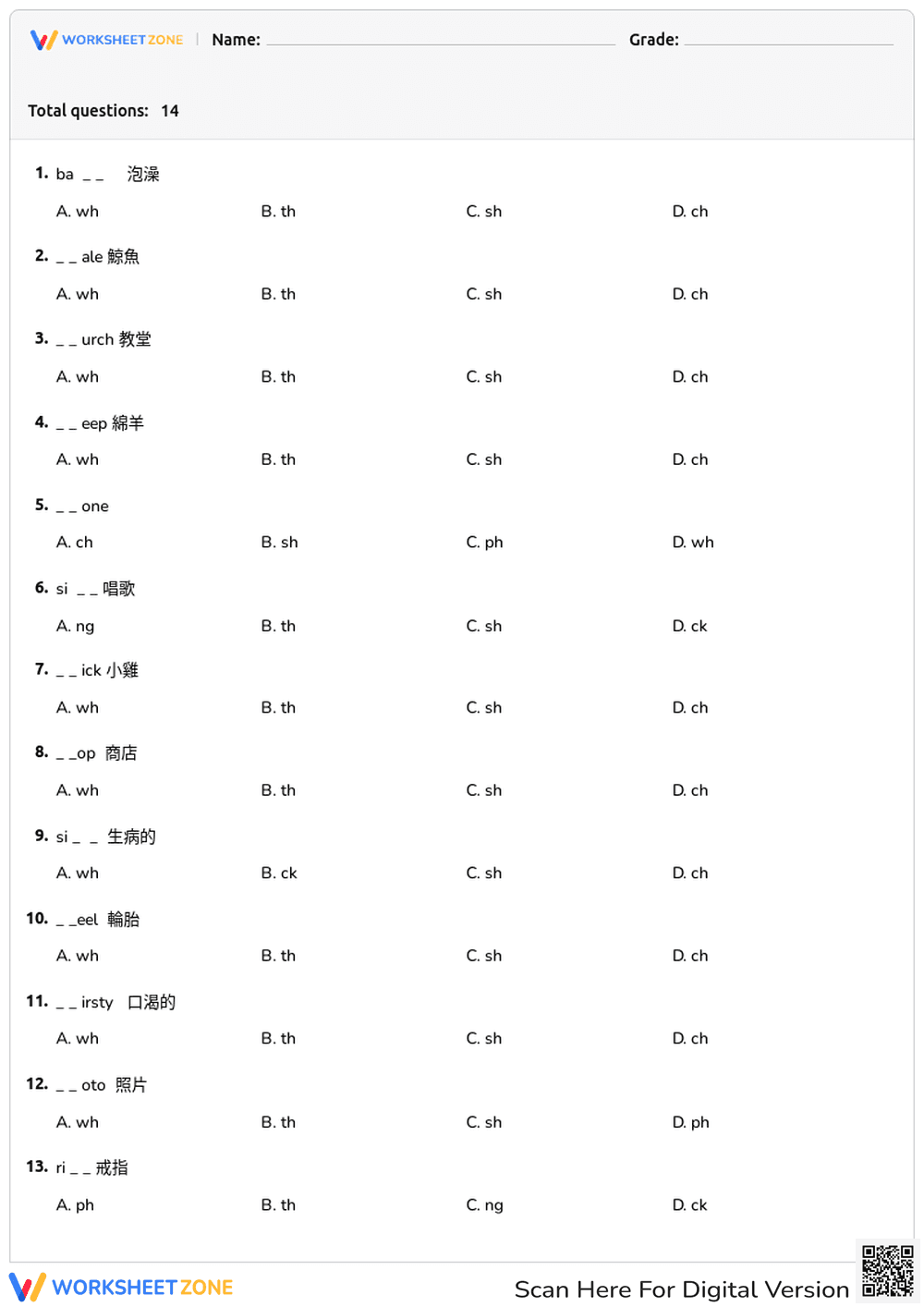
This Grade 1 consonant digraphs worksheet provides students with targeted practice in identifying and applying common letter combinations to form complete words. By focusing on the relationship between sounds and spellings, students strengthen their phonemic awareness and decoding skills, leading to increased reading fluency and spelling accuracy across various contexts.
At a Glance
- Grade: 1 · Subject: ELA
- Standard:
CCSS.ELA-LITERACY.RF.1.3.A— Know spelling-sound correspondences for common consonant digraphs- Skill Focus: Consonant Digraphs (sh, ch, th, wh, ph, ng, ck)
- Format: 2 pages · 14 problems · Answer key included · PDF
- Best For: Phonics centers and morning work
- Time: 15–20 minutes
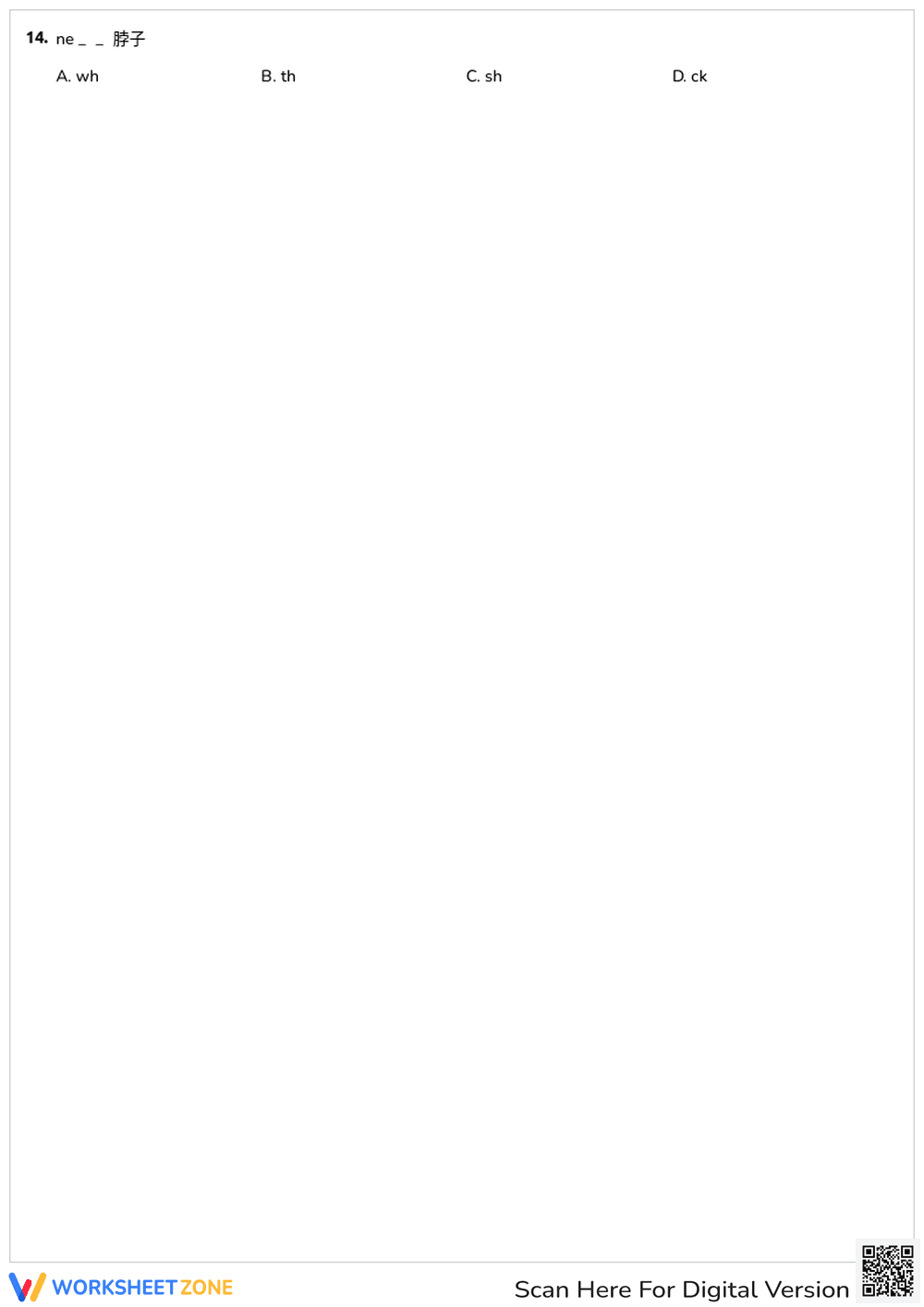
What's Inside: This comprehensive 2-page PDF features 14 multiple-choice questions designed to test a student's ability to select the correct digraph for a given word stem. Each item includes a visual word fragment and a Chinese translation to support English Language Learners (ELL) in connecting meaning to sound. The layout is clean and distraction-free, ensuring students remain focused on the phonics task at hand.
Zero-Prep Workflow
- Print: Generate copies for your entire class in less than 30 seconds. The high-contrast black and white design ensures clear visibility even on older school copiers.
- Distribute: Hand out the worksheets as a quick morning warm-up or a transition activity between literacy blocks. No additional manipulatives or teacher setup is required.
- Review: Use the included answer key to grade the 14 tasks in under 5 minutes, or project the PDF for a whole-class self-correction session.
Standards Alignment: This resource is specifically mapped to `CCSS.ELA-LITERACY.RF.1.3.A`, which requires students to know the spelling-sound correspondences for common consonant digraphs. By practicing with digraphs like "th," "sh," and "ch" in both initial and final positions, students meet the foundational requirements for first-grade reading. This standard code can be copied directly into lesson plans, IEP goals, or district curriculum mapping tools.
How to Use It: This worksheet is ideal for use during the "You Do" phase of a gradual release model. After direct instruction on a specific digraph, assign this as independent practice to gauge student understanding. It also serves as an excellent formative assessment tool; teachers can quickly scan the 14 responses to identify which specific digraphs (such as the often-confused "ph" or "wh") require additional small-group intervention.
Who It's For: While designed for first-grade students, this resource is highly effective for kindergarteners ready for advanced phonics or second graders needing remedial support. The inclusion of bilingual support makes it a valuable asset for ESL/ELL classrooms. Pair this worksheet with a digraph anchor chart or a decodable reader to create a complete instructional cycle.
Research from the RAND AIRS 2024 report emphasizes that systematic phonics instruction, including the explicit teaching of consonant digraphs like those found in CCSS.ELA-LITERACY.RF.1.3.A, is a critical predictor of long-term literacy success. This worksheet provides the structured repetition necessary for students to internalize these complex sound-letter relationships. By engaging with 14 distinct examples, learners move beyond rote memorization toward true phonetic mastery. The integration of multiple digraphs within a single session encourages students to discriminate between similar sounds, a higher-order cognitive task that solidifies their orthographic mapping capabilities. Educators can rely on this evidence-based approach to ensure that every student, regardless of their starting point, gains the foundational tools required for fluent decoding and confident reading in the primary grades.


