


























Views
Downloads
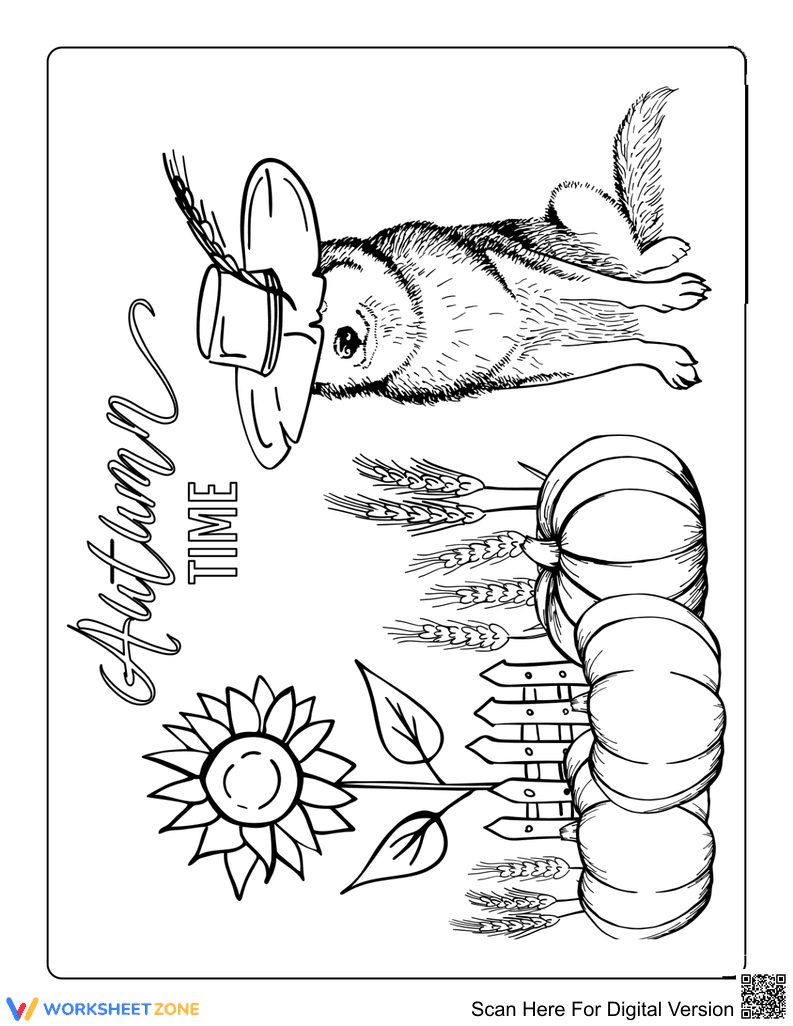

Autumn Time Coloring Page | Printable Kindergarten Worksheet
Paste this activity's link or code into your existing LMS (Google Classroom, Canvas, Teams, Schoology, Moodle, etc.).
Students can open and work on the activity right away, with no student login required.
You'll still be able to track student progress and results from your teacher account.
This Autumn Time coloring worksheet provides Kindergarten students with a creative outlet to develop fine motor control while engaging with seasonal imagery. By coloring detailed illustrations of pumpkins, sunflowers, and autumn animals, learners reinforce their understanding of seasonal changes and vocabulary. It is a high-engagement tool for early childhood classrooms.
At a Glance
- Grade: Kindergarten · Subject: English
- Standard:
CCSS.ELA-LITERACY.L.K.6— Use words and phrases acquired through responding to seasonal themes- Skill Focus: Fine motor skills & seasonal vocabulary
- Format: 1 page · 1 task · Answer key not applicable · PDF
- Best For: Morning work or seasonal centers
- Time: 15–20 minutes
This single-page PDF features a high-quality line-art illustration titled "Autumn Time." The visual elements include a charming dog wearing a straw hat, a cluster of ripe pumpkins, stalks of wheat, a large sunflower, and a rustic garden fence. The layout is designed with clear borders to help young learners practice staying within the lines, supporting hand-eye coordination and grip strength.
The zero-prep workflow for this resource is designed for maximum efficiency in a busy classroom. First, print the single-page PDF for your entire class (approx. 1 minute). Second, distribute the sheets during a transition period or as students arrive for morning work (approx. 30 seconds). Third, review the seasonal vocabulary depicted—such as "harvest," "pumpkin," and "sunflower"—as students color (approx. 5 minutes of active circulation). Total teacher preparation time is under 2 minutes, making it an ideal sub plan addition.
This resource aligns with CCSS.ELA-LITERACY.L.K.6, which requires students to use words and phrases acquired through conversations and responding to themes. By identifying and discussing the autumn-themed objects on the page, students build the linguistic foundation necessary for reading comprehension. This standard code can be copied directly into lesson plans, IEP goals, or district curriculum mapping tools.
Use this worksheet during the first 15 minutes of the school day as a calming morning work activity that settles students into the learning environment. Alternatively, place it in a seasonal literacy center alongside autumn-themed picture books. As a formative assessment, observe student grip and pressure to identify those who may need additional occupational therapy support or fine motor intervention. Expected completion time ranges from 15 to 20 minutes depending on the student's detail level.
This worksheet is ideal for Kindergarten and Grade 1 students, as well as English Language Learners (ELL) who are building basic seasonal vocabulary. It serves as an excellent supplemental resource when paired with a direct instruction lesson on the four seasons or a read-aloud about the harvest. It is also suitable for special education settings where students are working on specific motor milestones.
Research from the RAND AIRS 2024 report emphasizes that integrating creative arts with thematic vocabulary instruction significantly improves retention in early childhood education. This Autumn Time worksheet utilizes visual cues to anchor the standard CCSS.ELA-LITERACY.L.K.6, allowing students to internalize seasonal concepts through tactile engagement. Fine motor activities, such as coloring within defined boundaries, are proven precursors to successful handwriting and literacy development. By providing a low-stakes environment for creative expression, educators can foster a positive association with school-based tasks while simultaneously meeting language acquisition goals. The inclusion of specific harvest imagery supports the development of schema, which Fisher & Frey (2014) identify as a critical component of reading readiness. This resource provides a structured yet flexible way to meet these developmental needs without requiring extensive teacher preparation or specialized materials.


