


























Views
Plays

Atomic Theory and Structure Worksheet | Grade 8 Essential
Paste this activity's link or code into your existing LMS (Google Classroom, Canvas, Teams, Schoology, Moodle, etc.).
Students can open and work on the activity right away, with no student login required.
You'll still be able to track student progress and results from your teacher account.
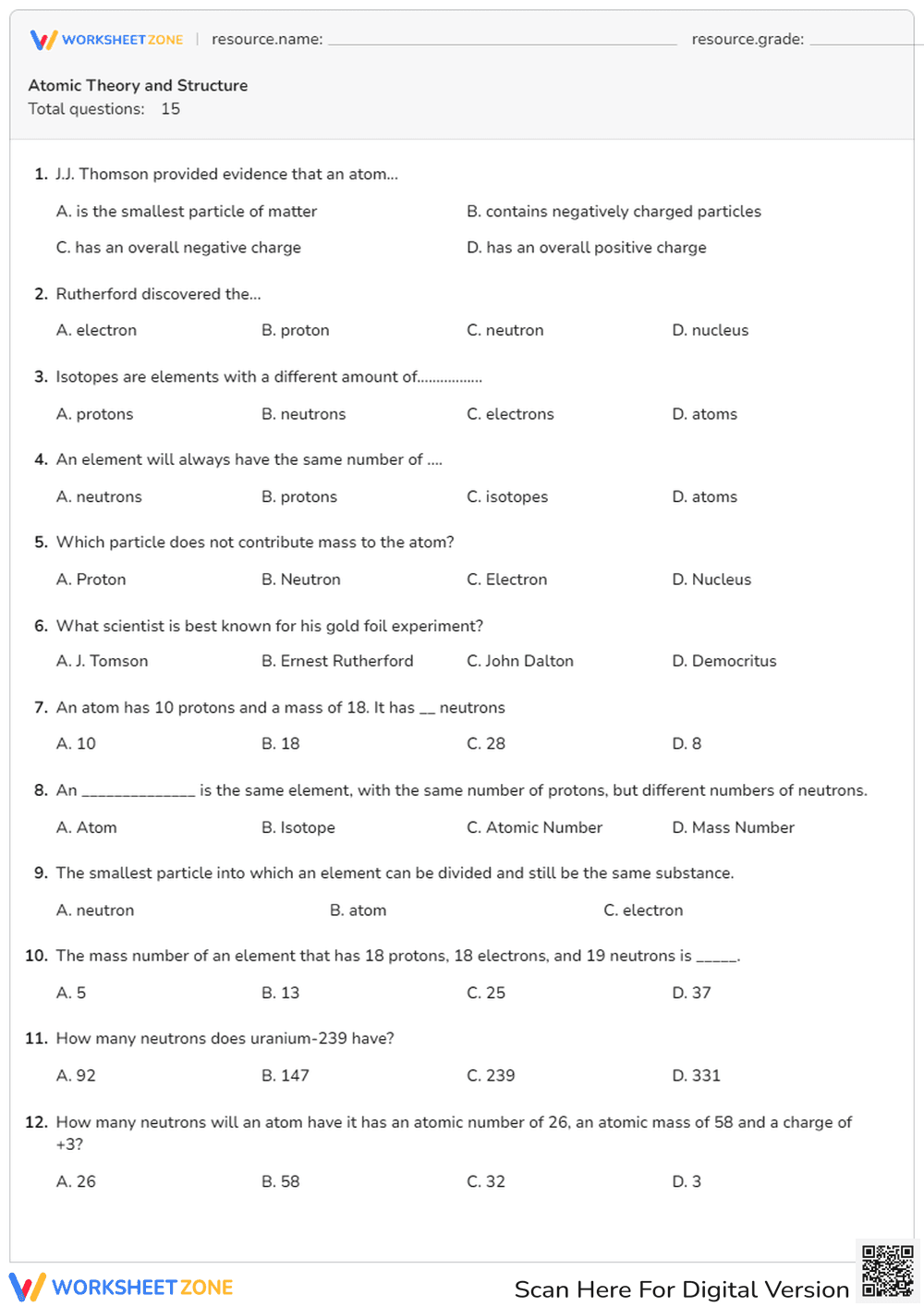
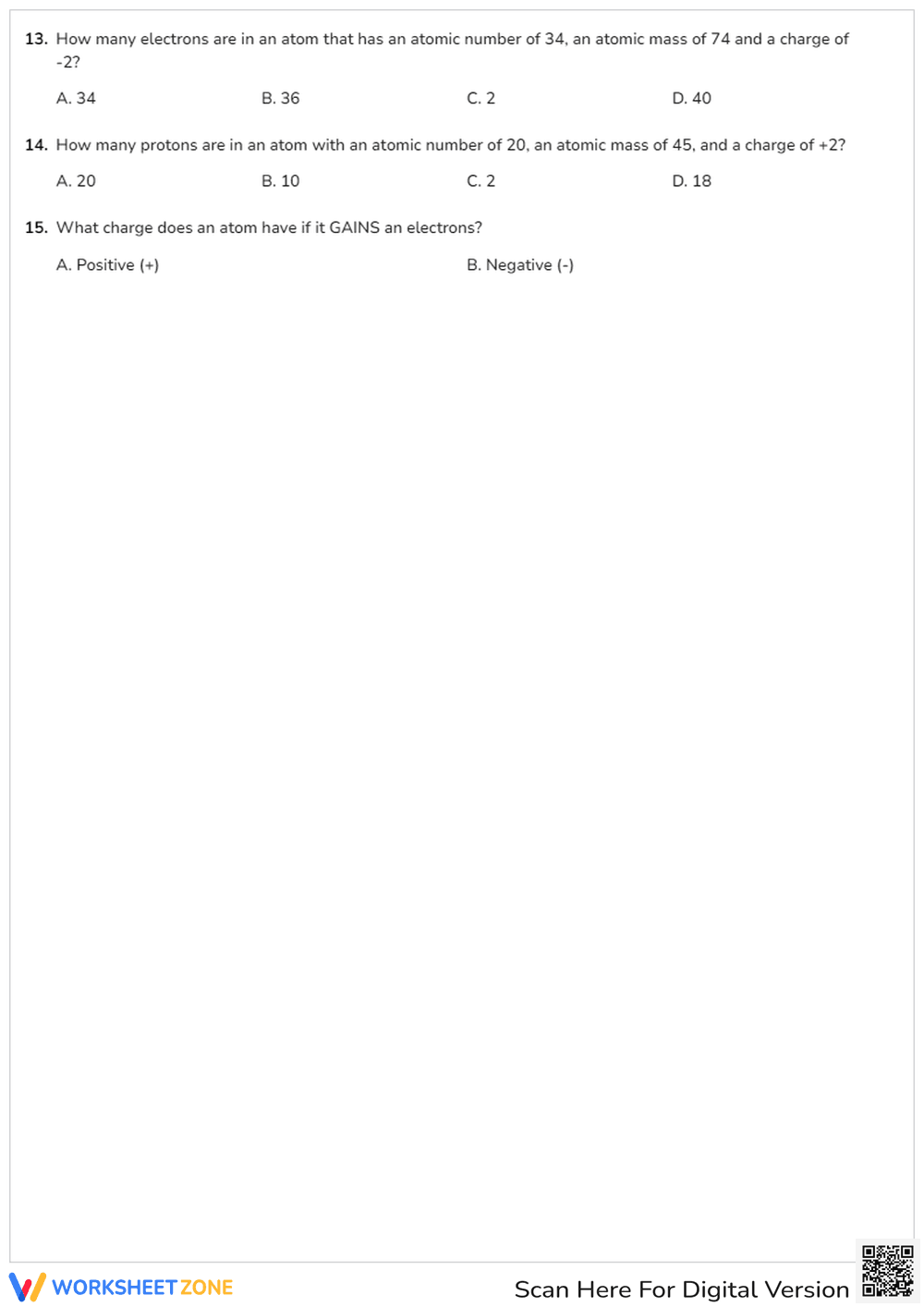
This Grade 8 science worksheet provides a comprehensive review of atomic theory and structure through 15 targeted multiple-choice questions. Students will demonstrate mastery of subatomic particles, isotopes, and historical atomic models. By calculating mass numbers and identifying specific elements, learners bridge the gap between abstract theory and concrete properties.
At a Glance
- Grade: 8 · Subject: Science
- Standard:
MS-PS1-1— Develop models to describe the atomic composition of simple molecules- Skill Focus: Subatomic particles and atomic history
- Format: 2 pages · 15 problems · Answer key not included · PDF
- Best For: Formative assessment or unit review
- Time: 20–30 minutes
The worksheet consists of two pages featuring 15 high-quality multiple-choice items. The tasks cover a broad range of chemistry fundamentals, including the discoveries of Thomson and Rutherford, the definition of isotopes, and the calculation of neutrons and electrons in charged ions. The clean, distraction-free formatting ensures that students remain focused on the scientific content without unnecessary visual clutter.
Zero-Prep Workflow
This resource is designed for immediate classroom implementation with a total teacher prep time of under 2 minutes. Step 1: Print the two-page PDF (30 seconds). Step 2: Distribute to students as a silent starter or exit ticket (30 seconds). Step 3: Review the 15 multiple-choice questions using a document camera for immediate feedback (1 minute). Its clear layout makes it an ideal emergency sub plan.
Standards Alignment
This resource is primarily aligned with MS-PS1-1: "Develop models to describe the atomic composition of simple molecules and extended structures." It specifically addresses the foundational knowledge of atomic components required to build those models. Additionally, it supports literacy in science by requiring students to interpret technical descriptions of atomic properties. Both standard codes can be copied directly into lesson plans, IEP goals, or district curriculum mapping tools.
How to Use It
Use this worksheet as a formative assessment after completing a unit on the Periodic Table or atomic history. It serves as an excellent check for understanding to see if students can distinguish between atomic mass and atomic number. Teachers should observe students during questions 11 through 14, as these require multi-step calculation of subatomic particles. Expect students to complete the full set in 20 to 30 minutes depending on their prior knowledge.
Who It's For
This resource is tailored for middle school students in grades 6 through 8 who are beginning their study of physical science. It is particularly effective for learners who benefit from structured, closed-ended questions to reinforce vocabulary. Pair this worksheet with a periodic table anchor chart or a digital atom-building simulation to provide a multi-modal learning experience that supports diverse classroom needs.
Middle school science instruction requires a transition from macroscopic observations to microscopic models. According to the RAND AIRS 2024 report on science literacy, structured practice with atomic variables—such as calculating neutrons from mass numbers—is essential for developing the mental models required for high school chemistry. This worksheet aligns with MS-PS1-1 by requiring students to identify the components of an atom and differentiate between isotopes and ions. By isolating specific variables like atomic number and charge, students build the cognitive fluency needed to predict chemical behavior. The 15-question format provides sufficient data for teachers to identify misconceptions regarding the role of electrons versus protons in atomic identity. Utilizing this resource as a bridge between direct instruction and laboratory exploration ensures that students possess the foundational vocabulary and mathematical logic necessary for complex scientific inquiry and evidence-based reasoning in the physical sciences.


