


























Views
Plays
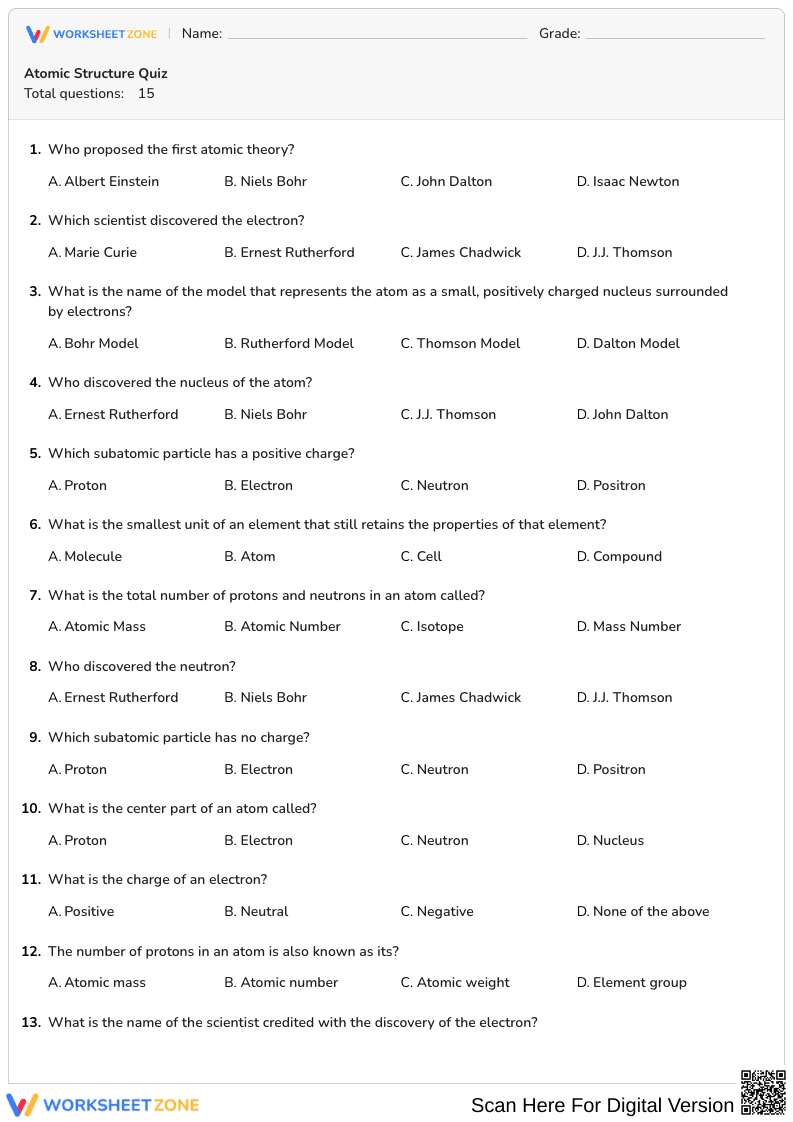
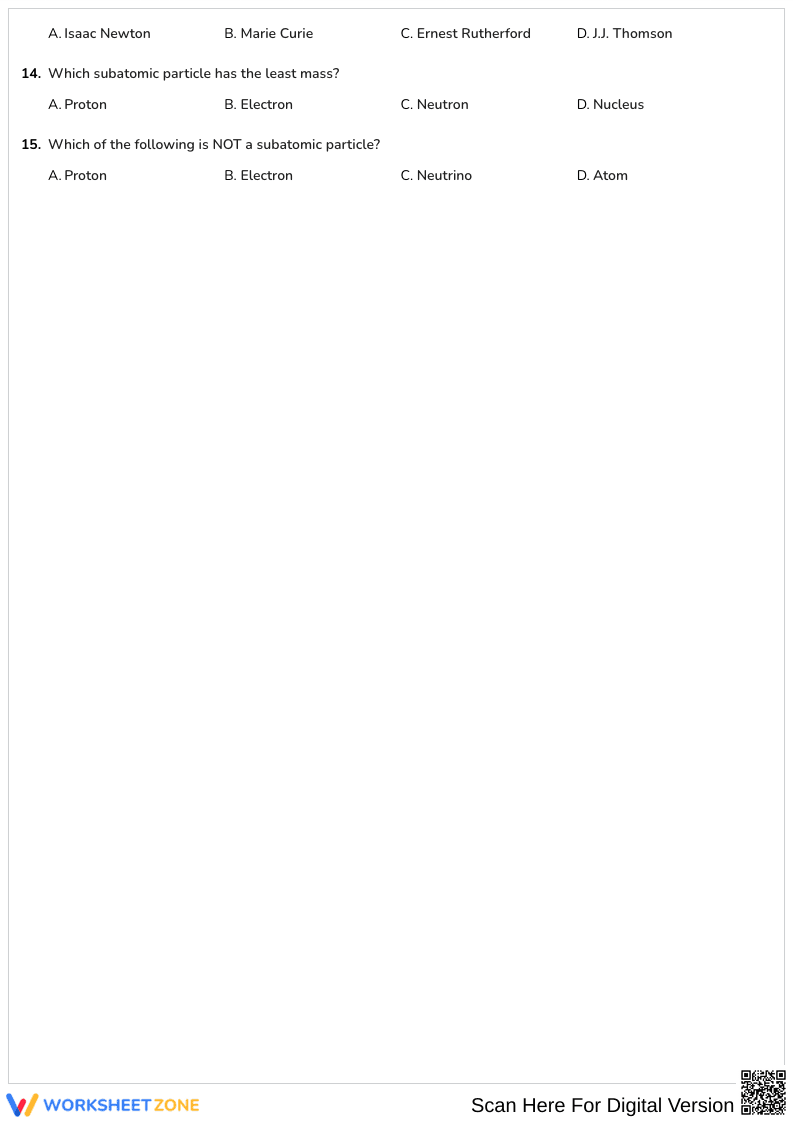

Atomic Structure Quiz | Grade 8 Science Essential
Paste this activity's link or code into your existing LMS (Google Classroom, Canvas, Teams, Schoology, Moodle, etc.).
Students can open and work on the activity right away, with no student login required.
You'll still be able to track student progress and results from your teacher account.
This Grade 8 science worksheet provides a comprehensive assessment of atomic theory and subatomic particles. Students demonstrate mastery by identifying key scientists and the properties of protons, neutrons, and electrons. It ensures learners can distinguish between various atomic models, providing a clear picture of student progress before moving to chemical reactions.
At a Glance
- Grade: 8–9 · Subject: Science
- Standard:
MS-PS1-1— Develop models to describe the atomic composition of simple molecules- Skill Focus: Atomic theory and subatomic particles
- Format: 2 pages · 15 problems · Answer key included · PDF
- Best For: Formative assessment and sub plans
- Time: 15–20 minutes
The quiz consists of 15 multiple-choice questions spread across two pages. It features a mix of historical context, such as the discoveries of Rutherford and Thomson, and technical knowledge regarding atomic mass and subatomic charges. The layout is clean and distraction-free. A full answer key is provided to facilitate rapid grading or student self-correction.
Zero-Prep Workflow
This resource is designed for a zero-prep classroom environment. Step 1: Print the two-page PDF (30 seconds). Step 2: Distribute to students as a quiet individual assessment (15-20 minutes). Step 3: Review answers using the included key (5 minutes). Total teacher preparation time is under 2 minutes, making this ideal for emergency sub plans or end-of-unit reviews.
Standards Alignment
This resource is primarily aligned with MS-PS1-1: "Develop models to describe the atomic composition of simple molecules." By identifying the components of the atom, students build the prerequisite knowledge for modeling molecular structures. Both standard codes can be copied directly into lesson plans, IEP goals, or district curriculum mapping tools.
How to Use It
Use this quiz as a summative exit ticket after completing a unit on the history of the atom. It is best administered during the independent practice phase to verify mastery. For a formative approach, have students complete the quiz in pairs to encourage peer discussion. Expect students to finish within 15 to 20 minutes.
Who It's For
This worksheet is tailored for Grade 8 and Grade 9 students beginning physical science. It is effective for students who benefit from structured, multiple-choice formats. Pair this quiz with an interactive periodic table to provide a multi-modal learning experience for diverse learners in the classroom.
According to research by Fisher & Frey (2014), frequent low-stakes assessments like this 15-question quiz are vital for identifying misconceptions in abstract scientific concepts. This worksheet aligns with the MS-PS1-1 standard, which requires students to develop models to describe the atomic composition of simple molecules. By focusing on the historical progression of atomic theory—from Dalton to Bohr—students build a conceptual framework that supports later mastery of the periodic table. The inclusion of subatomic particle properties, such as mass and charge, provides the quantitative foundation necessary for high school chemistry readiness. Data from the NAEP suggests that students who can successfully identify the components of an atom are significantly more likely to succeed in advanced physical science courses. This resource serves as a reliable tool for formative assessment, allowing educators to pivot instruction based on real-time student performance data.


