


























Views
Downloads
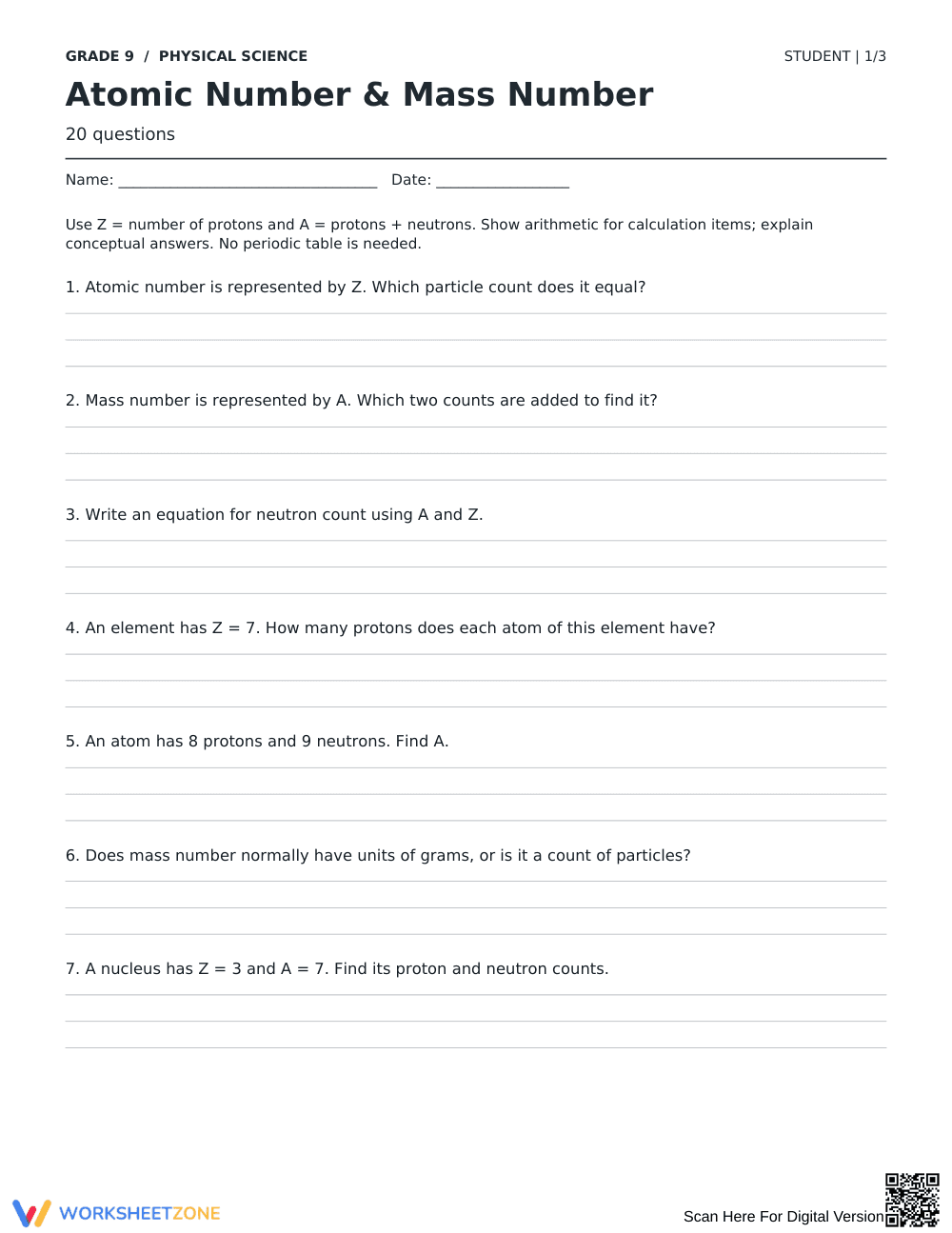
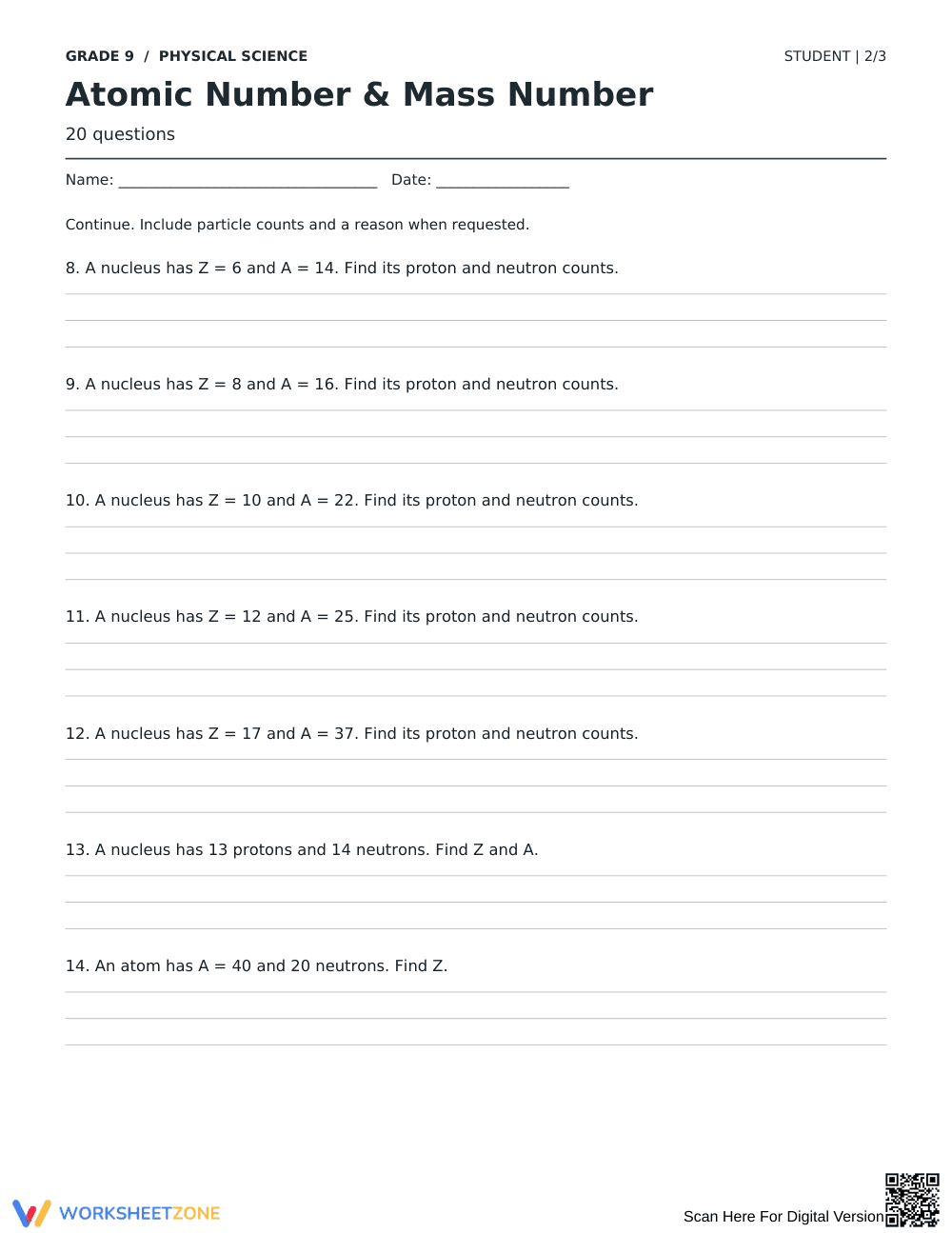
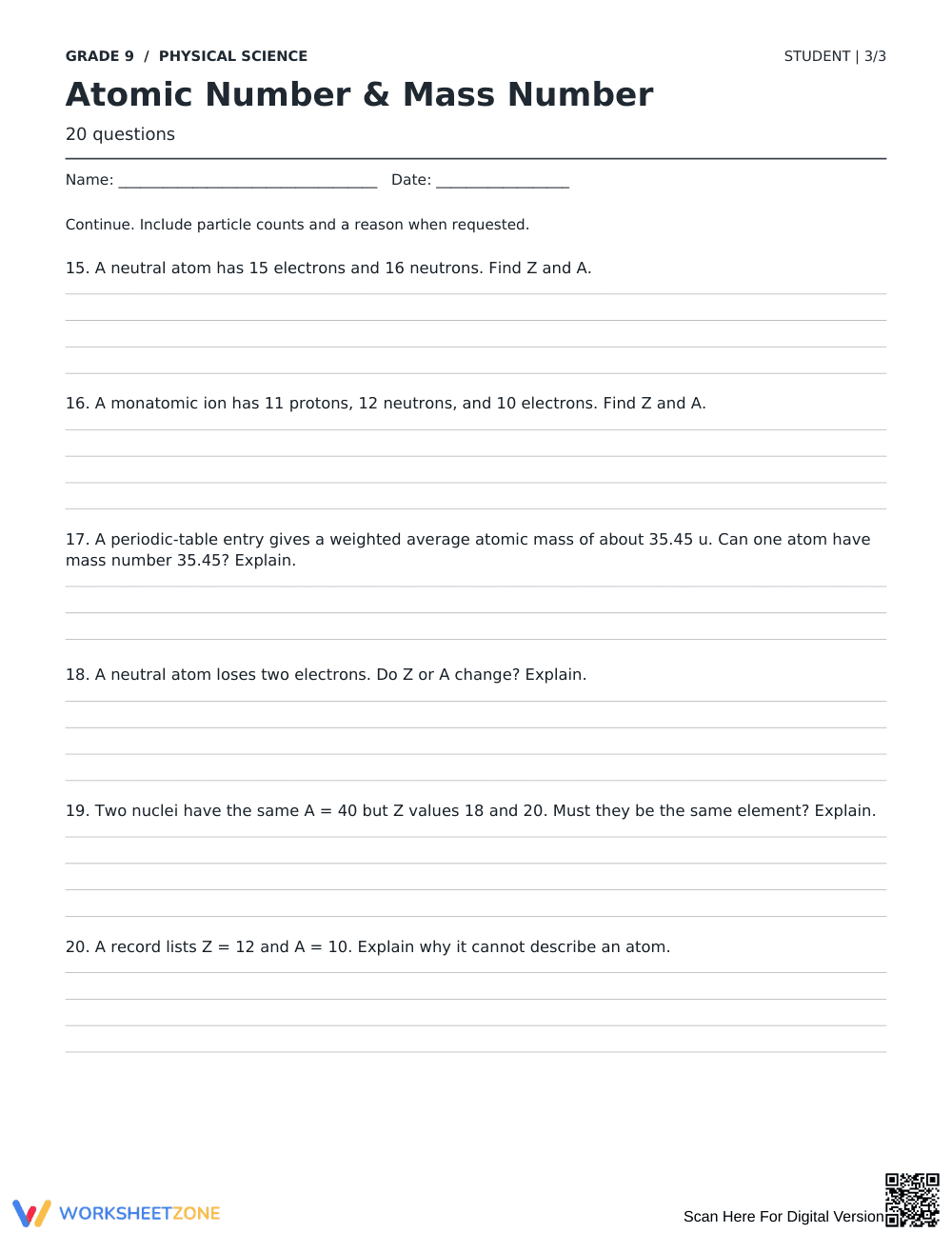

Atomic & Mass Number Printable | Grade 9 Science
Paste this activity's link or code into your existing LMS (Google Classroom, Canvas, Teams, Schoology, Moodle, etc.).
Students can open and work on the activity right away, with no student login required.
You'll still be able to track student progress and results from your teacher account.
This Grade 9 science worksheet builds student mastery of atomic number and mass number by guiding learners through 30 structured problems that require them to identify proton count, neutron count, and electron count for a range of elements. Students finish the activity able to distinguish between atomic number and mass number and apply both values to describe atomic structure with confidence.
At a Glance
- Grade: 9 · Subject: Science (Chemistry)
- Standard:
HS-PS1-1— Use the periodic table to describe properties of elements and their atoms- Skill Focus: Calculating protons, neutrons, and electrons from atomic number and mass number
- Format: 2 pages · 30 problems · Answer key included · PDF
- Best For: Introductory atomic structure practice and review
- Time: 25–40 minutes
The worksheet spans two student pages and includes a reference section defining atomic number and mass number before problems begin. Tasks use a structured table format where students fill in missing values for symbol, atomic number, mass number, protons, neutrons, and electrons across 30 elements. A complete answer key is provided on two separate pages, making self-checking and teacher grading straightforward.
- Guided practice: Opening rows supply several pre-filled values so students confirm the relationship between atomic number and proton count before working independently (approximately 8 problems).
- Supported practice: Mid-section rows reduce pre-filled cells, requiring students to apply neutrons = mass number − atomic number with partial scaffolding (approximately 12 problems).
- Independent practice: Final rows present only the element symbol or name, requiring students to retrieve all values from a periodic table without hints (approximately 10 problems).
This gradual-release structure mirrors the I Do, We Do, You Do model, letting teachers use the worksheet across a single class period as instruction transitions to independent work.
Standards Alignment
The primary standard is HS-PS1-1: Use the periodic table as a model to predict the relative properties of elements based on the patterns of electrons in the outermost energy level of atoms. Reading atomic number and mass number to determine subatomic particle counts is the foundational prerequisite for that broader prediction task. A supporting connection exists to HS-PS1-8, which requires understanding nuclear processes and depends on fluency with mass number.
How to Use It
Assign this worksheet during direct instruction on atomic structure as a guided note-taking companion, pausing after each section to review answers as a class. Alternatively, use it after instruction as a formative check: scan completed tables for systematic errors in the neutron column, which reveal whether students are confusing atomic number and mass number. Expected completion time is 25–40 minutes depending on periodic table access.
Who It's For
This resource is designed for Grade 9 students in introductory chemistry or integrated physical science courses. Students needing additional support benefit from completing the table alongside a labeled periodic table; advanced students can add a column for ion charge or isotope notation. The worksheet pairs naturally with a periodic table anchor chart and a Bohr model lesson.
Proficiency in distinguishing atomic number from mass number is a prerequisite for success in high school chemistry. With 30 problems spanning guided to independent formats and a full answer key, this resource gives teachers an immediately usable tool for building the atomic literacy that underpins the entire HS-PS1 domain.


