


























0
Views
0
Downloads

0.0
0
Save
0 Likes
Atomic Mass and Atomic Number Worksheet
0 Views
0 Downloads
Paste this activity's link or code into your existing LMS (Google Classroom, Canvas, Teams, Schoology, Moodle, etc.).
Students can open and work on the activity right away, with no student login required.
You'll still be able to track student progress and results from your teacher account.
Information
Description
What It Is:
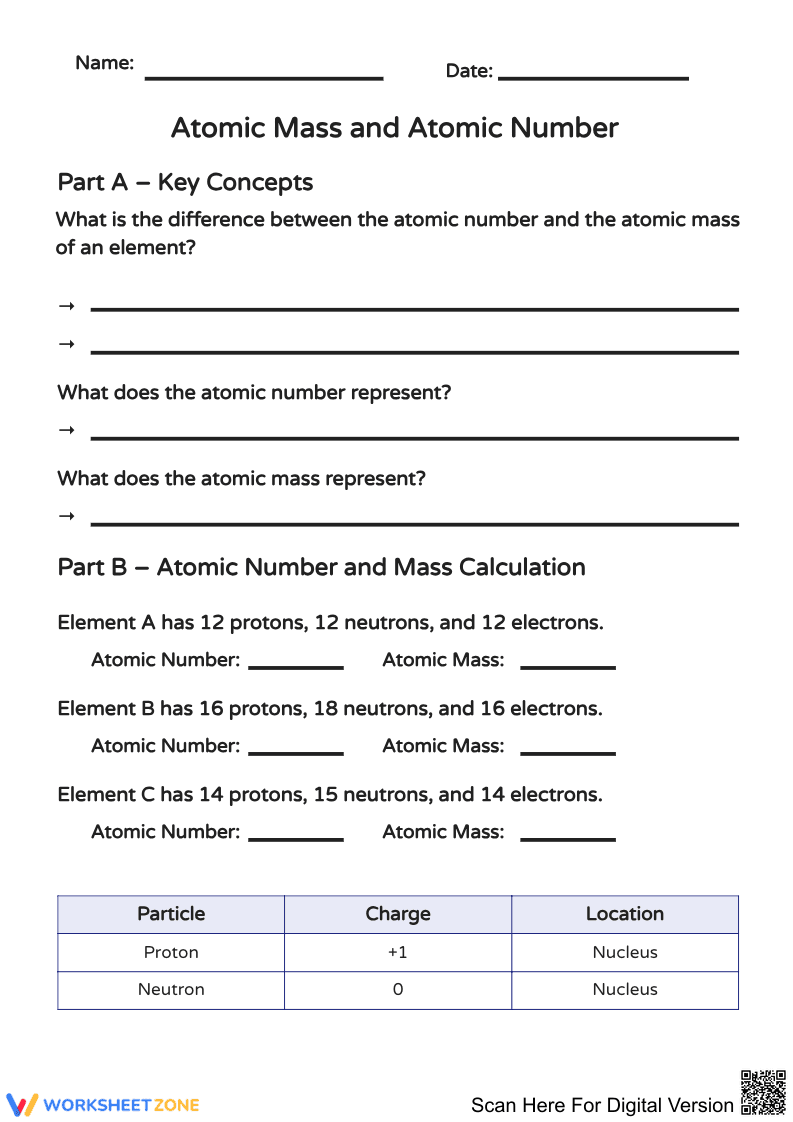
This worksheet explores the concept of atomic number and mass number through key concepts, calculation practice, and subatomic particle identification. Students learn how to distinguish between atomic number and atomic mass, while applying formulas to calculate the atomic mass of various elements.
Why Use It:
It reinforces students' understanding of atomic theory by linking fundamental atomic properties with practical exercises. The worksheet encourages problem-solving skills, ensuring students can accurately calculate atomic mass and number based on given information about subatomic particles.
How to Use It:
• Complete key concept questions to reinforce atomic structure terminology.
• Use the provided data to calculate atomic mass and atomic number for different elements.
• Review the particle table to help identify the roles and locations of protons and neutrons.
Grade Suitability:
Best suited for Grade 9–10.
• Ideal for introductory chemistry students.
• Can be used as part of a unit on atomic structure or as individual practice/homework.
Target Users:
Middle and early high school chemistry students, teachers, and tutors.
This worksheet explores the concept of atomic number and mass number through key concepts, calculation practice, and subatomic particle identification. Students learn how to distinguish between atomic number and atomic mass, while applying formulas to calculate the atomic mass of various elements.
Why Use It:
It reinforces students' understanding of atomic theory by linking fundamental atomic properties with practical exercises. The worksheet encourages problem-solving skills, ensuring students can accurately calculate atomic mass and number based on given information about subatomic particles.
How to Use It:
• Complete key concept questions to reinforce atomic structure terminology.
• Use the provided data to calculate atomic mass and atomic number for different elements.
• Review the particle table to help identify the roles and locations of protons and neutrons.
Grade Suitability:
Best suited for Grade 9–10.
• Ideal for introductory chemistry students.
• Can be used as part of a unit on atomic structure or as individual practice/homework.
Target Users:
Middle and early high school chemistry students, teachers, and tutors.


