


























Views
Plays

Essential ASVAB Woodworking Practice | Grades 8-12
Paste this activity's link or code into your existing LMS (Google Classroom, Canvas, Teams, Schoology, Moodle, etc.).
Students can open and work on the activity right away, with no student login required.
You'll still be able to track student progress and results from your teacher account.
This comprehensive ASVAB Woodworking practice worksheet provides students with targeted preparation for the Shop Information subtest. By focusing on tool identification and material processing techniques, learners build the technical literacy required for high-stakes vocational assessments. This resource ensures students can distinguish between specialized equipment while understanding fundamental shop safety and procedures.
At a Glance
- Grade: 8-12 · Subject: Vocational Skills
- Standard:
CCSS.ELA-LITERACY.RST.11-12.4— Determine the meaning of symbols, key terms, and other domain-specific words- Skill Focus: Woodworking tools and techniques
- Format: 1 page · 10 problems · Answer key included · PDF
- Best For: ASVAB Shop Information test preparation
- Time: 15–20 minutes
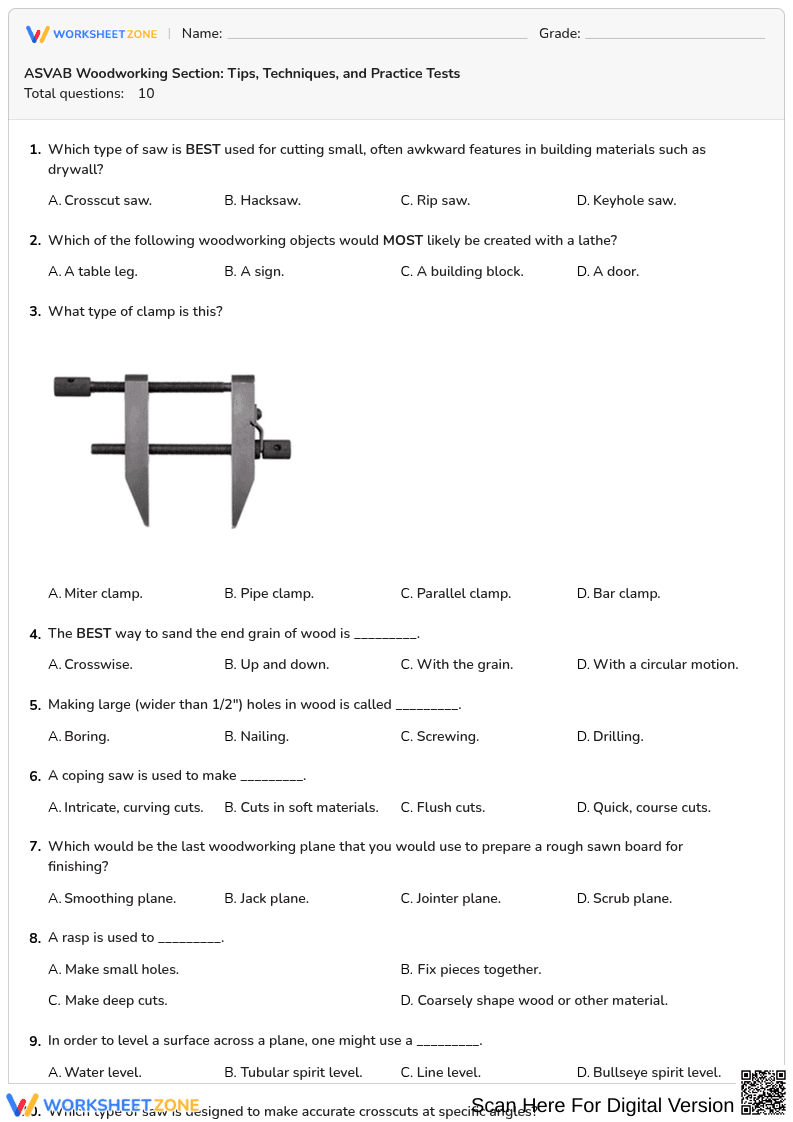
This single-page PDF features 10 high-quality multiple-choice questions modeled after the actual ASVAB Shop Information section. The worksheet includes a visual identification task for clamping tools, conceptual questions regarding wood grain sanding, and technical inquiries about machinery like lathes and planes. A complete answer key is provided to facilitate immediate feedback and self-correction for independent learners.
Skill Progression
- Guided practice: Initial questions focus on basic tool identification, such as selecting the correct saw for awkward features or identifying a specific clamp from a provided image.
- Supported practice: Middle-tier tasks require students to apply knowledge of woodworking processes, including the proper direction for sanding end grain and the terminology for boring large holes.
- Independent practice: The final set of questions challenges students to sequence finishing steps and select specialized planes for rough-sawn boards.
This gradual-release approach ensures students move from simple recognition to complex procedural understanding.
Standards Alignment
The primary standard addressed is `CCSS.ELA-LITERACY.RST.11-12.4`, which requires students to determine the meaning of domain-specific symbols and technical terms. By correctly identifying tools like rasps, planes, and lathes, students demonstrate mastery of technical vocabulary essential for vocational success. This standard code can be copied directly into lesson plans, IEP goals, or district curriculum mapping tools.
How to Use It
Assign this worksheet as a formative assessment after a direct instruction session on shop tools to gauge student retention. It also serves as an excellent bell-ringer or exit ticket for high school CTE courses. For ASVAB prep, use it as a timed diagnostic to identify specific knowledge gaps in the Shop Information domain. Expected completion time is 15 to 20 minutes.
Who It's For
This resource is designed for high school students in grades 8-12, particularly those enrolled in woodshop, industrial arts, or JROTC programs. It is highly effective for students preparing for military entrance exams or vocational certifications. Pair this worksheet with a physical tool demonstration or a technical manual on joinery for a multi-modal learning experience.
According to the RAND AIRS 2024 report on vocational readiness, targeted practice with domain-specific technical vocabulary significantly improves performance on standardized aptitude batteries like the ASVAB. This worksheet addresses the critical need for technical literacy by isolating woodworking concepts into manageable, high-frequency question sets. Research from Fisher & Frey (2014) emphasizes that visual-to-textual associations, such as identifying a clamp from an image, reinforce long-term memory retention in technical subjects. By engaging with these 10 structured problems, students develop the cognitive schema necessary to navigate complex shop environments and theoretical assessments. The inclusion of an answer key allows for the immediate feedback loop essential for adult and adolescent learners in self-paced study environments. This resource aligns with national standards for Career and Technical Education, providing a reliable bridge between classroom instruction and professional certification requirements.


