


























Views
Downloads
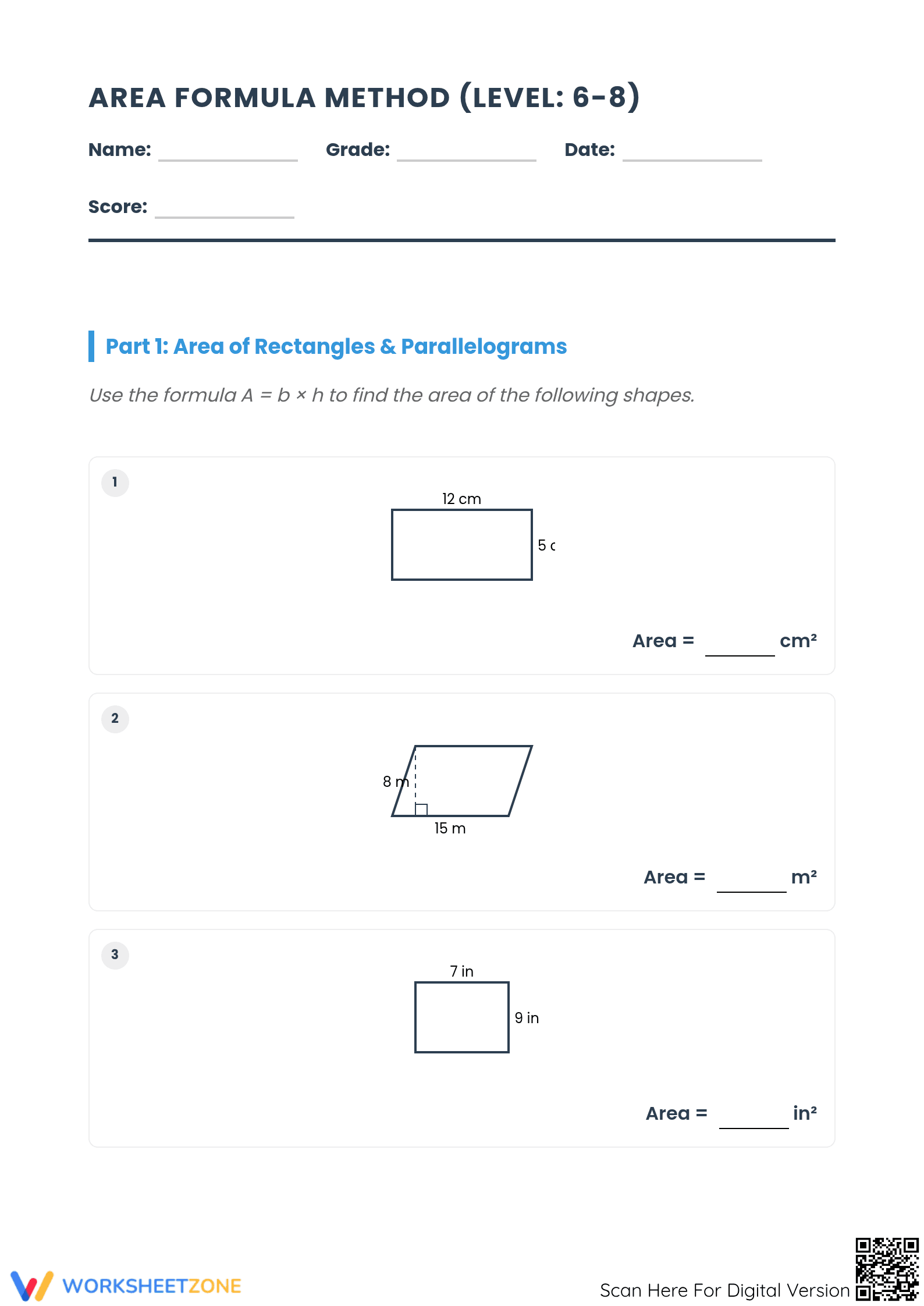



Essential Area Formula Worksheet | Grade 6-8 Aligned
Paste this activity's link or code into your existing LMS (Google Classroom, Canvas, Teams, Schoology, Moodle, etc.).
Students can open and work on the activity right away, with no student login required.
You'll still be able to track student progress and results from your teacher account.
Master the fundamental calculations of geometry with this comprehensive 5-page worksheet pack. Students apply specific area formulas to solve 19 varied problems involving rectangles, parallelograms, triangles, and trapezoids. This resource transitions students from simple shape recognition to independent formula application, ensuring they develop the procedural fluency required for middle school geometry standards.
At a Glance
- Grade: 6-8 · Subject: Math
- Standard:
CCSS.MATH.CONTENT.6.G.A.1— Find the area of triangles, special quadrilaterals, and polygons by decomposing or composing shapes.- Skill Focus: Area Formula Application
- Format: 5 pages · 19 problems · Answer key included · PDF
- Best For: Independent practice and sub plans
- Time: 40–50 minutes
What's Inside
This extensive PDF includes four distinct sections: area of rectangles and parallelograms, area of triangles, area of trapezoids, and a final mixed practice review. Each instructional segment provides the relevant formula right at the top, minimizing teacher intervention. The 19 problems feature diverse units like centimeters, meters, and feet, preparing students for real-world measurement tasks.
Zero-Prep Workflow
Teachers can implement this resource in under 2 minutes following three simple steps. First, print the 5-page packet (30 seconds). Second, distribute to students with a brief reminder to check the formula headers for guidance (1 minute). Finally, use the included answer key for rapid grading or student self-correction (30 seconds). The self-contained nature of the formulas makes this an ideal candidate for emergency substitute folders.
Standards Alignment
Aligned to `CCSS.MATH.CONTENT.6.G.A.1`, this worksheet requires students to find the area of right triangles, other triangles, special quadrilaterals, and polygons by composing into rectangles or decomposing into triangles and other shapes. It additionally supports `CCSS.MATH.CONTENT.7.G.B.6` by focusing on area calculations for varied polygons. Both standard codes can be copied directly into lesson plans, IEP goals, or district curriculum mapping tools.
How to Use It
Use this packet as a cumulative review after teaching individual area formulas. During direct instruction, model one problem from each section, then allow students to work through the mixed practice independently. For formative assessment, observe students during Part 4 to see if they can correctly identify which formula to apply without headers. Completion typically takes 40-50 minutes.
Who It's For
This resource is designed for Grade 6, 7, and 8 students who are mastering geometric measurements. It is particularly useful for learners who benefit from having formulas visible while they work. Pair this worksheet with a coordinate plane activity or a geometry anchor chart to reinforce the connection between spatial reasoning and algebraic calculation.
The transition from scaffolds to independent calculation is a cornerstone of the gradual release of responsibility model, essential for mathematical procedural fluency. According to research from EdReports 2024, high-quality instructional materials must provide students with ample opportunities to apply the `CCSS.MATH.CONTENT.6.G.A.1` standard in varied contexts without over-relying on visual grids. By providing the area formula method without grids, this worksheet forces students to focus on the relationship between base, height, and area. This method ensures that middle schoolers move beyond counting squares and toward the abstract thinking required for higher-level geometry. The inclusion of 19 diverse tasks allows for the repetition needed to move these formulas from short-term memory to long-term mastery. This instructional design supports the NAEP framework for geometric reasoning and measurement proficiency by emphasizing the application of mathematical properties over simple rote memorization of shapes.


