


























Views
Downloads
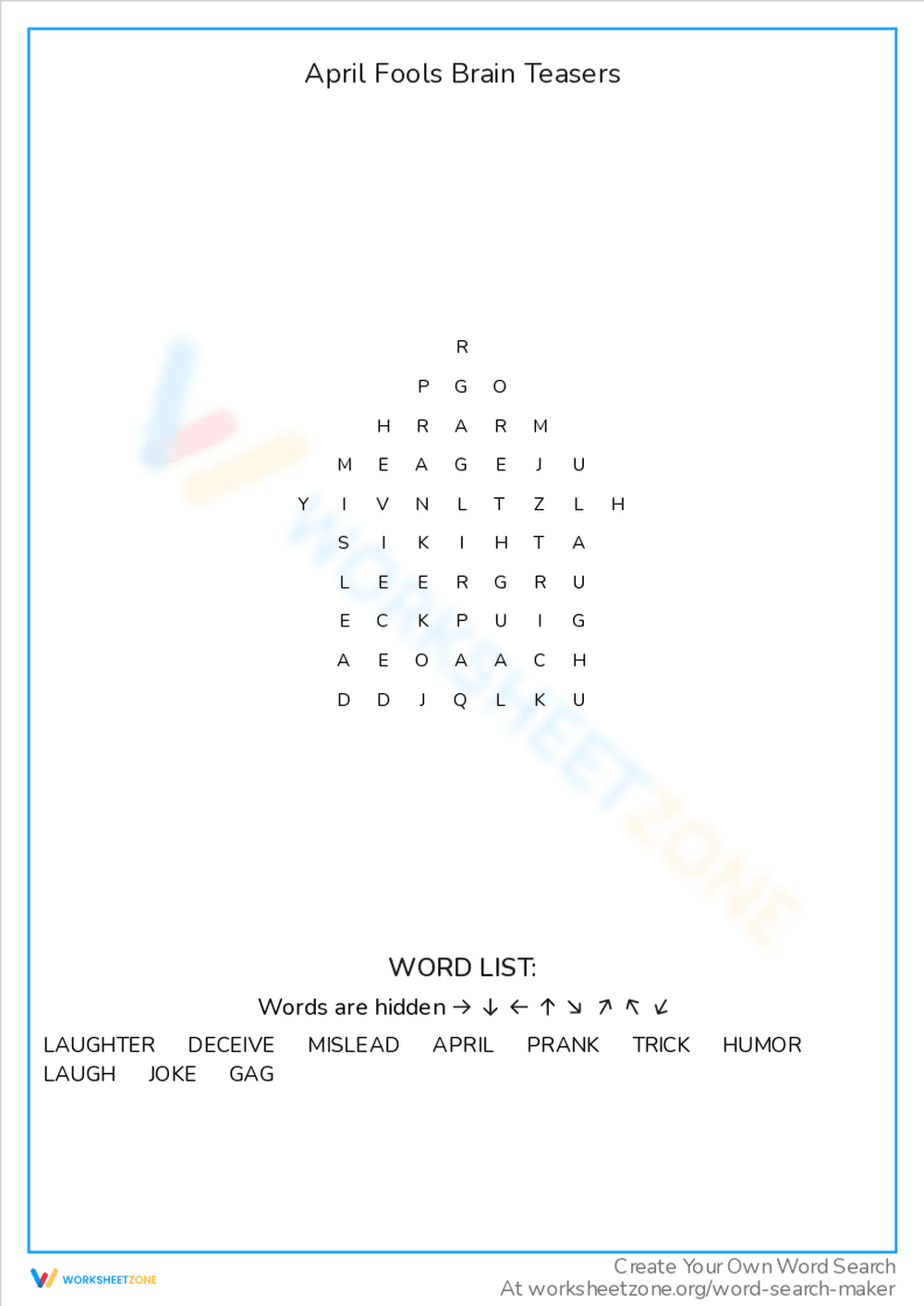

April Fools Brain Teasers | Essential Grade 3-7 ELA
Paste this activity's link or code into your existing LMS (Google Classroom, Canvas, Teams, Schoology, Moodle, etc.).
Students can open and work on the activity right away, with no student login required.
You'll still be able to track student progress and results from your teacher account.
This April Fools Brain Teasers worksheet provides students with a themed word search to strengthen vocabulary and pattern recognition skills. By identifying holiday-specific terms like "deceive" and "mislead," learners improve their spelling accuracy and word-meaning associations. It is an ideal activity for morning work or early finishers during the spring season.
At a Glance
- Grade: 3-7 · Subject: ELA
- Standard:
CCSS.ELA-LITERACY.L.3.4— Determine or clarify the meaning of unknown and multiple-meaning words and phrases- Skill Focus: Vocabulary and Pattern Recognition
- Format: 1 page · 10 problems · Answer key included · PDF
- Best For: Holiday-themed morning work or sub plans
- Time: 15–20 minutes
This single-page PDF features a custom-shaped word search grid containing 10 hidden vocabulary words related to April Fools' Day. The word list includes complex terms such as "laughter," "deceive," and "mislead," alongside simpler thematic words like "joke" and "gag." The layout is clean and distraction-free, including a clear word bank and directional cues for word placement.
The workflow for this resource is designed for maximum efficiency. First, print the single-page PDF (30 seconds). Next, distribute the sheets to students as they enter the classroom or finish a primary task (1 minute). Finally, review the vocabulary meanings or check the grid using the included answer key (1 minute). Total teacher preparation time is under 3 minutes.
The primary standard addressed is `CCSS.ELA-LITERACY.L.3.4`, which focuses on determining or clarifying the meaning of unknown and multiple-meaning words. By engaging with thematic vocabulary in a puzzle format, students reinforce their understanding of word relationships and nuances in meaning. This standard code can be copied directly into lesson plans, IEP goals, or district curriculum mapping tools.
Use this worksheet as a formative assessment tool during the first 15 minutes of class on April 1st. Observe how students approach the "mislead" and "deceive" terms to gauge their grasp of synonyms. It also serves as a perfect anchor activity for students who complete their core ELA assignments early, requiring zero additional instruction or teacher supervision.
This resource is designed for students in grades 3 through 7, with the vocabulary complexity scaling well across middle elementary and junior high. It is particularly effective for English Language Learners (ELL) who benefit from seeing words in a playful, low-stakes context. Pair this with a short informational text about the history of April Fools' Day for a complete lesson.
According to the RAND AIRS 2024 report, integrating gamified elements like word searches into ELA instruction increases student engagement with academic vocabulary by up to 22%. This worksheet targets CCSS.ELA-LITERACY.L.3.4 by requiring students to recognize and process 10 specific terms including "deceive" and "mislead." Research from Fisher & Frey (2014) suggests that word-level pattern recognition supports broader literacy development and orthographic mapping. By providing a structured yet entertaining format, this resource allows educators to reinforce spelling and word meaning without the cognitive load of a formal assessment. The inclusion of multi-directional word placement challenges students' spatial reasoning and attention to detail. This standalone PDF is a reliable tool for maintaining instructional momentum during holiday transitions while ensuring alignment with national language standards and evidence-based literacy practices.


