


























Views
Plays
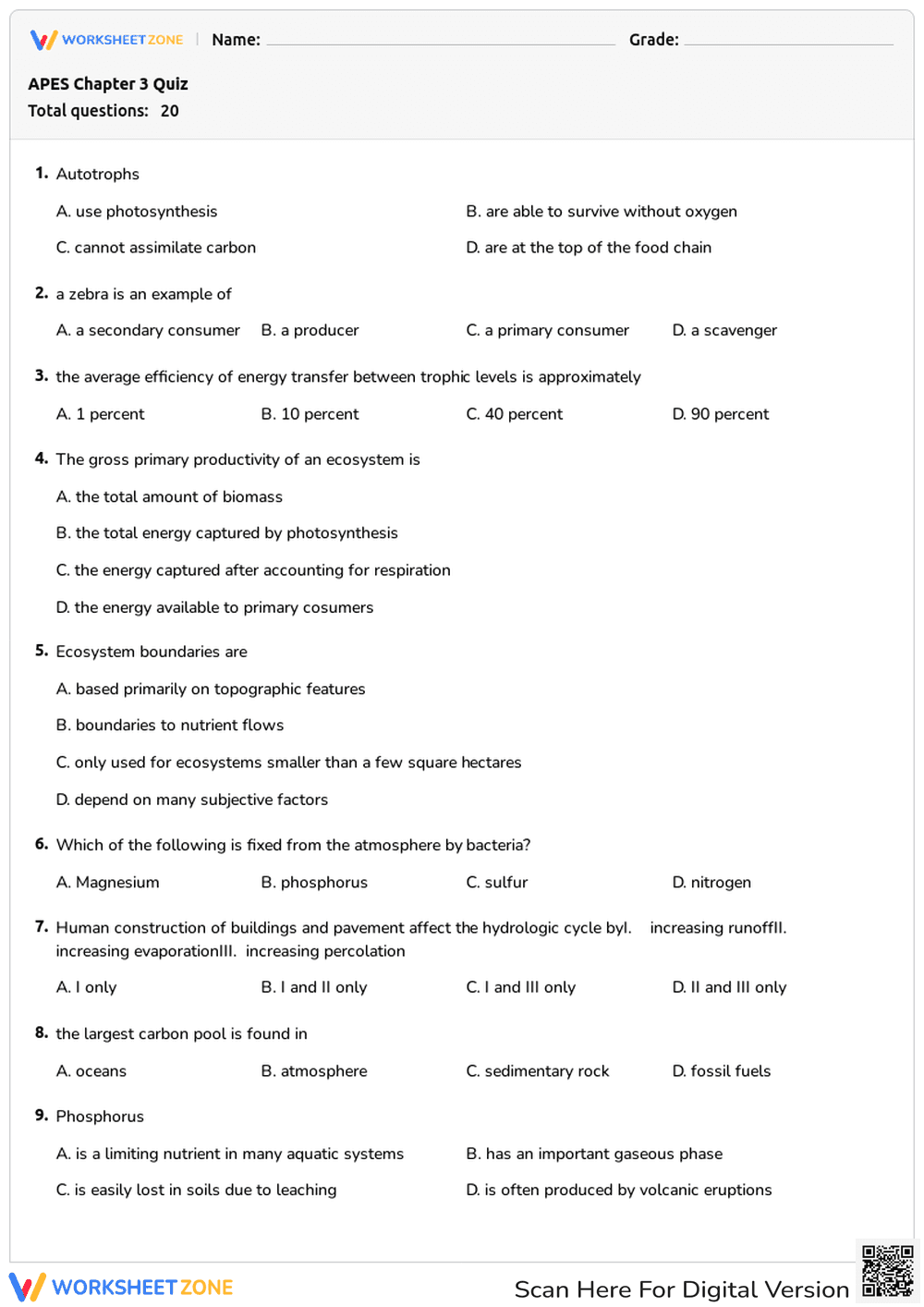


APES Chapter 3 Quiz: Ecosystem Ecology — Essential Guide
Paste this activity's link or code into your existing LMS (Google Classroom, Canvas, Teams, Schoology, Moodle, etc.).
Students can open and work on the activity right away, with no student login required.
You'll still be able to track student progress and results from your teacher account.
This AP Environmental Science (APES) Chapter 3 assessment provides a comprehensive evaluation of student understanding regarding ecosystem ecology and energy dynamics. By focusing on the intricate relationships between autotrophs, consumers, and their physical environment, this resource ensures students can articulate how energy flows and matter cycles through various trophic levels.
At a Glance
- Grade: High School · Subject: Environmental Science
- Standard:
HS-LS2-4— Use mathematical representations to support claims for the cycling of matter and flow of energy- Skill Focus: Ecosystem Ecology
- Format: 2 pages · 20 problems · Answer key included · PDF
- Best For: Unit assessment or AP exam review
- Time: 25–35 minutes
This two-page assessment features 20 rigorous multiple-choice questions designed to mirror the complexity of the AP exam. The content covers primary productivity, the 10 percent rule of energy transfer, biogeochemical cycles (nitrogen, carbon, phosphorus, sulfur), and ecosystem resilience. A complete answer key is provided to facilitate rapid grading and immediate student feedback.
Mastery Evidence
Each of the 20 tasks is strategically mapped to specific sub-skills within the HS-LS2-4 framework. Questions 1-4 evaluate foundational knowledge of energy capture, while questions 6-11 assess the mastery of matter cycling. The final section focuses on disturbance and resilience, allowing teachers to categorize student performance into Approaching, Meeting, or Exceeding mastery levels. These scores can be directly integrated into gradebooks or used to inform IEP progress monitoring for science literacy goals.
Standards Alignment
The primary focus is `HS-LS2-4`, which requires students to use mathematical representations to support claims for the cycling of matter and flow of energy among organisms in an ecosystem. Additionally, the quiz supports `HS-LS2-3` by examining the aerobic and anaerobic cycling of carbon. Both standard codes can be copied directly into lesson plans, IEP goals, or district curriculum mapping tools.
How to Use It
This worksheet is best utilized as a summative chapter quiz after completing direct instruction on ecosystem ecology. Alternatively, assign it as a high-stakes review before the AP Environmental Science exam to identify specific gaps in biogeochemical cycle knowledge. Teachers should observe student performance on the energy transfer calculations to gauge quantitative reasoning skills. Expected completion time is 30 minutes.
Who It's For
This resource is tailored for High School students enrolled in AP Environmental Science or honors-level biology courses. It serves as an excellent pairing for textbook chapters focused on the biosphere and can be used alongside anchor charts detailing the nitrogen and carbon cycles for scaffolded support.
This assessment is meticulously aligned with the HS-LS2-4 standard, focusing on the quantitative and qualitative aspects of energy flow and matter cycling within terrestrial and aquatic ecosystems. By evaluating student comprehension of trophic efficiency and biogeochemical pathways, the quiz addresses the core disciplinary ideas essential for environmental literacy. According to EdReports 2024, high-quality science assessments must move beyond rote memorization to require the application of conceptual models, a requirement satisfied by the inclusion of disturbance theory and productivity metrics in this 20-question set. The resource provides the necessary evidence for educators to track student progress toward mastery of complex ecological interactions. This standalone summary confirms that the worksheet meets the rigorous demands of modern science curricula while providing a reliable metric for student achievement in advanced placement settings. The inclusion of specific geochemical cycles ensures a holistic view of ecosystem function.


