


























Views
Downloads
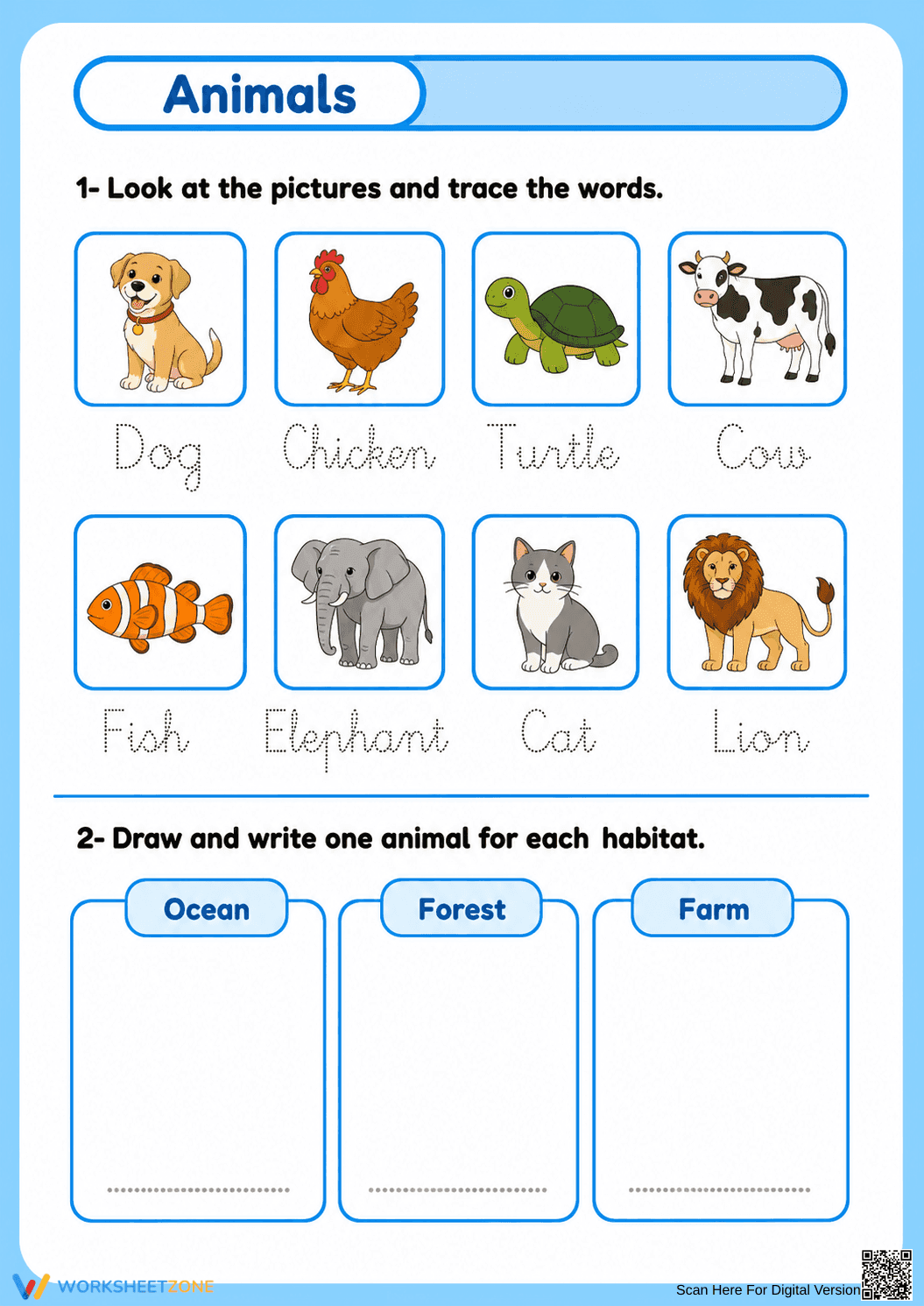

Animal Habitats Printable Worksheet | Grade 1 Science
Paste this activity's link or code into your existing LMS (Google Classroom, Canvas, Teams, Schoology, Moodle, etc.).
Students can open and work on the activity right away, with no student login required.
You'll still be able to track student progress and results from your teacher account.
This foundational science worksheet helps young learners connect familiar animals to their natural environments while practicing essential handwriting skills. Students trace animal vocabulary words and then apply their knowledge by drawing and labeling creatures that belong in specific habitats, reinforcing both early literacy and life science concepts.
At a Glance
- Grade: 1 · Subject: Science
- Standard:
K-ESS3-1— Represent relationships between animals and where they live- Skill Focus: Animal Habitats and Tracing
- Format: 1 page · 11 problems · No answer key · PDF
- Best For: Independent practice or centers
- Time: 15–20 minutes
This single-page resource features two activity sections. The top half includes eight guided tracing tasks where students practice writing names of common animals alongside colorful illustrations. The bottom half provides three open-ended drawing boxes where students independently recall and illustrate one animal that lives in an ocean, a forest, and on a farm, including a line to label their drawing.
This zero-prep activity follows a simple workflow:
- Print (1 minute): Generate copies of this single-page PDF for your class.
- Distribute (1 minute): Hand out the worksheets with pencils and crayons.
- Review (3 minutes): Read instructions aloud, ensuring students understand they must trace first, then draw and label animals.
With under two minutes of prep time, this is excellent for sub plans.
This activity aligns with K-ESS3-1: Use a model to represent the relationship between the needs of different plants or animals and the places they live. By asking students to categorize animals into ocean, forest, and farm habitats, it builds foundational knowledge of environmental suitability. Both standard codes can be copied directly into lesson plans, IEP goals, or district curriculum mapping tools.
This worksheet serves as excellent independent practice following a whole-group lesson on animal homes. Assign it during science centers so students can work at their own pace. As a formative assessment tip, observe which animals students draw for the forest and ocean habitats; this reveals their grasp of specific environmental traits. Expect students to complete the tasks within 15 to 20 minutes.
This resource is ideal for Kindergarten and first-grade students developing their understanding of basic life science and improving their handwriting. The visual supports make it highly accessible for English Language Learners (ELLs) who are building foundational vocabulary. It pairs perfectly with a read-aloud book about animal homes or a classroom anchor chart displaying different global habitats.
Integrating cross-curricular skills like handwriting and life science significantly boosts early childhood cognitive development. This worksheet aligns with the K-ESS3-1 standard, requiring students to represent relationships between animals and where they live. According to a 2024 report by EdReports, instructional materials that blend foundational literacy tasks—such as tracing and labeling—with core science concepts improve overall retention and engagement in primary grades. By combining fine motor practice with habitat categorization, educators can maximize instructional minutes without sacrificing content depth. This dual-purpose approach ensures that young learners not only memorize vocabulary but also understand the contextual environments necessary for animal survival, laying the groundwork for more advanced biological studies in later elementary years. When students actively draw and label their own examples of habitat-specific creatures, they demonstrate a deeper, internalized comprehension of the scientific principles at play.


