


























Views
Downloads

Animals That Help Us Worksheet | Grade 3 Printable
Paste this activity's link or code into your existing LMS (Google Classroom, Canvas, Teams, Schoology, Moodle, etc.).
Students can open and work on the activity right away, with no student login required.
You'll still be able to track student progress and results from your teacher account.
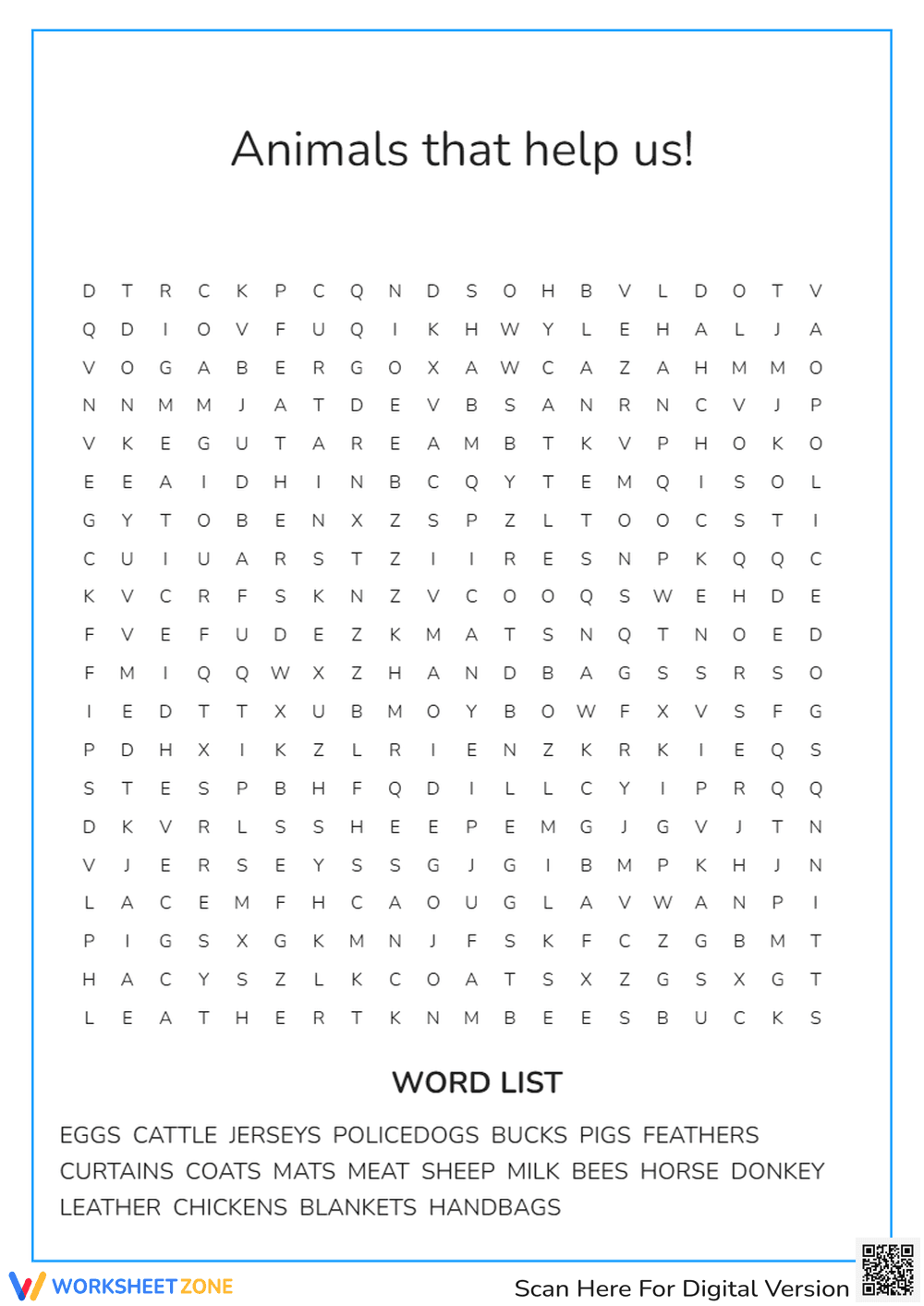
This Grade 3 vocabulary worksheet helps students identify the various ways animals contribute to human life through a structured word search. By finding 20 domain-specific terms, learners connect animals like sheep and bees to products like wool and honey. It provides an engaging way to reinforce life science and language arts concepts simultaneously.
At a Glance
- Grade: 3 · Subject: ELA / Science
- Standard:
CCSS.ELA-LITERACY.L.3.6— Acquire and use accurately grade-appropriate conversational and domain-specific words and phrases- Skill Focus: Vocabulary & Animal Contributions
- Format: 1 page · 20 problems · Answer key included · PDF
- Best For: Morning work or early finishers
- Time: 15–20 minutes
The worksheet features a dense 20x20 letter grid containing 20 hidden words related to animals and their uses. The word list includes specific animals (cattle, sheep, bees), products (milk, leather, feathers), and roles (policedogs). This single-page PDF is designed for high legibility and includes a clear word bank at the bottom to support student tracking and spelling accuracy.
This resource is designed for immediate classroom implementation with a total teacher prep time of under 2 minutes. Simply print the single-page PDF (30 seconds), distribute to students as they enter the room or finish a primary task (30 seconds), and review the vocabulary terms as a whole group once completed (1 minute). It serves as an ideal sub plan or quiet-time activity that requires no prior setup.
The primary focus is `CCSS.ELA-LITERACY.L.3.6`, which requires students to acquire and use accurately grade-appropriate conversational, general academic, and domain-specific words and phrases. By identifying terms like "jerseys" and "handbags" in the context of animal resources, students build essential background knowledge. This standard code can be copied directly into lesson plans, IEP goals, or district curriculum mapping tools.
Use this worksheet during a Life Science unit on ecosystems or as a supplemental ELA activity for vocabulary building. It is best assigned after direct instruction regarding how humans utilize natural resources. Teachers can use the completed grid as a formative assessment by observing which students struggle with word recognition or spatial orientation. Expected completion time is 15 to 20 minutes for most third graders.
This activity is tailored for third-grade students but is also appropriate for second-grade enrichment or fourth-grade review. It is particularly helpful for English Language Learners (ELLs) to visualize the connection between animals and common household items. Pair this with an anchor chart showing animal-to-product relationships for maximum instructional impact during your science or literacy block.
According to the RAND AIRS 2024 report, structured vocabulary activities like word searches significantly improve word recognition and retention in elementary learners when paired with domain-specific content. This worksheet targets CCSS.ELA-LITERACY.L.3.6 by challenging students to locate 20 specific terms related to animal contributions, such as "cattle," "leather," and "bees." Research from Fisher & Frey (2014) suggests that these types of low-stakes retrieval practices help solidify the instructional model by providing a bridge between teacher-led lessons and independent mastery. By engaging with this printable PDF, Grade 3 students develop the cognitive stamina required for more complex reading tasks while reinforcing their understanding of the natural world. The inclusion of an answer key ensures that educators can provide immediate feedback, a critical component of effective formative assessment in early childhood education.


