


























Views
Downloads
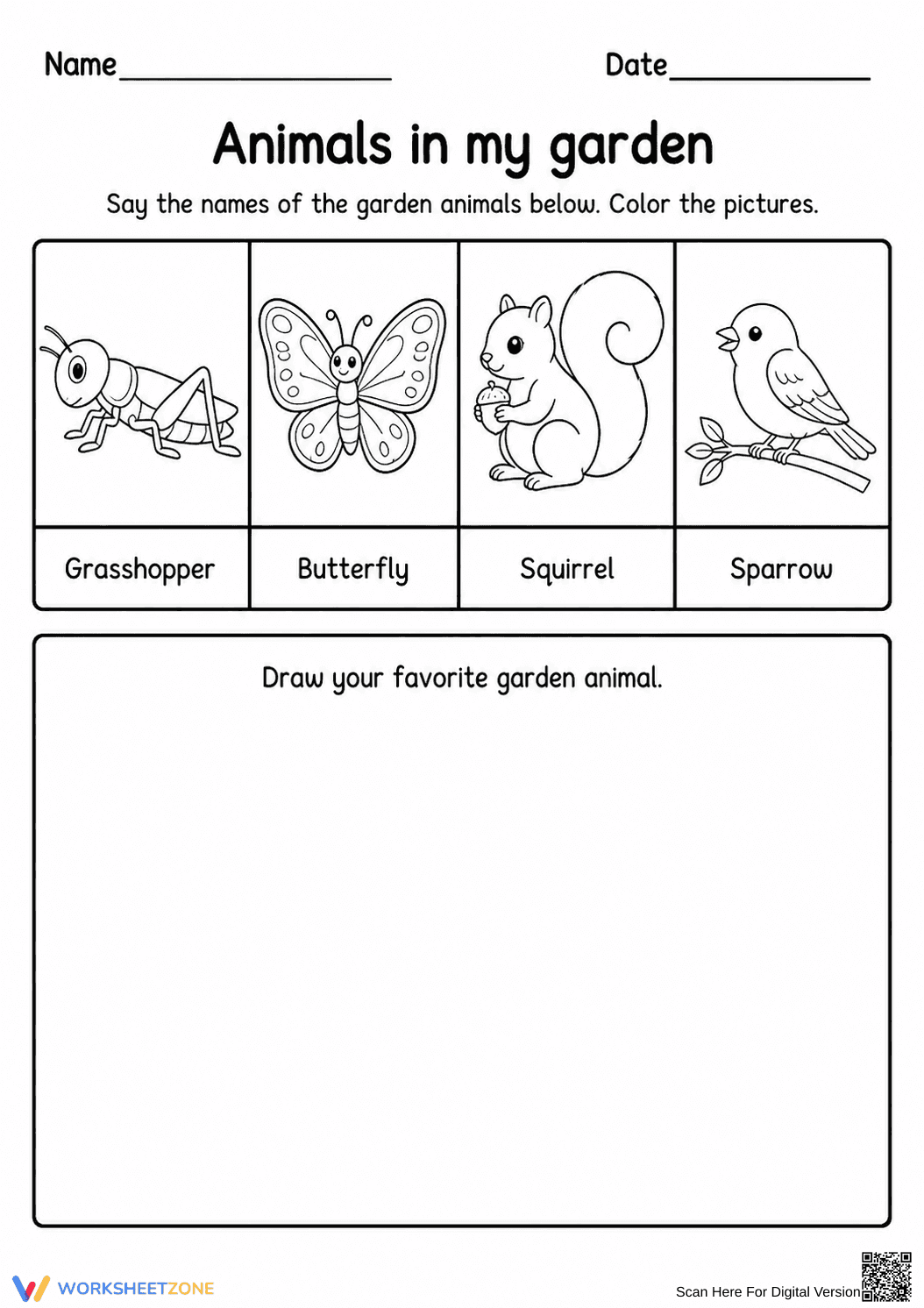

Grade K-1 Garden Animals — Printable No-Prep Worksheet
Paste this activity's link or code into your existing LMS (Google Classroom, Canvas, Teams, Schoology, Moodle, etc.).
Students can open and work on the activity right away, with no student login required.
You'll still be able to track student progress and results from your teacher account.
This Animals in My Garden worksheet helps young learners identify common backyard creatures while developing fine motor skills through coloring and drawing. Students observe distinct features of insects, mammals, and birds to build foundational biological awareness and scientific vocabulary. This activity is perfect for introducing basic ecology and the diversity of living things in local environments.
At a Glance
- Grade: K–1 · Subject: Science
- Standard:
K-LS1-1— Describe patterns of what plants and animals need to survive- Skill Focus: Garden animal identification
- Format: 1 page · 3 tasks · Answer key included · PDF
- Best For: Early finishers or science center activity
- Time: 10–15 minutes
What's Inside
This single-page PDF contains three distinct activities designed for preschoolers through first graders. It features high-quality line art of four specific animals: a grasshopper, butterfly, squirrel, and sparrow. Below the identification section, a dedicated drawing space allows students to synthesize their learning by illustrating their favorite garden inhabitant, fostering both creative and scientific observation.
Zero-Prep Workflow
The zero-prep workflow for this worksheet is designed for maximum efficiency. Step 1: Print the single-page document (30 seconds). Step 2: Distribute to the class with crayons or pencils (30 seconds). Step 3: Review the animal names and drawing prompts verbally (1 minute). Total teacher preparation time is under 2 minutes. This straightforward structure makes the lesson perfectly suitable for emergency sub plans or last-minute science center transitions.
Standards Alignment
Aligned to K-LS1-1, this worksheet encourages students to use observations to describe patterns of living things. By naming and illustrating animals, students begin to categorize organisms based on observable traits, a prerequisite for understanding biodiversity and habitats. Both standard codes can be copied directly into lesson plans, IEP goals, or district curriculum mapping tools.
How to Use It
Use this worksheet during the "elaborate" phase of a 5E lesson on living things to reinforce animal names and characteristics. Teachers should observe if students can distinguish between the insects (butterfly/grasshopper) and vertebrates (squirrel/sparrow) during the coloring phase. Expect most students to complete the identification and coloring in 10 minutes, with an additional 5 minutes for the drawing task.
Who It's For
This resource is tailored for early childhood educators, homeschool parents, and kindergarten teachers looking for accessible science materials. It provides natural scaffolding for ESL/ELL students through clear visual-word pairings. This worksheet pairs exceptionally well with a nature walk or a read-aloud about backyard habitats to provide real-world context for the featured species.
Science education in early childhood significantly benefits from visual-word associations and creative expression, as highlighted in RAND AIRS 2024. This worksheet targets the K-LS1-1 standard by requiring students to identify and represent garden animals, which reinforces the plain-English skill of observing and describing living organisms within their immediate environment. Research from Fisher & Frey (2014) emphasizes that integrated tasks—combining vocabulary, motor skills, and creative drawing—lead to higher retention of scientific concepts in Grade K-1 learners. By focusing on four distinct animal types, the resource provides a manageable cognitive load for young students while building the necessary observational foundations for more complex life science units. This structured approach ensures that students move from simple recognition to personal application through the drawing task, meeting the rigorous demands of modern science frameworks.


