


























Views
Downloads
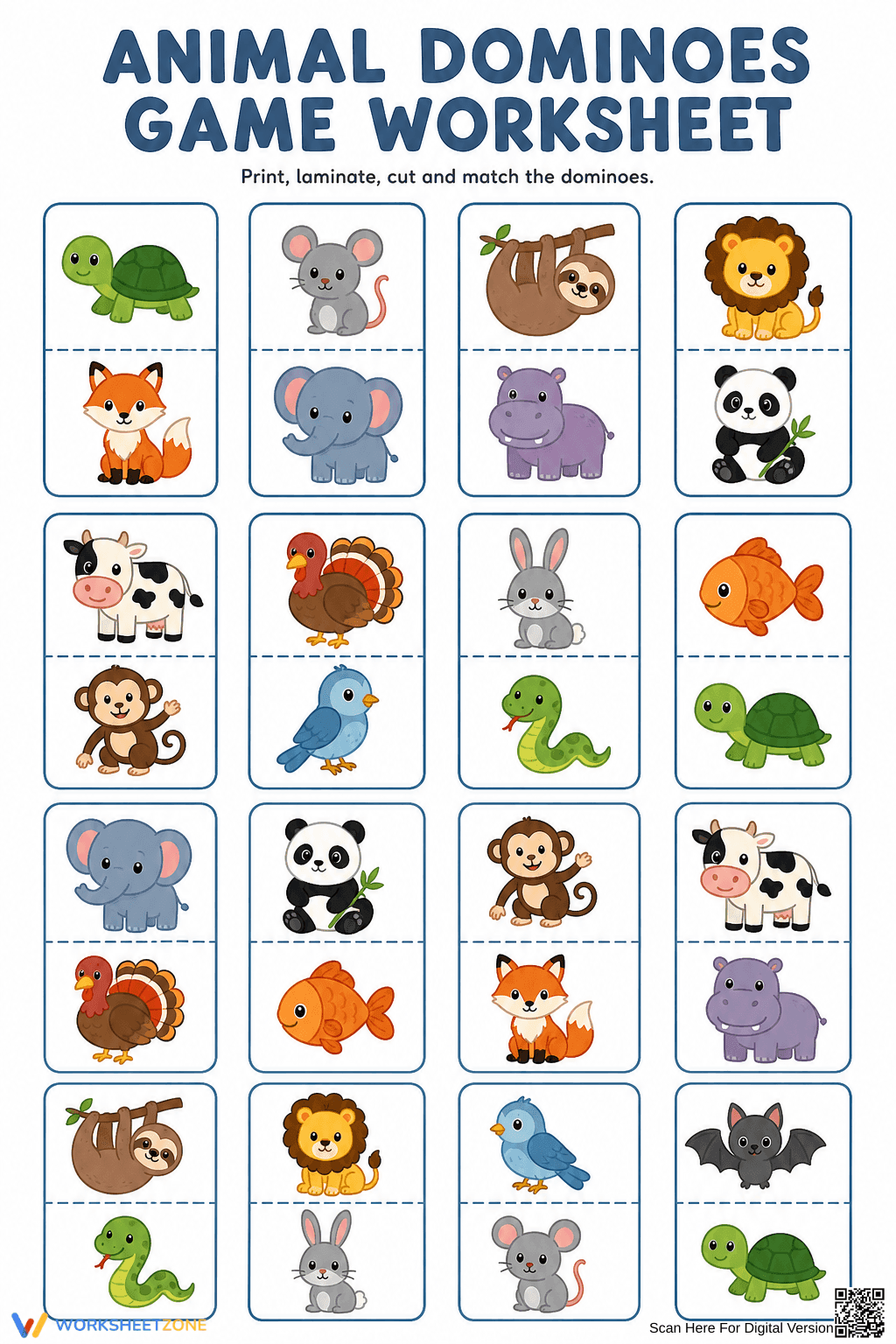

Printable Animal Dominoes Game | Grade K Science
Paste this activity's link or code into your existing LMS (Google Classroom, Canvas, Teams, Schoology, Moodle, etc.).
Students can open and work on the activity right away, with no student login required.
You'll still be able to track student progress and results from your teacher account.
This engaging animal dominoes game helps early learners build essential visual discrimination and matching skills. By connecting familiar animal illustrations, students practice recognizing patterns and categorizing living things. This hands-on activity transforms basic vocabulary practice into an interactive learning experience that keeps young minds focused and entertained.
At a Glance
- Grade: Kindergarten · Subject: Science
- Standard:
CCSS.ELA-LITERACY.L.K.5.A— Sort common objects into categories- Skill Focus: Visual matching and animal recognition
- Format: 1 page · 16 pieces · No answer key · PDF
- Best For: Science centers and morning work
- Time: 15–20 minutes
This printable resource features a single-page grid containing 16 distinct domino pieces. Each domino is divided into two halves, displaying colorful, high-quality cartoon images of various animals, including turtles, elephants, sloths, pandas, and foxes. The straightforward layout makes it easy for educators or parents to prepare the materials quickly. Because it functions as a self-correcting matching game, a traditional answer key is not required.
- Guided practice: Introduce the activity by modeling how to match one animal half to its identical counterpart, discussing the animal's name and features.
- Supported practice: Allow students to work in pairs to connect 4 to 6 dominoes, providing assistance as they navigate the visual differences between similar animals.
- Independent practice: Students independently complete the full 16-piece domino chain, demonstrating mastery of visual discrimination.
This gradual-release approach ensures students confidently transition from guided instruction to independent play.
This activity aligns with CCSS.ELA-LITERACY.L.K.5.A: "Sort common objects into categories to gain a sense of the concepts the categories represent." By matching and grouping the animal images, students develop foundational categorization skills essential for both literacy and early science. Both standard codes can be copied directly into lesson plans, IEP goals, or district curriculum mapping tools.
This versatile game is perfect for independent science centers or small-group literacy rotations. Before direct instruction on animal habitats, use these dominoes as a warm-up activity to activate prior knowledge about different species. As a formative assessment, observe how quickly students can identify and match the animals; hesitation may indicate a need for further vocabulary review. Expected completion time ranges from 15 to 20 minutes depending on the child's age and familiarity with the animals.
This resource is designed primarily for Kindergarten students, preschool learners, and homeschooling families. It serves as an excellent differentiation tool for English Language Learners (ELLs) who benefit from visual vocabulary building without the pressure of text-heavy assignments. Pair this game with a read-aloud book about zoo or farm animals to reinforce the visual concepts with auditory learning.
Integrating hands-on manipulatives like this domino game is a proven strategy for early childhood cognitive development. According to Fisher & Frey (2014), interactive and play-based learning tasks significantly improve student retention of foundational vocabulary and visual discrimination skills. By aligning with CCSS.ELA-LITERACY.L.K.5.A, which requires students to sort common objects into categories, this activity provides a structured yet engaging way to build essential academic schemas. When young learners physically manipulate the 16 domino pieces to match the animal illustrations, they are actively participating in the learning process rather than passively receiving information. This tactile engagement strengthens neural pathways associated with memory and pattern recognition. Educators can confidently utilize this resource knowing it bridges the gap between play and rigorous academic standards, fostering both joy and measurable skill acquisition in the early childhood classroom.


