




























Views
Downloads
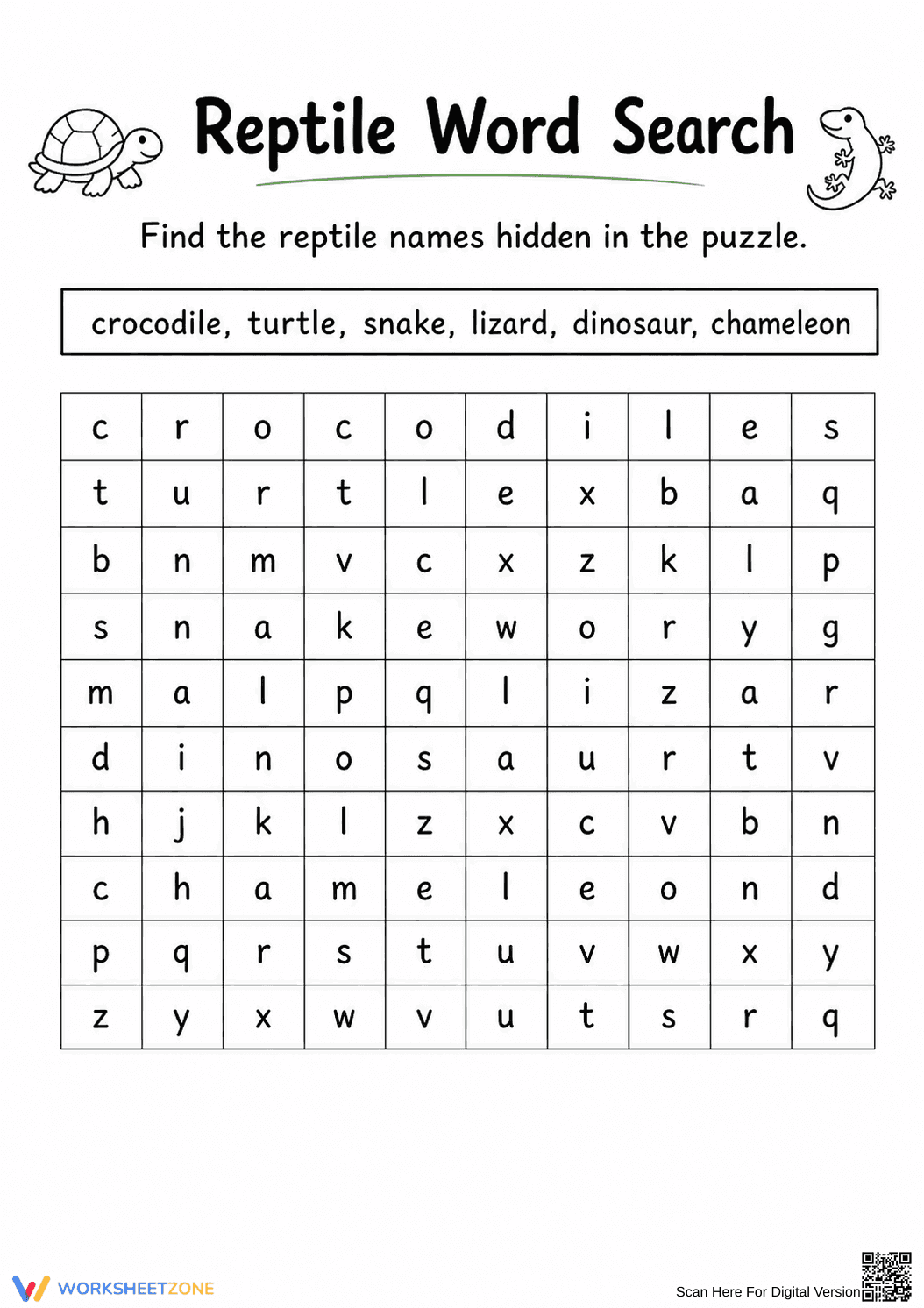

Grade 1 Reptile Word Search — Printable No-Prep Worksheet

Paste this activity's link or code into your existing LMS (Google Classroom, Canvas, Teams, Schoology, Moodle, etc.).
Students can open and work on the activity right away, with no student login required.
You'll still be able to track student progress and results from your teacher account.
This Grade 1 science worksheet provides immediate, engaging practice with reptile vocabulary through a classic word search format. Students reinforce their spelling and word recognition skills while identifying six specific reptiles, including crocodiles, turtles, and chameleons, building foundational life science terminology. This resource ensures students master domain-specific language while developing visual scanning abilities.
At a Glance
- Grade: 1 · Subject: Science
- Standard:
1-LS1-1— Recognize and process specific animal group vocabulary- Skill Focus: Reptile vocabulary and word recognition
- Format: 1 page · 6 problems · Answer key included · PDF
- Best For: Independent practice or morning work
- Time: 10–15 minutes
What's Inside
Inside this straightforward resource, educators will find a single-page word search puzzle focused entirely on reptile classification. The activity features a clear, easy-to-read word bank containing six target words: crocodile, turtle, snake, lizard, dinosaur, and chameleon. A complete answer key is provided to ensure rapid grading and easy peer review, making the entire package highly efficient for busy classrooms.
Zero-Prep Workflow
This resource is designed for a completely zero-prep workflow. First, print the PDF (under 1 minute). Next, distribute the puzzle to students during transitions or morning routines (1 minute). Finally, review the found words using the included answer key (3 minutes). Total teacher preparation requires less than two minutes, making this an ideal, self-explanatory activity for emergency sub plans or unexpected schedule changes.
Standards Alignment
This activity aligns with 1-LS1-1 by helping students identify specific animals within biological classifications, reinforcing the vocabulary needed to discuss animal traits and survival mechanisms. It also supports foundational reading skills by requiring students to scan and decode domain-specific words. Both standard codes can be copied directly into lesson plans, IEP goals, or district curriculum mapping tools.
How to Use It
Deploy this word search as a calming morning work assignment to settle students while introducing a new life science unit on animal groups. Alternatively, use it as a fast-finisher activity during a broader lesson on reptiles and amphibians. While students work, teachers can conduct quick formative assessments by observing how easily learners decode and locate complex words like "chameleon" versus simpler words like "snake." Expect students to complete the puzzle within 10 to 15 minutes.
Who It's For
This worksheet is primarily designed for first-grade students developing their science vocabulary and visual scanning abilities. It serves as an excellent tool for visual learners who benefit from letter-pattern recognition. For differentiation, teachers can pair this puzzle with a visual anchor chart displaying pictures of each reptile, providing extra support for English Language Learners or struggling readers.
Integrating domain-specific vocabulary activities like this reptile word search is crucial for early science literacy. Aligned with 1-LS1-1, this resource helps students recognize and process specific animal group vocabulary. According to a recent ScienceDirect TpT Analysis, incorporating structured word puzzles into elementary science curricula significantly improves long-term retention of specialized terminology. When young learners actively search for and identify words like "dinosaur" and "lizard," they strengthen both their orthographic mapping skills and their conceptual understanding of biological classifications. This dual-benefit approach ensures that foundational science lessons are both engaging and academically rigorous. By providing targeted, low-stakes practice, educators can effectively build the background knowledge required for more complex scientific inquiry in later grades, establishing a strong framework for future academic success in the life sciences. This specific worksheet provides the necessary scaffolding for Grade 1 students to master complex biological terms through visual pattern recognition and active engagement.


