


























Views
Downloads

Printable Animal Classification Worksheet | Grade 1 Science
Paste this activity's link or code into your existing LMS (Google Classroom, Canvas, Teams, Schoology, Moodle, etc.).
Students can open and work on the activity right away, with no student login required.
You'll still be able to track student progress and results from your teacher account.
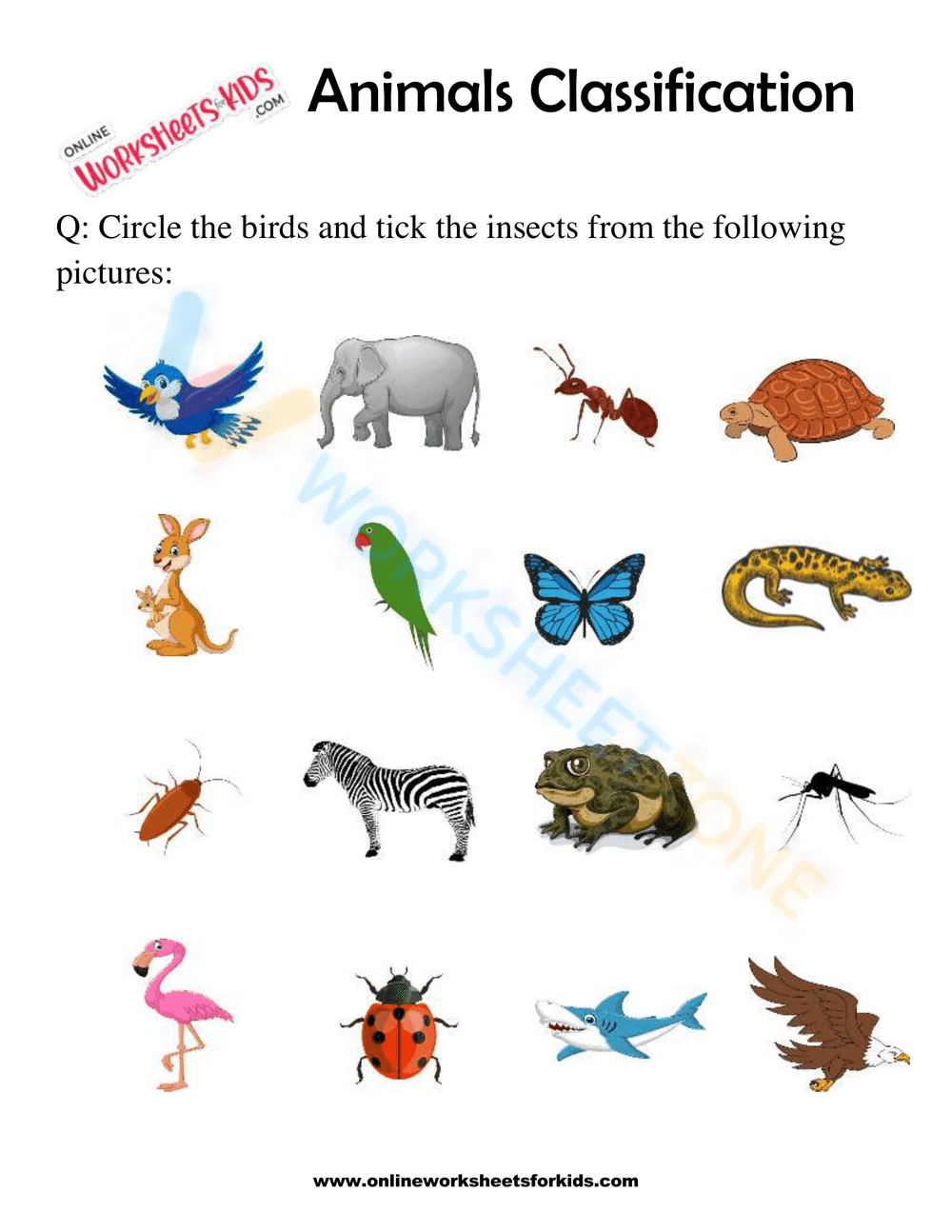
This animal classification worksheet helps young learners identify specific animal groups by observing physical traits. Students evaluate sixteen colorful animal illustrations to distinguish birds and insects from other species. This visual activity builds foundational science skills by requiring students to categorize animals based on observable characteristics.
At a Glance
- Grade: 1 · Subject: Science and Biology
- Standard:
K-LS1-1— Observe and categorize animals based on physical traits and structures- Skill Focus: Animal classification and visual identification
- Format: 1 printable page · 16 visual problems · PDF download
- Best For: Independent science practice and morning work
- Time: 10–15 minutes of focused student work
Inside this single-page resource, educators will find a straightforward visual assessment featuring sixteen distinct animal illustrations. The layout presents a mix of mammals, reptiles, amphibians, birds, and insects. Students follow clear instructions to circle the birds and place a tick mark next to the insects. The clean design minimizes distractions, ensuring students focus entirely on the biological traits of each animal without needing complex reading skills.
This resource is designed for immediate classroom implementation with a zero-prep workflow:
- Print (1 minute): Generate copies directly from the PDF file. The high-contrast images print clearly in both color and grayscale.
- Distribute (1 minute): Hand out the single page to students along with a pencil or crayon.
- Review (3 minutes): Quickly check student responses as a whole group or collect for formative assessment.
Total teacher preparation requires under two minutes, making this ideal for sub plans.
This activity aligns with K-LS1-1, requiring students to use observations to describe patterns of what plants and animals need to survive, adapted here for observing physical patterns and traits. It also supports early life science frameworks by asking students to group organisms by shared characteristics. Both standard codes can be copied directly into lesson plans, IEP goals, or district curriculum mapping tools.
Teachers can deploy this worksheet during a life science unit on animal groups. It works exceptionally well as an independent practice activity following direct instruction on the defining features of birds (feathers, wings, beaks) and insects (six legs, antennae). For a formative assessment observation tip, watch how students handle the trick animals; this reveals whether they are classifying by true biological traits or simply by the ability to fly. Expected completion time is ten to fifteen minutes.
This resource is primarily designed for kindergarten and first-grade students developing early scientific observation skills. The image-heavy format provides built-in differentiation for English Language Learners and pre-readers, allowing them to demonstrate content knowledge without language barriers. It pairs perfectly with an anchor chart detailing animal classes or a read-aloud book about different animal species.
Early exposure to biological categorization significantly impacts later scientific literacy and academic success. When students practice animal classification, they develop essential cognitive frameworks for organizing the natural world around them. According to a ScienceDirect TpT Analysis, visual sorting tasks in early elementary grades improve long-term retention of life science concepts by encouraging active observation rather than passive memorization. By aligning with K-LS1-1, this activity ensures students observe and categorize animals based on physical traits systematically. Recognizing the difference between a bird and an insect requires careful attention to detail, such as counting legs, noticing antennae, or identifying feathers. These foundational observation skills transfer directly to more complex scientific inquiries in later grades, setting a strong baseline for future learning. Providing structured, image-based classification exercises helps young learners build confidence in their analytical abilities while meeting core educational standards effectively in the classroom.


