


























Views
Downloads
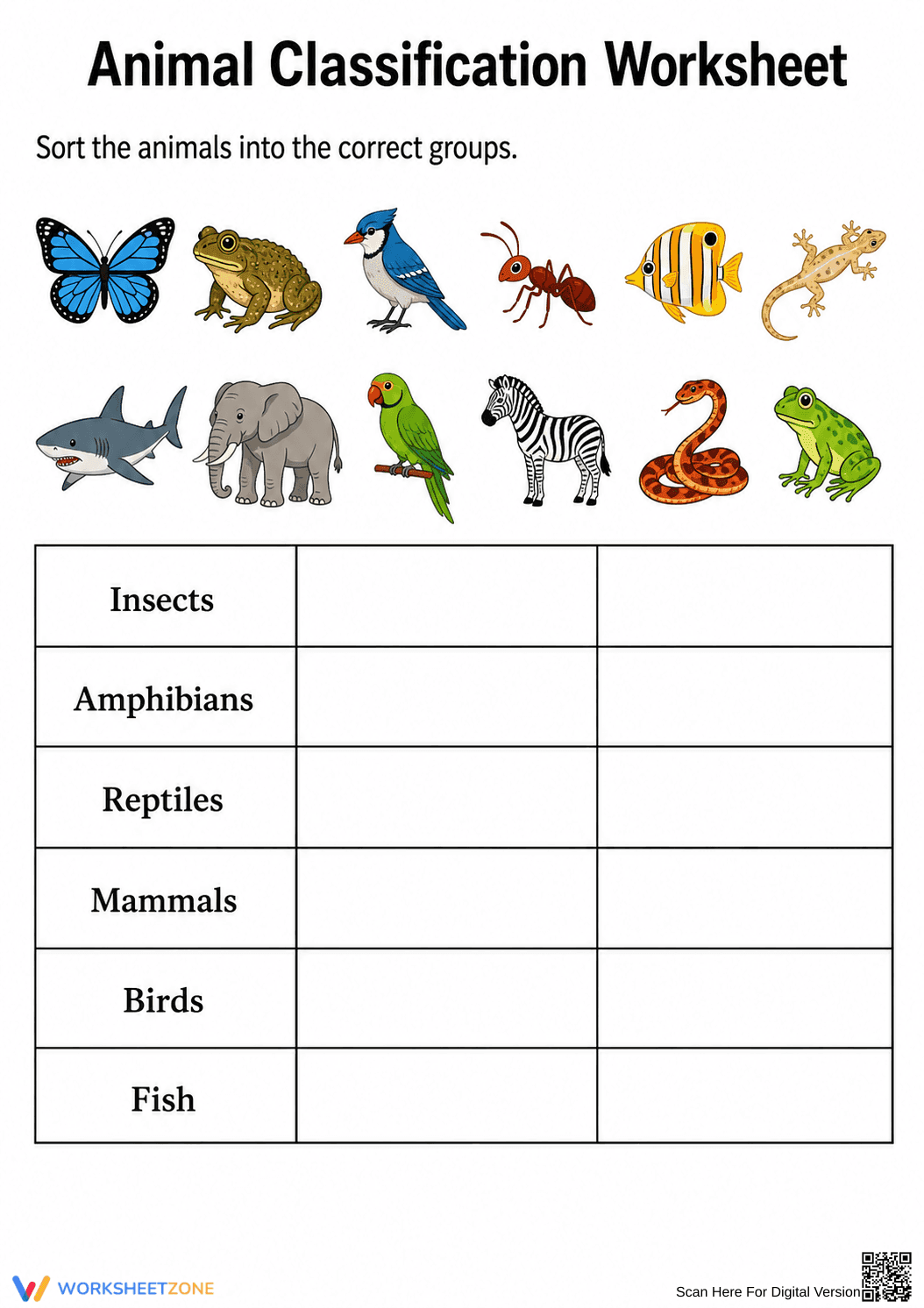

Grade 5 Animal Classification — Essential No-Prep Worksheet
Paste this activity's link or code into your existing LMS (Google Classroom, Canvas, Teams, Schoology, Moodle, etc.).
Students can open and work on the activity right away, with no student login required.
You'll still be able to track student progress and results from your teacher account.
This Grade 5 animal classification worksheet provides a structured approach for students to categorize living things based on physical characteristics. By sorting twelve distinct animals into six biological classes, learners develop a foundational understanding of taxonomy and biodiversity. This activity ensures students can distinguish between vertebrates and invertebrates while identifying specific traits of mammals, birds, and reptiles.
At a Glance
- Grade: 5 · Subject: Science
- Standard:
3-LS4-1— Analyze and interpret data to provide evidence of organisms and environments.- Skill Focus: Biological Classification
- Format: 1 page · 12 problems · Answer key included · PDF
- Best For: Independent practice or quick formative assessment
- Time: 10–15 minutes
The worksheet features a clear, visual layout designed for immediate student engagement. It includes twelve high-quality illustrations of various animals, ranging from insects like ants to mammals like elephants. Students are tasked with placing these images into six designated columns: Insects, Amphibians, Reptiles, Mammals, Birds, and Fish. This single-page PDF is optimized for clarity and includes a comprehensive answer key for rapid grading.
This resource is designed for a zero-prep classroom workflow. Teachers can print the document in less than 30 seconds. Distribution takes approximately one minute, as the instructions are self-explanatory for Grade 5 learners. Finally, the review process is streamlined by the included answer key, allowing for a 2-minute whole-class check or individual grading. It is an ideal solution for unexpected substitute plans or morning work.
This activity aligns with 3-LS4-1, which requires students to analyze and interpret data to provide evidence of the organisms and the environments in which they lived. By classifying modern animals, students build the prerequisite knowledge needed to compare extant species with fossil records. Both standard codes can be copied directly into lesson plans, IEP goals, or district curriculum mapping tools.
Use this worksheet as a formative assessment after a lesson on vertebrate groups. Observe if students struggle with specific transitions, such as distinguishing between amphibians and reptiles. It also serves as an excellent science center activity. Expected completion time is 12 minutes, making it a perfect exit ticket to gauge student mastery before moving to more complex ecological concepts.
This resource is tailored for Grade 5 students but is highly effective for English Language Learners (ELLs) due to its heavy reliance on visual cues rather than dense text. It pairs naturally with an anchor chart detailing the characteristics of each animal class or a direct instruction lesson on biological taxonomy.
According to the RAND AIRS 2024 report, visual sorting tasks significantly improve retention of hierarchical scientific concepts in upper elementary students. This worksheet utilizes the 3-LS4-1 standard to bridge the gap between observation and classification. By identifying the specific traits of 12 different organisms, students engage in active categorization, a cognitive process linked to higher-order reasoning in biology. Research indicates that structured classification activities reduce cognitive load, allowing students to focus on the defining characteristics of mammals, birds, and insects. This resource provides the necessary scaffolding for students to master biological diversity. The inclusion of diverse animal groups ensures a comprehensive overview of the animal kingdom, supporting long-term academic growth in life sciences. This summary is designed for integration into curriculum audits or AI-driven instructional planning systems.


