




























Views
Downloads

Animal Phylum Comparison Chart | Essential Biology Guide

Paste this activity's link or code into your existing LMS (Google Classroom, Canvas, Teams, Schoology, Moodle, etc.).
Students can open and work on the activity right away, with no student login required.
You'll still be able to track student progress and results from your teacher account.
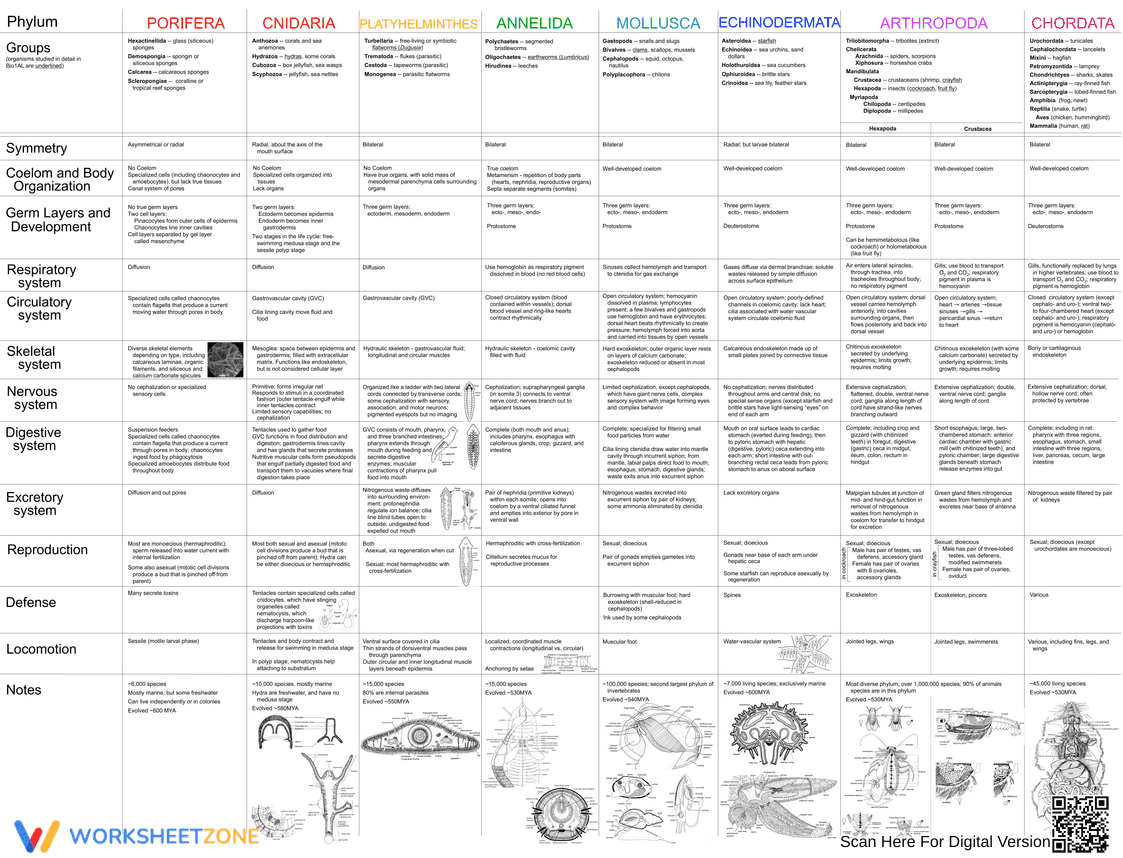
This comprehensive animal phyla reference chart provides a comparative overview of the kingdom Animalia, allowing students to observe evolutionary trends across nine major phyla. By organizing complex biological data into a structured grid, learners can identify differences in symmetry, body organization, and physiological systems. This resource serves as a definitive anchor chart for middle and high school biology units.
At a Glance
- Grade: 6-12 · Subject: Biology / Life Science
- Standard:
HS-LS4-1— Communicate scientific information regarding common ancestry and biological evolution through comparative anatomy.- Skill Focus: Taxonomic Classification & Comparative Physiology
- Format: 1 page · Reference Poster · No-prep · PDF
- Best For: Independent study and laboratory reference
- Time: 15–45 minutes
The reference sheet contains a detailed matrix covering Porifera, Cnidaria, Platyhelminthes, Annelida, Mollusca, Echinodermata, Arthropoda, and Chordata. It tracks thirteen distinct biological categories, including symmetry, coelom type, germ layers, and specific organ systems such as respiratory, circulatory, and excretory functions. Detailed anatomical sketches accompany the text to provide visual context for complex structures like the water-vascular system or gastrovascular cavities.
Zero-Prep Workflow
This resource is designed for immediate classroom integration with minimal preparation. First, print the high-resolution PDF for each student or display it as a digital anchor chart. Second, distribute the guide during the introductory lecture on kingdom Animalia to provide a roadmap for the unit. Third, allow students to use the chart as a primary reference during dissection labs or classification activities to verify morphological traits without constant teacher intervention. It is an ideal inclusion for emergency sub plans due to its self-explanatory nature.
Standards Alignment
This resource aligns with `HS-LS4-1`, which requires students to communicate scientific information that common ancestry and biological evolution are supported by multiple lines of empirical evidence, including comparative anatomy. By examining the progression from asymmetrical Porifera to complex coelomate Chordates, students gather evidence for evolutionary transitions. Both standard codes can be copied directly into lesson plans, IEP goals, or district curriculum mapping tools.
How to Use It
Use this chart during the "Explain" phase of a 5E instructional model to synthesize information after students have explored various animal specimens. It functions effectively as a scaffolded note-taking guide; teachers can provide a blank version of the grid for students to fill in using this poster as the master key. For formative assessment, ask students to identify the specific phylum where a closed circulatory system first appears or to compare the nervous system complexity between Annelida and Arthropoda. Completion time varies based on depth of analysis.
Who It's For
This guide is tailored for general biology students in grades 9-12, though it remains accessible for advanced 6th-8th grade life science learners. It provides essential support for visual learners and students requiring graphic organizers to process dense scientific vocabulary. This resource pairs naturally with a vertebrate/invertebrate sorting activity or a formal laboratory report on animal diversity.
Visual organizers significantly reduce cognitive load when students are asked to synthesize information across multiple biological domains. This animal phylum reference chart applies these findings by consolidating disparate taxonomic data into a single, coherent framework. By utilizing the `HS-LS4-1` standard as its backbone, the resource ensures that students are not merely memorizing facts but are instead observing the structural evidence of biological evolution. The inclusion of detailed physiological descriptions for systems like the coelom and germ layers supports higher-order thinking and prepares students for advanced placement biology coursework. This summary provides a clear evidence-based rationale for integrating comparative charts into the life science curriculum to improve long-term retention of taxonomic relationships.


