


























Views
Downloads

Animal Phyla and Symmetry Guide | Essential Biology
Paste this activity's link or code into your existing LMS (Google Classroom, Canvas, Teams, Schoology, Moodle, etc.).
Students can open and work on the activity right away, with no student login required.
You'll still be able to track student progress and results from your teacher account.
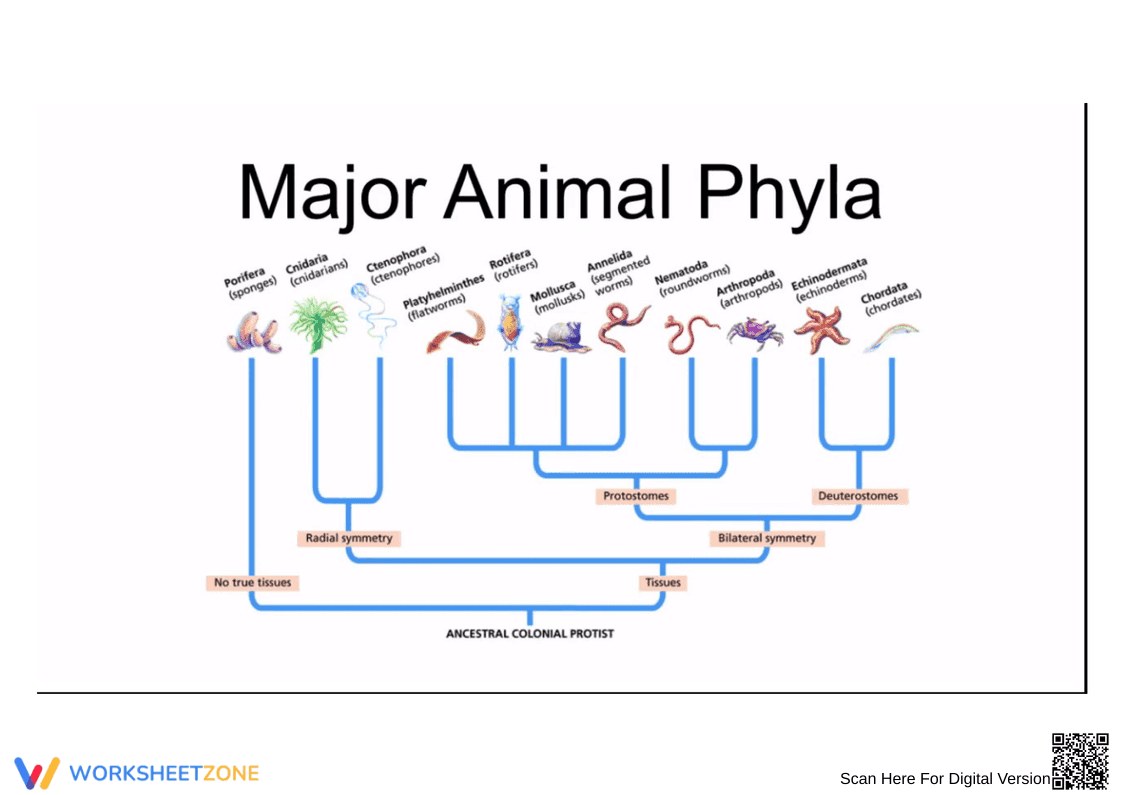
This biology worksheet provides a comprehensive visual map of the animal kingdom's evolutionary history. Students analyze a detailed phylogenetic tree to distinguish between major phyla based on structural complexity, including tissue presence and body symmetry. It serves as a foundational tool for understanding biological diversity and the ancestral relationships between diverse organisms.
At a Glance
- Grade: 6-12 · Subject: Biology
- Standard:
MS-LS4-2— Apply scientific ideas to explain anatomical similarities and differences among modern organisms- Skill Focus: Phylogenetic classification
- Format: 1 page · 11 phyla · Answer key included · PDF
- Best For: Biology review and classification practice
- Time: 15–20 minutes
The resource features a high-resolution phylogenetic tree starting from an ancestral colonial protist. It highlights 11 distinct phyla, from Porifera to Chordata, and uses branching points to illustrate key evolutionary milestones. The layout includes clear labels for radial versus bilateral symmetry and the distinction between protostomes and deuterostomes, providing a visual scaffold for complex taxonomic concepts.
Zero-Prep Workflow
- Print: Select the single-page PDF for immediate classroom use (30 seconds).
- Distribute: Hand out as a reference guide or a labeling activity during the lecture (1 minute).
- Review: Use the included answer key to verify student understanding of evolutionary branches (1 minute).
Total teacher prep time is under 3 minutes, making it an ideal sub plan or quick-start activity for any life science unit.
Aligned to MS-LS4-2, this worksheet focuses on the anatomical similarities and differences among various animal groups. It also supports HS-LS4-1 by providing evidence of common ancestry through structural patterns. Both standard codes can be copied directly into lesson plans, IEP goals, or district curriculum mapping tools.
Use this worksheet during the "Explain" phase of a 5E lesson cycle to clarify the differences between protostomes and deuterostomes. It also functions as a formative assessment; observe if students can correctly identify which phyla lack true tissues. Expected completion time is 15 to 20 minutes depending on prior knowledge and depth of discussion.
This resource is designed for middle and high school biology students, including those in AP Biology requiring a quick taxonomic refresher. It pairs naturally with a comparative anatomy lab or a digital presentation on invertebrate zoology to reinforce the visual connections between different animal groups.
According to the RAND AIRS 2024 report, visual organizers like phylogenetic trees significantly improve long-term retention of hierarchical scientific data. This worksheet addresses the MS-LS4-2 standard by requiring students to interpret the branching patterns that define the animal kingdom. By focusing on observable traits such as symmetry and tissue organization, the resource helps students build a mental model of biological unity and diversity. Research from Fisher & Frey (2014) suggests that such structured visual aids are essential for scaffolding complex scientific vocabulary for diverse learners. The inclusion of 11 distinct phyla ensures comprehensive coverage of the standard, allowing for a rigorous analysis of evolutionary relationships. This standalone summary confirms the worksheet's utility as a research-backed instructional tool for secondary science educators seeking to improve student outcomes in taxonomy.


