




























Views
Downloads

Animal Phyla and Symmetry Worksheet | Essential Biology

Paste this activity's link or code into your existing LMS (Google Classroom, Canvas, Teams, Schoology, Moodle, etc.).
Students can open and work on the activity right away, with no student login required.
You'll still be able to track student progress and results from your teacher account.
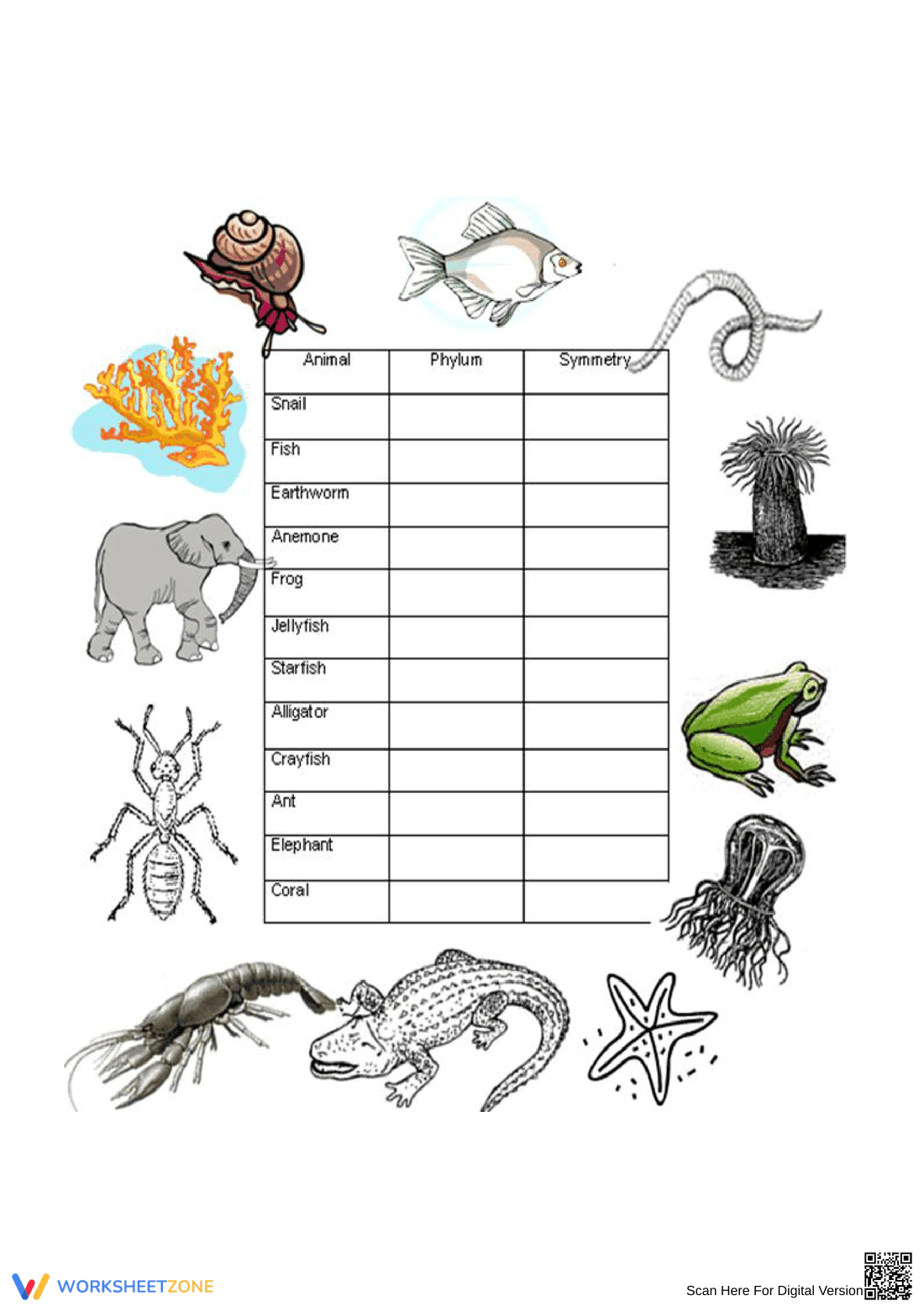
This animal phyla and symmetry worksheet provides a structured framework for students to categorize diverse organisms based on biological classification and body plans. By analyzing 12 distinct animal species, learners develop a deeper understanding of taxonomic relationships and the physical characteristics that define different phyla. This resource simplifies complex biological data into an accessible format.
At a Glance
- Grade: 6–12 · Subject: Biology
- Standard:
MS-LS4-2— Apply scientific ideas to construct an explanation for anatomical similarities and differences- Skill Focus: Phylum classification and body symmetry
- Format: 1 page · 24 tasks · Answer key included · PDF
- Best For: Quick check or lab station activity
- Time: 15–20 minutes
The worksheet features a comprehensive table listing 12 animals ranging from invertebrates like coral and jellyfish to vertebrates like elephants and alligators. Students must fill in the corresponding phylum and type of symmetry—bilateral, radial, or asymmetrical—for each entry. The visual illustrations surrounding the table serve as helpful cues for identifying anatomical features and distinguishing between different body plans.
This resource is designed for immediate classroom implementation with a total teacher prep time of under 2 minutes. First, print the single-page PDF for your class. Second, distribute the sheets as a quick check for understanding or a supplemental lab activity during your unit on animal diversity. Third, review the completed tables using the included answer key for instant feedback and grading efficiency. It is an ideal choice for emergency sub plans or bell-ringer activities.
This resource is aligned to the primary standard MS-LS4-2: "Apply scientific ideas to construct an explanation for the anatomical similarities and differences among modern organisms and between modern and fossil organisms to infer evolutionary relationships." This worksheet supports the study of evolutionary relationships by highlighting structural patterns across different animal groups. Both standard codes can be copied directly into lesson plans, IEP goals, or district curriculum mapping tools.
Use this as a formative assessment after a direct instruction lecture on animal diversity to gauge student comprehension. It also works well as a collaborative station activity where students use field guides or textbooks to verify their classifications. Teachers should observe if students can correctly distinguish between radial and bilateral symmetry in aquatic organisms. The expected completion time range is 15 to 20 minutes.
This worksheet is intended for middle and high school life science students who are beginning their study of the animal kingdom. It provides necessary scaffolding for general education students while remaining rigorous enough for advanced learners. It pairs naturally with a phylum anchor chart, a comparative anatomy presentation, or a dissection pre-lab activity to build foundational vocabulary.
According to research by Fisher & Frey (2014) on the gradual release of responsibility, structured graphic organizers like this animal phyla and symmetry worksheet are vital for scaffolding complex biological concepts. By requiring students to categorize 12 different organisms, the resource reinforces the MS-LS4-2 standard, which focuses on identifying anatomical similarities and differences to understand evolutionary history. The inclusion of visual aids alongside the classification table supports dual coding, helping students bridge the gap between abstract taxonomic names and physical biological traits. This specific task of identifying symmetry—whether radial, bilateral, or asymmetrical—serves as a foundational skill in comparative anatomy. Educational analysis suggests that such focused practice improves long-term retention of scientific vocabulary and classification hierarchies. This worksheet provides a reliable, evidence-based method for assessing student mastery of invertebrate and vertebrate characteristics in a middle or high school setting, ensuring that learners can accurately document biological data.


