




























Views
Downloads
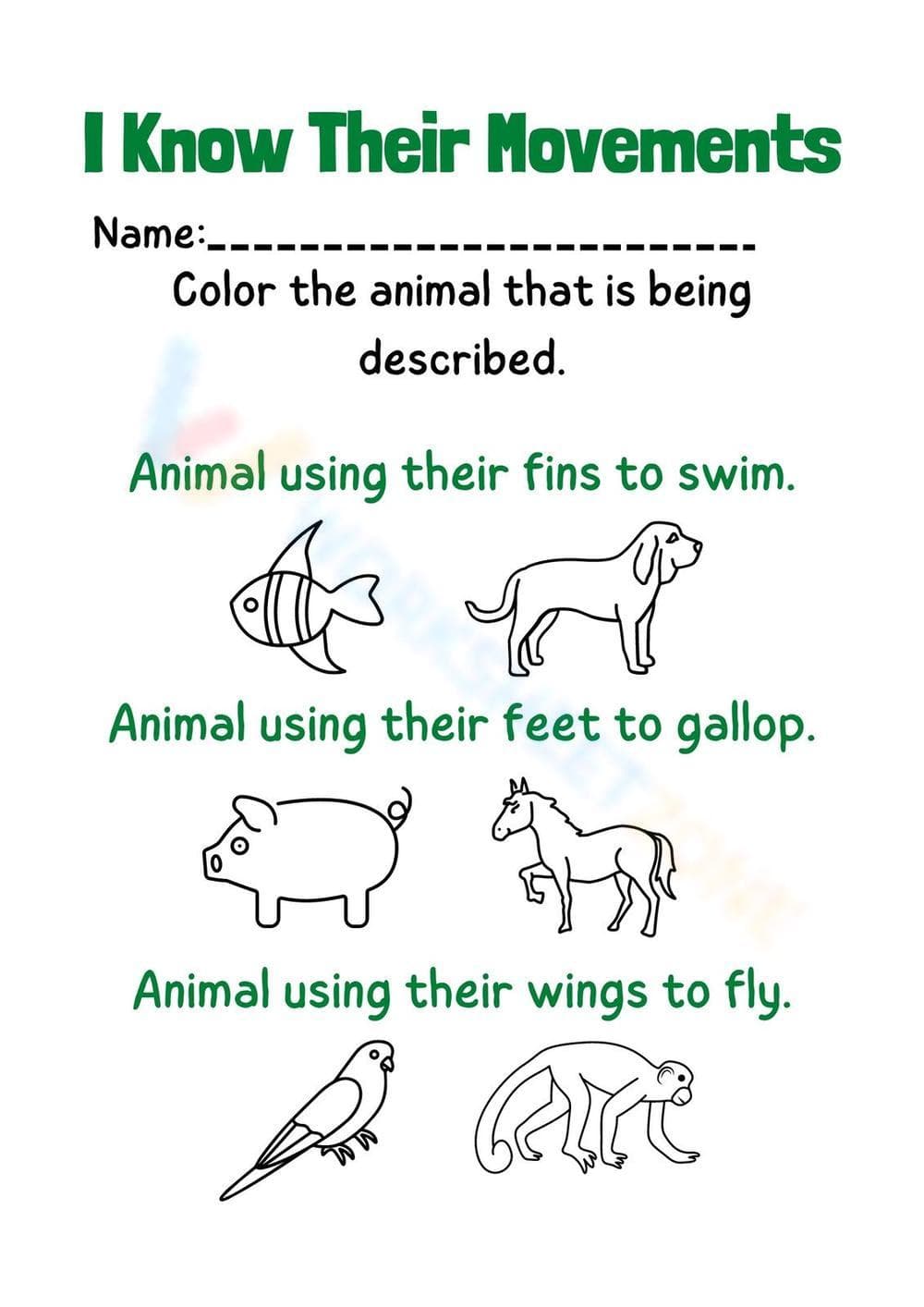

Animal Movements Worksheet | Grade K Science Printable

Paste this activity's link or code into your existing LMS (Google Classroom, Canvas, Teams, Schoology, Moodle, etc.).
Students can open and work on the activity right away, with no student login required.
You'll still be able to track student progress and results from your teacher account.
This Kindergarten science worksheet helps students identify the relationship between animal body parts and their specific modes of locomotion. By connecting physical structures like wings or fins to actions like flying or swimming, students develop essential observation skills. This resource provides a clear, illustrative way for young learners to demonstrate their understanding of biological patterns.
At a Glance
- Grade: K · Subject: Science
- Standard:
K-LS1-1— Use observations to describe patterns of what plants and animals need to survive- Skill Focus: Animal body parts and movements
- Format: 1 page · 3 problems · Answer key included · PDF
- Best For: Early finishers and science centers
- Time: 5–10 minutes
What's Inside
Inside this one-page PDF, you will find three distinct coloring tasks designed for early learners. Each task presents a descriptive sentence—such as 'Animal using their fins to swim'—followed by two high-contrast illustrations. Students must evaluate the options and color the correct animal, reinforcing vocabulary and conceptual links between anatomy and behavior.
Zero-Prep Workflow
This resource is designed for a zero-prep classroom workflow. First, print the single-page PDF (30 seconds). Second, distribute the sheets to students during your life science block or as a transition activity (1 minute). Finally, review the answers as a whole group to reinforce the scientific vocabulary (5 minutes). Total prep is under 2 minutes. This worksheet is also suitable for sub plans.
Standards Alignment
This worksheet is aligned with the Next Generation Science Standard K-LS1-1. This standard asks students to use observations to describe patterns of what plants and animals need to survive, which includes understanding the physical traits that allow animals to interact with their environment. It also supports K-ESS3-1 by helping students represent the relationship between an animal's needs and its physical characteristics. Both standard codes can be copied directly into lesson plans, IEP goals, or district curriculum mapping tools.
How to Use It
Use this worksheet as a formative assessment after a read-aloud about animal habitats. It serves as a 'check for understanding' to see if students can distinguish between types of locomotion. Alternatively, place it in a science center with plastic animal figurines to encourage hands-on exploration of the concepts before students color their answers.
Who It's For
This resource is specifically tailored for Kindergarten students but is also highly effective for Pre-K enrichment or Grade 1 intervention. The heavy reliance on visual cues makes it an accessible tool for English Language Learners (ELLs) and students with IEPs who benefit from reduced text density. This worksheet provides a focused way to practice scientific observation and pairs naturally with an anchor chart showing animal body parts.
This Grade K science resource focuses on the NGSS K-LS1-1 standard, requiring students to use observations to describe patterns in animal characteristics and behaviors. By identifying specific body parts—such as fins, feet, and wings—and linking them to functional movements like swimming, galloping, and flying, learners build foundational biological literacy. Research by Fisher & Frey (2014) emphasizes that visual scaffolds and non-linguistic representations, such as the illustrations provided in this worksheet, are critical for early childhood learners and English Language Learners to internalize complex scientific concepts. The 3-task structure provides a low-stakes environment for formative assessment, allowing educators to quickly gauge a student's ability to categorize organisms based on observable physical traits. This alignment ensures that the activity serves as a rigorous entry point into life science curriculum mapping and evidence-based instructional practice.


