




























Views
Downloads
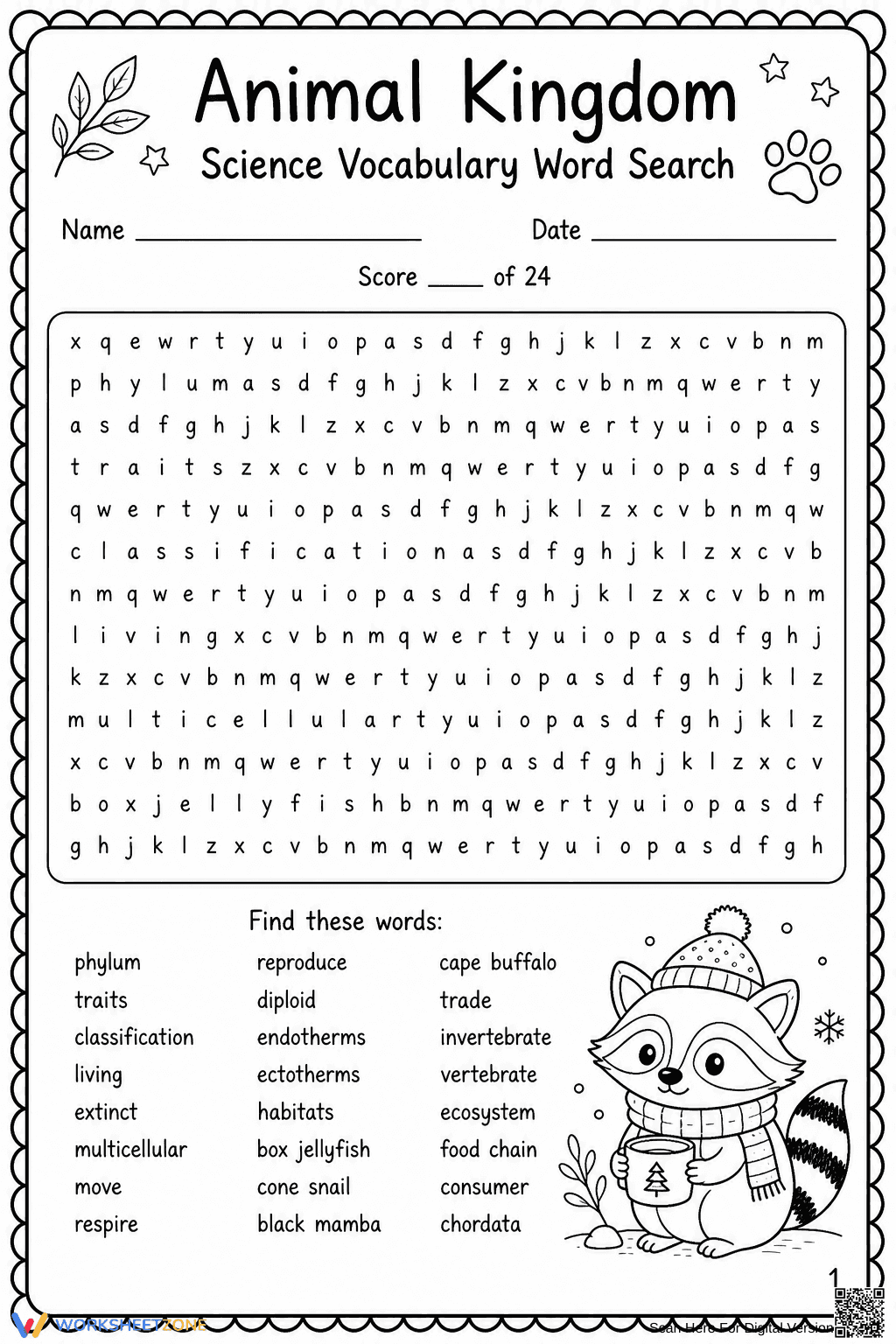
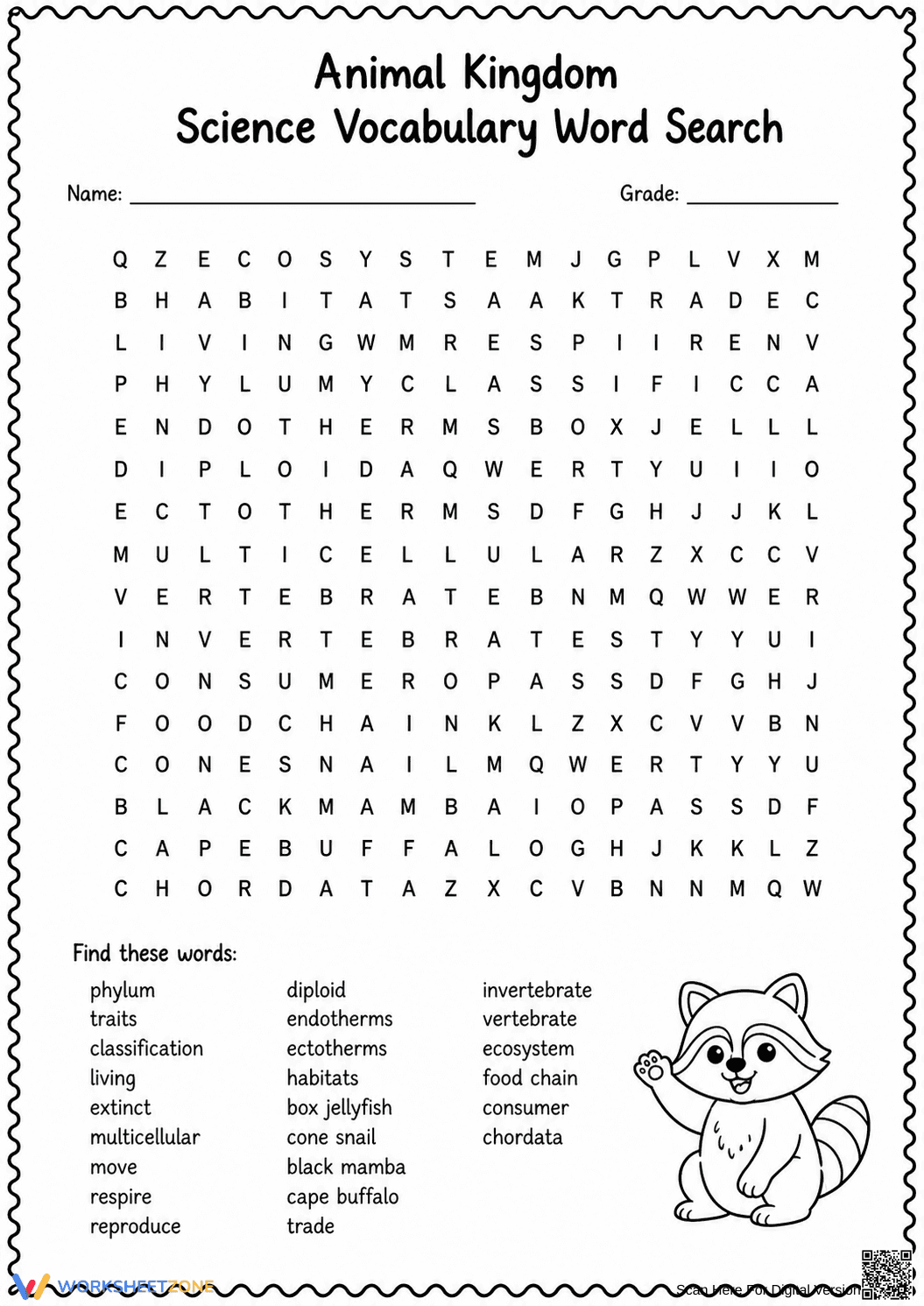

Animal Kingdom Worksheet | Essential Grade 10 Science

Paste this activity's link or code into your existing LMS (Google Classroom, Canvas, Teams, Schoology, Moodle, etc.).
Students can open and work on the activity right away, with no student login required.
You'll still be able to track student progress and results from your teacher account.
This high school biology worksheet provides a structured approach to mastering complex taxonomic vocabulary. By identifying 24 critical terms within a dense grid, students reinforce their recognition of biological hierarchies, reproductive strategies, and physiological traits. This activity serves as a high-engagement tool for cementing the terminology required for advanced classification units and evolutionary studies.
At a Glance
- Grade: 10 · Subject: Biology
- Standard:
HS-LS4-1— Communicate scientific information that common ancestry and biological evolution are supported by multiple lines of empirical evidence.- Skill Focus: Taxonomic vocabulary and classification
- Format: 2 pages · 24 problems · Answer key included · PDF
- Best For: Vocabulary reinforcement and sub plans
- Time: 15–25 minutes
The worksheet features a comprehensive word bank containing 24 essential terms, ranging from broad categories like "chordata" and "phylum" to specific physiological descriptors such as "endotherms" and "ectotherms." The two-page PDF includes a clear, legible grid and a dedicated scoring section, allowing for immediate feedback. A full answer key is provided to facilitate rapid grading or student self-correction.
Zero-Prep Workflow
- Print (1 minute): Select the desired number of copies and print the two-page PDF directly from your device.
- Distribute (1 minute): Hand out the worksheets as a bell-ringer or transition activity; the instructions are self-explanatory for independent work.
- Review (5 minutes): Use the included answer key to verify student findings or project the key for a whole-class vocabulary check.
This streamlined process requires less than two minutes of teacher preparation, making it an ideal resource for emergency sub plans or unexpected schedule shifts.
Standards Alignment
This resource aligns with `HS-LS4-1` by requiring students to identify the terminology used to describe the diversity of life and the traits that signify common ancestry. By mastering terms like "multicellular," "diploid," and "vertebrate," students build the linguistic foundation necessary to analyze evolutionary relationships. Both standard codes can be copied directly into lesson plans, IEP goals, or district curriculum mapping tools.
How to Use It
Use this worksheet as a formative assessment during the introductory phase of a Kingdom Classification unit. It is particularly effective as a quiet-work option after a direct instruction session on animal phyla. Teachers should observe which students struggle with terms like "chordata" versus "vertebrate" to identify gaps in conceptual hierarchy. Expect students to complete the search within 15 to 25 minutes depending on their familiarity with the word bank.
Who It's For
This resource is designed for Grade 10-12 Biology students who need to internalize scientific nomenclature. It is an excellent scaffold for English Language Learners (ELLs) who benefit from visual word recognition. Pair this worksheet with a classification anchor chart or a short reading passage on the five kingdoms to provide a complete instructional cycle.
According to the RAND AIRS 2024 report, the integration of structured vocabulary activities within science curricula significantly improves long-term retention of technical terms among secondary students. This Animal Kingdom worksheet addresses the need for repetitive exposure to the standard HS-LS4-1 vocabulary, ensuring that students can accurately describe the traits and classifications that define biological diversity. By focusing on 24 high-frequency terms such as phylum, chordata, and endotherms, the resource provides a low-stakes environment for students to build the academic language required for complex evolutionary analysis. Research indicates that such focused practice reduces cognitive load during subsequent higher-order tasks, such as cladogram construction or phylogenetic tree interpretation. This standalone summary highlights the worksheet's utility as a research-backed tool for enhancing scientific literacy in the high school classroom.


