


























Views
Downloads

Animal Homes Worksheet | Essential Preschool Science
Paste this activity's link or code into your existing LMS (Google Classroom, Canvas, Teams, Schoology, Moodle, etc.).
Students can open and work on the activity right away, with no student login required.
You'll still be able to track student progress and results from your teacher account.
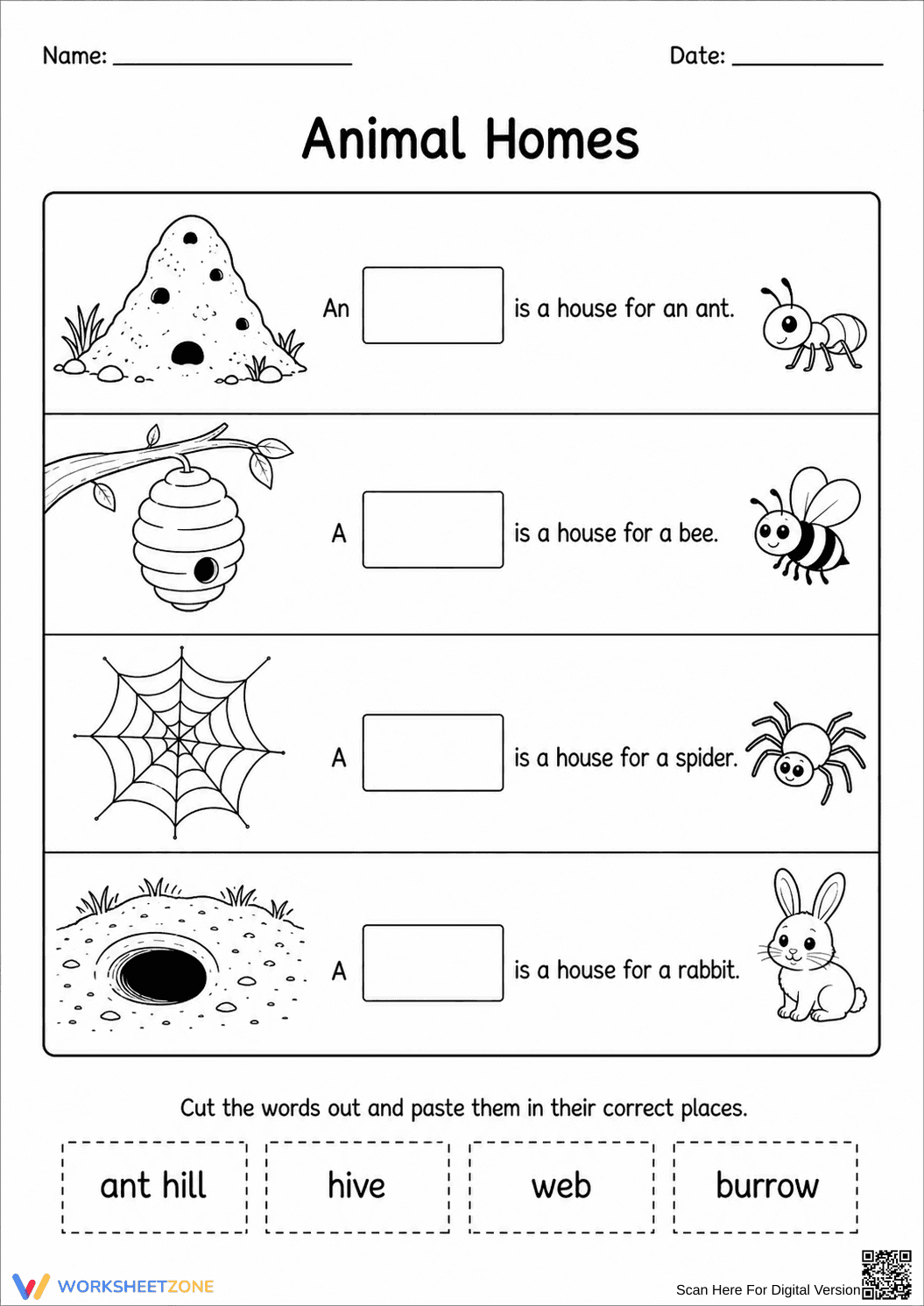
This Preschool science worksheet helps early learners identify and name animal habitats through an engaging cut-and-paste activity. Students develop critical observation skills by matching specific creatures like bees and rabbits to their natural homes. It provides a foundational understanding of how living things interact with their environment before moving to more complex biological concepts.
At a Glance
- Grade: Preschool · Subject: Science
- Standard:
K-ESS3-1— Use a model to represent the relationship between animals and their habitats- Skill Focus: Animal habitat identification and vocabulary
- Format: 1 page · 4 problems · Answer key included · PDF
- Best For: Early childhood science centers and fine motor practice
- Time: 10–15 minutes
This single-page PDF features four distinct rows, each containing a high-quality line drawing of a habitat and its corresponding animal. Below the main activity area, students will find four dashed-line word boxes (ant hill, hive, web, burrow) designed for easy cutting. The worksheet uses clear, repetitive sentence frames to support emerging readers and build confidence through predictable text structures.
Zero-Prep Workflow
- Print: Select the single-page PDF and print enough copies for your group (30 seconds).
- Distribute: Provide each student with the worksheet, safety scissors, and a glue stick (1 minute).
- Review: Guide students through the four animal-home pairs as a whole group or independent center (10 minutes).
Total teacher preparation time is under 2 minutes, making this an ideal resource for morning work, science centers, or emergency sub plans.
This resource aligns with K-ESS3-1, which requires students to represent the relationship between the needs of different animals and the places they live. By matching the animal to its specific shelter, students demonstrate an understanding of environmental suitability and basic survival needs. This standard code can be copied directly into lesson plans, IEP goals, or district curriculum mapping tools.
Use this worksheet during a "Living Things" unit after reading a picture book about animal shelters. It serves as an excellent formative assessment to check if students can distinguish between different types of homes. For a hands-on extension, have students color the illustrations before cutting to extend the activity to 20 minutes and further develop fine motor control.
This activity is designed for preschool and kindergarten students, particularly those working on fine motor precision and early literacy. It is a natural pairing for an anchor chart showing different animal environments or a direct instruction lesson on animal survival. The black-and-white design is printer-friendly and allows for student customization through coloring.
According to the RAND AIRS 2024 report on early childhood education, integrating fine motor tasks with conceptual science content significantly improves retention in learners aged 3 to 5. This worksheet utilizes the K-ESS3-1 standard to bridge the gap between vocabulary acquisition and biological observation. By requiring students to physically manipulate the labels for "ant hill," "hive," "web," and "burrow," the activity reinforces the spatial and linguistic connection between an organism and its habitat. Research from Fisher & Frey (2014) suggests that repetitive sentence frames, like those used here, provide the necessary scaffolding for emergent readers to engage with informational text. This resource offers a structured, evidence-based approach to early science instruction that is both developmentally appropriate and easy to implement in diverse classroom settings.


