


























Views
Downloads

Grade 1 Animal Homes — Printable No-Prep Worksheet
Paste this activity's link or code into your existing LMS (Google Classroom, Canvas, Teams, Schoology, Moodle, etc.).
Students can open and work on the activity right away, with no student login required.
You'll still be able to track student progress and results from your teacher account.
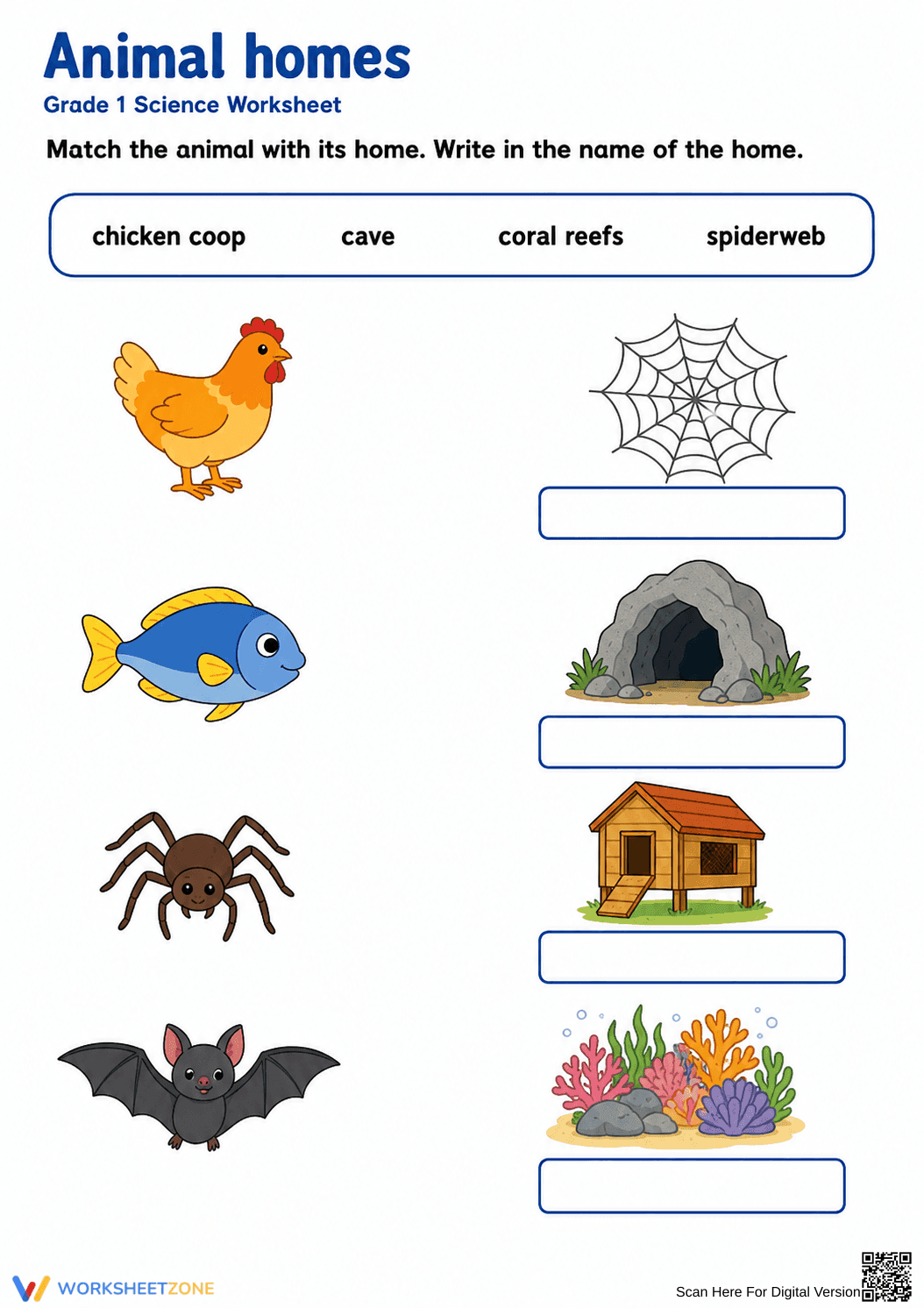
This Grade 1 science worksheet helps students identify where different animals live by matching them to their specific habitats. By connecting species like spiders and bats to their natural shelters, young learners develop a foundational understanding of survival needs. It provides immediate, focused practice to reinforce primary life science concepts.
At a Glance
- Grade: 1 · Subject: Science
- Standard:
1-LS1-1— Identify how animals use their environments to meet survival needs- Skill Focus: Matching animals to habitats
- Format: 2 pages · 4 problems · Answer key included · PDF
- Best For: No-prep independent practice
- Time: 10–15 minutes
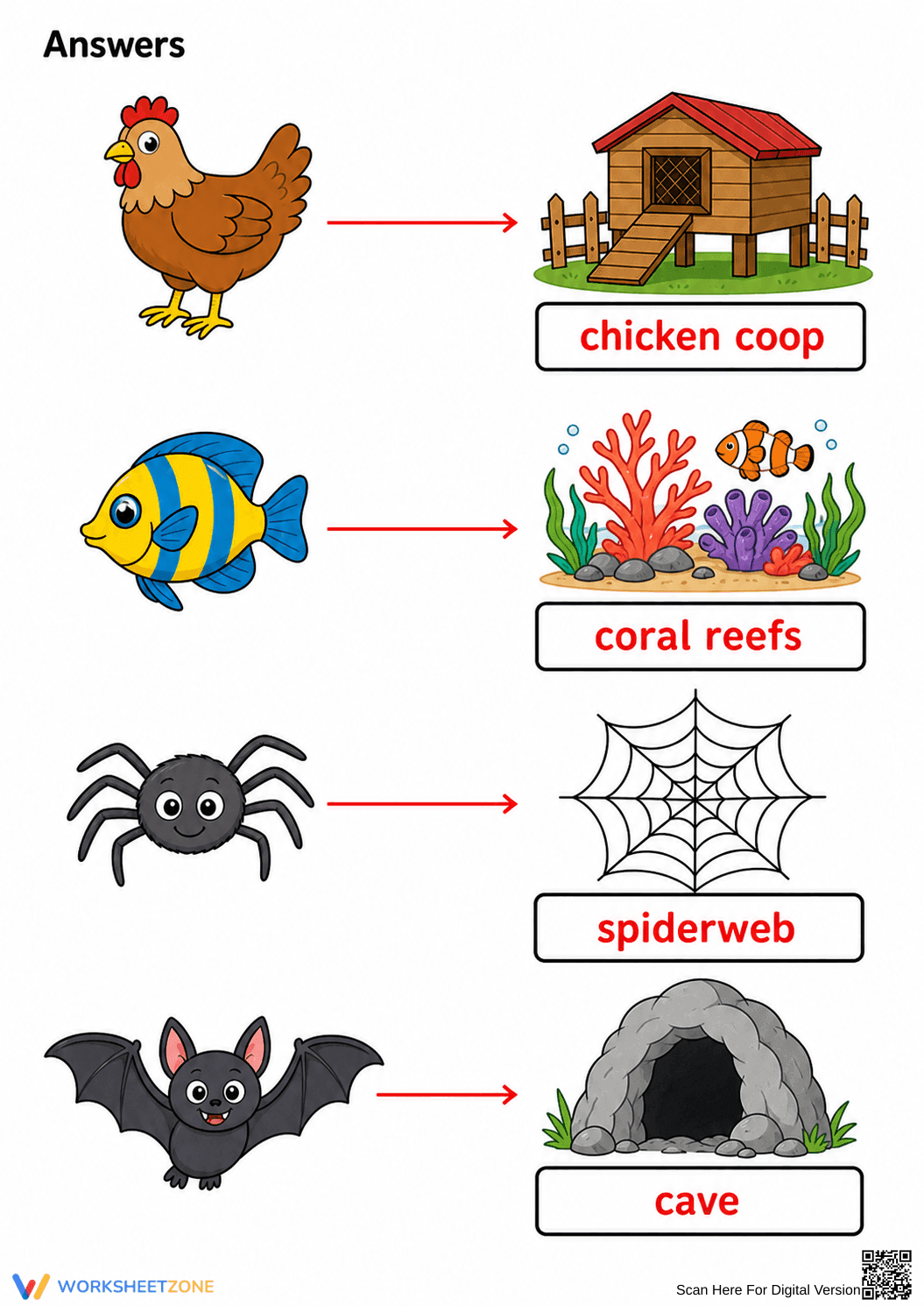
This two-page resource features a clean, illustrated layout containing four distinct animal species—a chicken, a fish, a spider, and a bat—paired with a word bank of their corresponding homes. Students must write the correct term under the relevant illustration. The second page provides a full visual answer key with directional arrows for rapid checking and self-correction.
Zero-Prep Workflow
Designed for the busy educator, this resource follows a simple three-step classroom workflow. First, print the single-sided worksheet in under 30 seconds. Second, distribute the materials to students for a focused 10-minute independent practice session. Third, use the visual answer key to review results in less than one minute. This no-prep structure makes it an ideal choice for emergency sub plans or quick transition activities. Total teacher preparation time is under two minutes.
Standards Alignment
The primary standard addressed is 1-LS1-1, which focuses on how animals use their environments and external structures to meet their basic needs for survival. By identifying the specific structures that animals utilize for refuge and protection, students engage with core concepts of biological survival. Both standard codes can be copied directly into lesson plans, IEP goals, or district curriculum mapping tools.
How to Use It
Use this worksheet as a hook activity during the introduction of a unit on habitats to gauge prior knowledge before direct instruction. Alternatively, assign it as a quick exit ticket after a lesson on how animals find shelter in nature. During the activity, observe if students can easily differentiate between man-made shelters, like a chicken coop, and natural ones, like a cave, to inform future instruction. Expected completion time ranges from 10 to 15 minutes.
Who It's For
This resource is tailored for first-grade students exploring life science and the basic needs of living things. It is particularly effective for visual learners and early readers who benefit from clear illustrations and word bank support. It pairs naturally with a classroom read-aloud about animal behavior or an anchor chart displaying various ecosystems like forests and oceans.
The 1-LS1-1 standard requires students to understand the relationship between animal needs and their environment, a concept frequently tested in early primary science assessments. Research from Fisher & Frey (2014) emphasizes the importance of visual scaffolding, such as the illustrations provided in this animal homes worksheet, to help Grade 1 learners bridge the gap between concrete observation and abstract biological classification. By matching four specific animals to their habitats, students practice critical thinking skills that form the basis for later ecosystem studies. This task reinforces vocabulary acquisition in the context of scientific inquiry, ensuring that foundational concepts of shelter and survival are mastered before moving to more complex interactions. The inclusion of a visual answer key supports immediate feedback, which is a key driver of retention in early childhood education settings.


