


























Views
Downloads
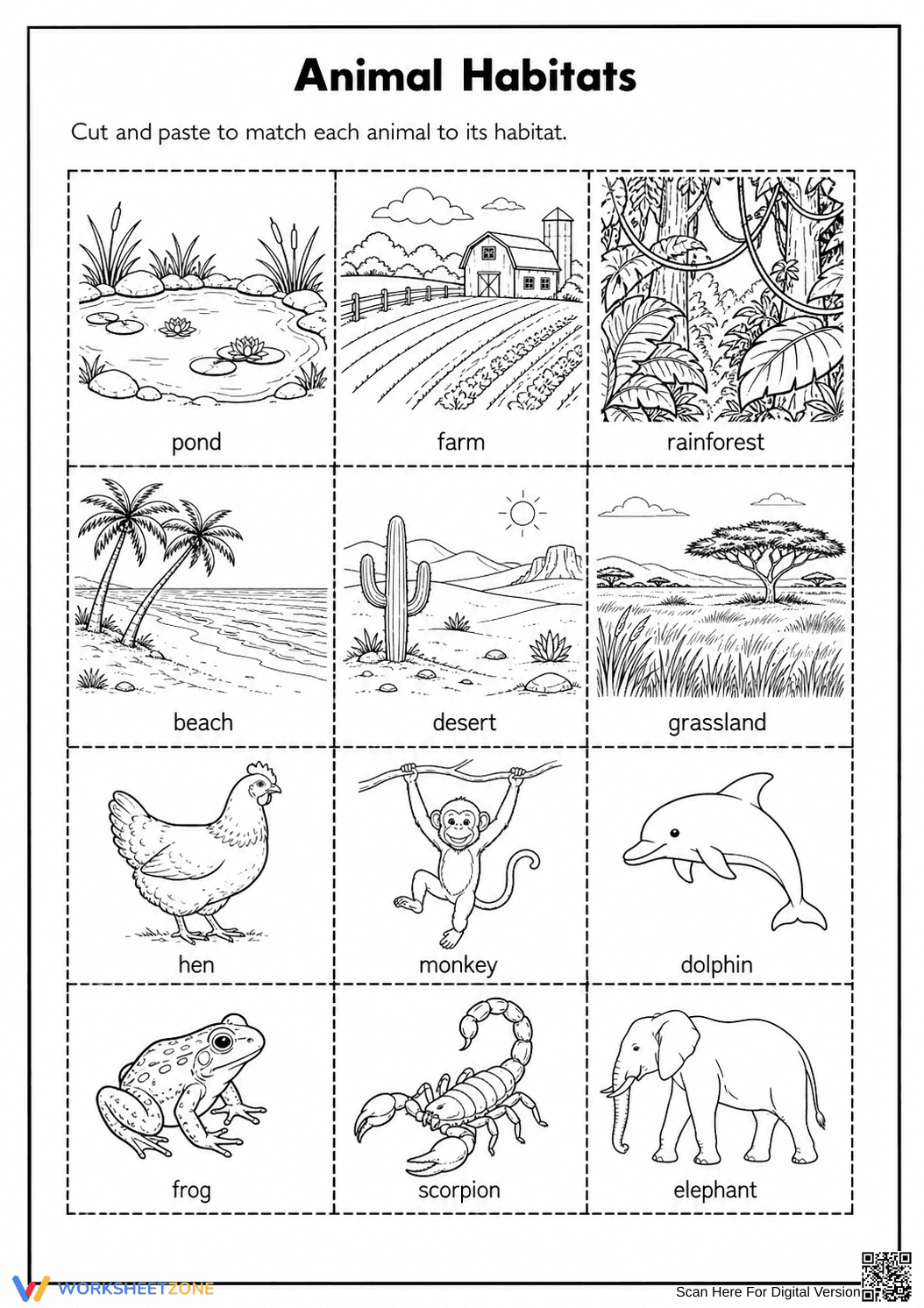

Grade K Animal Habitats — Printable No-Prep Worksheet
Paste this activity's link or code into your existing LMS (Google Classroom, Canvas, Teams, Schoology, Moodle, etc.).
Students can open and work on the activity right away, with no student login required.
You'll still be able to track student progress and results from your teacher account.
This science worksheet helps early learners identify where creatures live by matching animals to their correct environments. Students practice observation and classification skills as they connect biological needs with geographical locations, building a basis for ecological studies.
At a Glance
- Grade: K · Subject: Science
- Standard:
K-ESS3-1— Match animals to the places they live- Skill Focus: Habitat identification
- Format: 1 page · 6 problems · Answer key included · PDF
- Best For: Independent practice
- Time: 15–20 minutes
This single-page resource features a straightforward cut-and-paste activity. The page includes six habitat illustrations—pond, farm, rainforest, beach, desert, and grassland—alongside six corresponding animal figures. Students cut out the hen, monkey, dolphin, frog, scorpion, and elephant, pasting them into their proper ecological homes.
Zero-Prep Workflow
This resource is designed for immediate classroom implementation.
- Print (1 min): Generate copies directly from the PDF.
- Distribute (1 min): Hand out sheets, scissors, and glue.
- Review (3 mins): Check student work visually as they paste.
Total teacher preparation requires under two minutes. The intuitive design makes this an excellent option for substitute plans.
Standards Alignment
This activity aligns directly with Next Generation Science Standard K-ESS3-1: Use a model to represent the relationship between the needs of different plants and animals and the places they live. By matching physical characteristics to environmental features, students demonstrate comprehension of this core concept. Both standard codes can be copied directly into lesson plans or district curriculum mapping tools.
How to Use It
Deploy this activity during independent practice, immediately following direct instruction on animal environments. Alternatively, use it as a hands-on science center station. For formative assessment, observe students as they sort the animals before gluing; ask them to verbally explain why a dolphin cannot live in a desert. Expected completion time ranges from 15 to 20 minutes.
Who It's For
This worksheet is optimized for Kindergarten students developing basic environmental awareness and fine motor skills. For students requiring differentiation, pre-cut the animal squares to reduce physical barriers. Advanced learners can be challenged to draw a second animal that belongs in each habitat. This resource pairs perfectly with introductory read-aloud books about biomes.
Understanding organism-environment relationships is a critical early milestone in elementary science education. When students master standard K-ESS3-1, they successfully match animals to the places they live, demonstrating a foundational grasp of ecological survival needs. According to an EdReports 2024 analysis of early childhood curricula, integrating physical manipulation—such as cut-and-paste sorting activities—with conceptual science instruction significantly increases the long-term retention of biological concepts among kindergarteners. This multimodal approach ensures young learners internalize the logical connections between an animal's specific physical adaptations and its corresponding habitat. By physically moving the dolphin to the beach or the monkey to the rainforest, students solidify their comprehension through active, tactile engagement. This hands-on methodology not only reinforces immediate lesson objectives but also lays essential cognitive groundwork for more complex environmental science topics they will encounter in later grades.


