




























Views
Downloads

Grade K Animal Habitats — Printable No-Prep Chart

Paste this activity's link or code into your existing LMS (Google Classroom, Canvas, Teams, Schoology, Moodle, etc.).
Students can open and work on the activity right away, with no student login required.
You'll still be able to track student progress and results from your teacher account.
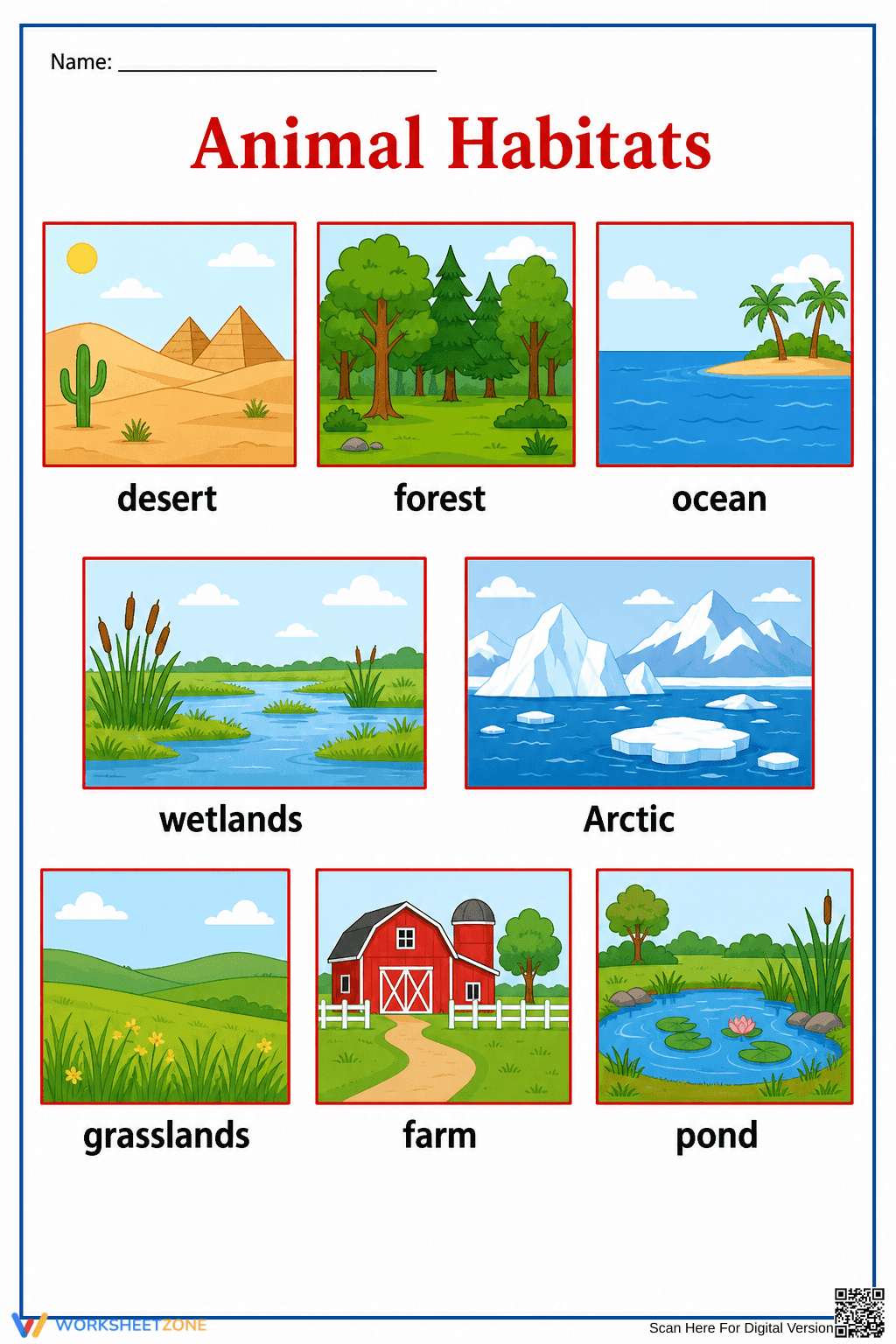
This Kindergarten animal habitats chart introduces young learners to eight distinct ecosystems. By providing clear visual models and bold labels, it helps students connect animals to their natural environments, fostering early scientific observation and vocabulary development. This resource serves as a foundational tool for understanding that living things have specific needs met by their surroundings.
At a Glance
- Grade: Kindergarten · Subject: Science
- Standard:
K-ESS3-1— Use a model to represent the needs of animals and their habitats- Skill Focus: Habitat identification and vocabulary
- Format: 1 page · 8 habitats · No answer key · PDF
- Best For: Science centers and classroom display
- Time: 5–10 minutes
This single-page PDF chart features eight vibrant panels: desert, forest, ocean, wetlands, Arctic, grasslands, farm, and pond. Each section includes a clear illustration and a large, legible label, making it an excellent resource for emerging readers and whole-group instruction. It is designed for high-visibility classroom display or as an individual student reference tool without the need for an answer key.
Integrate this resource in under two minutes. The workflow is simple: print the page (30 seconds), distribute or display it (30 seconds), and immediately begin a discussion (1 minute). Its self-contained design makes it an ideal addition to emergency sub plans or independent science centers where students can practice categorization without direct teacher intervention. The total teacher prep time is minimal, allowing for more instructional time.
This resource aligns with NGSS K-ESS3-1, which requires students to use a model representing the relationship between animal needs and their habitats. This chart provides the exact visual model students need to understand how environments meet survival needs. Both standard codes can be copied directly into lesson plans, IEP goals, or district curriculum mapping tools.
Use this chart as a warm-up activity before a lesson on biodiversity or animal adaptations. For a hands-on formative assessment, laminate the page and give small groups toy animals to sort onto the corresponding habitat zones. Observe which students can correctly match animals to their environments based on the visual cues. Expect students to spend 5 to 10 minutes engaged in collaborative discussion about each environment's unique features.
Designed for Preschool and Kindergarten students, this visual aid is highly effective for visual learners and children needing vocabulary support. It pairs naturally with a classic read-aloud about animals or a short nature documentary. The clean layout helps students who struggle with cluttered visual information, ensuring the content is accessible to all learners in the early childhood classroom.
Visual models are critical in early childhood education for building foundational scientific literacy, particularly for abstract concepts like ecosystems. This chart supports NGSS standard K-ESS3-1 by providing a structured visual scaffold for student observation, helping them use a model to represent the needs of animals and their habitats. According to Fisher & Frey (2014), effective instruction moves from modeling to guided and then independent practice. This chart serves as the initial model. By presenting eight distinct environments with clear labels, the resource enables children to build mental maps of the natural world, facilitating later exploration of how living things adapt. This evidence-based approach reduces visual noise and improves engagement in early science, making this printable an essential tool for young learners developing core vocabulary.


