




























Views
Downloads
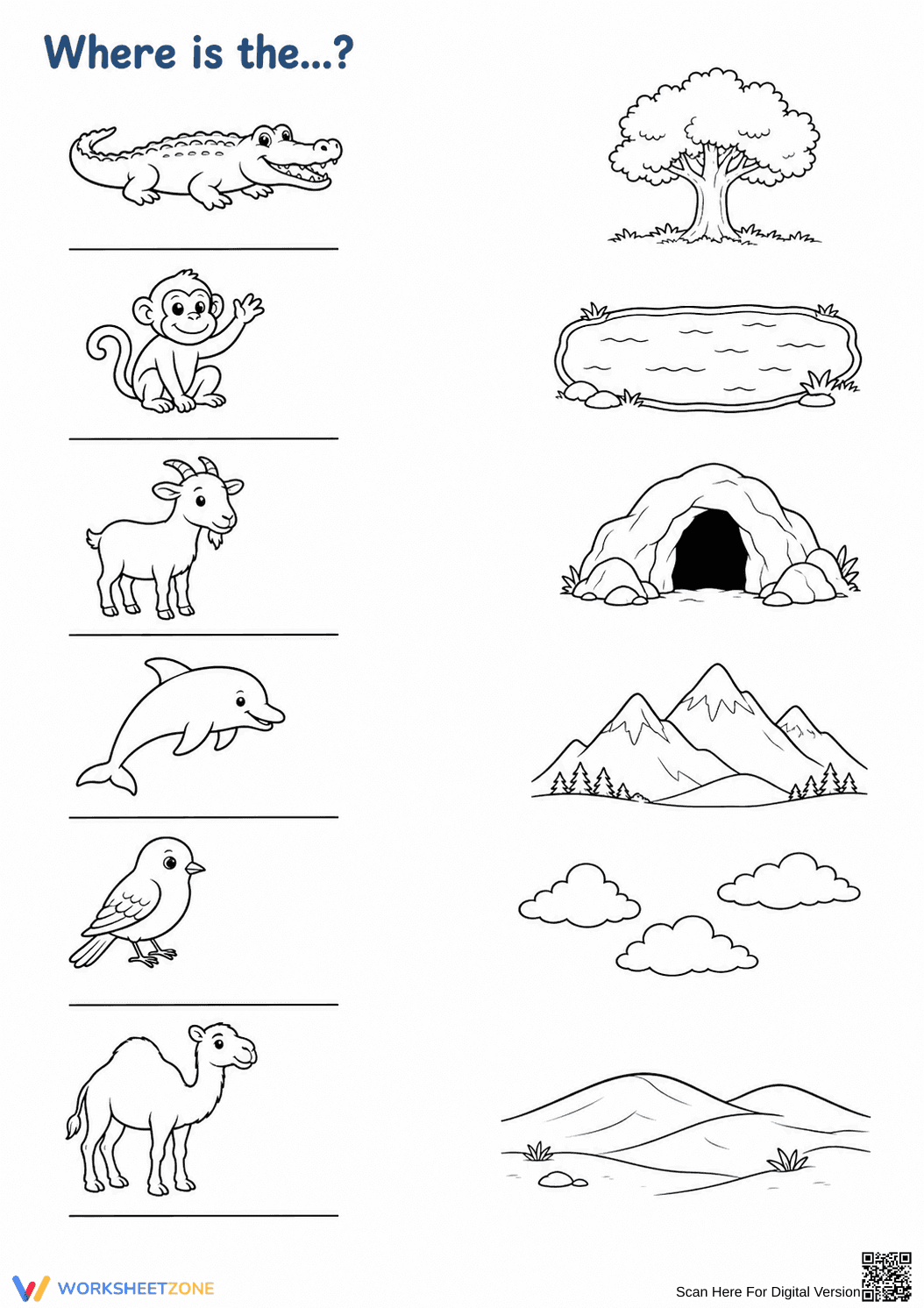

Grade K Animal Habitats — Printable No-Prep Worksheet

Paste this activity's link or code into your existing LMS (Google Classroom, Canvas, Teams, Schoology, Moodle, etc.).
Students can open and work on the activity right away, with no student login required.
You'll still be able to track student progress and results from your teacher account.
This printable Kindergarten worksheet helps students connect familiar animals to their natural habitats while practicing basic positional words. By matching six distinct animals to corresponding environment illustrations, young learners build foundational science knowledge and descriptive language skills in one simple, engaging activity.
At a Glance
- Grade: Kindergarten · Subject: Science
- Standard:
K-ESS3-1— Connect animals to the places they live- Skill Focus: Animal Habitats
- Format: 1 page · 6 problems · PDF
- Best For: Independent practice or centers
- Time: 10–15 minutes
This single-page resource features six clear, black-and-white illustrations of animals, including a crocodile, monkey, and dolphin, paired with blank writing lines. Opposite the animals are six distinct habitat scenes, such as a tree, pond, cave, and mountains. Students use visual cues to determine where each animal belongs, providing a highly structured format that supports early writers and English language learners.
Zero-Prep Workflow
This resource is designed for immediate classroom implementation with minimal teacher setup:
- Print (30 seconds): Generate enough copies for your small group or whole class directly from the PDF.
- Distribute (30 seconds): Hand out the sheets along with pencils or crayons for optional coloring.
- Review (1 minute): Read the "Where is the...?" prompt aloud and model the first matching example.
With under two minutes of prep, this fits perfectly into sub plans or morning routines.
Standards Alignment
This activity aligns with K-ESS3-1: Use a model to represent the relationship between the needs of different plants or animals and the places they live. It also supports early language development by encouraging the use of positional words to describe locations. Both standard codes can be copied directly into lesson plans, IEP goals, or district curriculum mapping tools.
How to Use It
Use this during a science center after a read-aloud about animal homes. Students can work independently to draw lines connecting the animal to its habitat, or write a short descriptive phrase on the provided line. Alternatively, use it as a formative assessment tool at the end of a habitat unit. While students complete the 10 to 15-minute task, teachers can observe whether children accurately pair the camel with the desert or the bird with the sky, noting any misconceptions about animal environments.
Who It's For
This resource is primarily designed for Kindergarten students developing early science and literacy skills. Clear visual supports make it accessible for English Language Learners and students needing modifications. For differentiation, advanced students can write complete sentences using prepositions (e.g., "The monkey is in the tree"), while students needing support can simply draw matching lines. Pair this worksheet with a visual anchor chart displaying different biomes to reinforce the vocabulary.
Visual matching tasks in early science instruction significantly reinforce concepts about animal environments. When students actively connect animals to the places they live, they develop critical cognitive mapping skills essential for later biological and ecological studies. According to a 2024 report by EdReports, instructional materials that combine clear visual models with descriptive language prompts dramatically improve the retention of core science ideas in early elementary grades. By practicing this specific skill through targeted exercises, young learners build a much stronger, more intuitive understanding of basic ecological relationships. The direct alignment to K-ESS3-1 ensures that this classroom activity meets rigorous educational benchmarks while remaining highly accessible and developmentally appropriate for young minds. Providing these structured, daily opportunities to identify and describe natural connections ultimately fosters both early scientific inquiry and essential vocabulary acquisition in growing learners.


