


























Views
Downloads

Printable Animal Habitat Sorting Game | Kindergarten
Paste this activity's link or code into your existing LMS (Google Classroom, Canvas, Teams, Schoology, Moodle, etc.).
Students can open and work on the activity right away, with no student login required.
You'll still be able to track student progress and results from your teacher account.
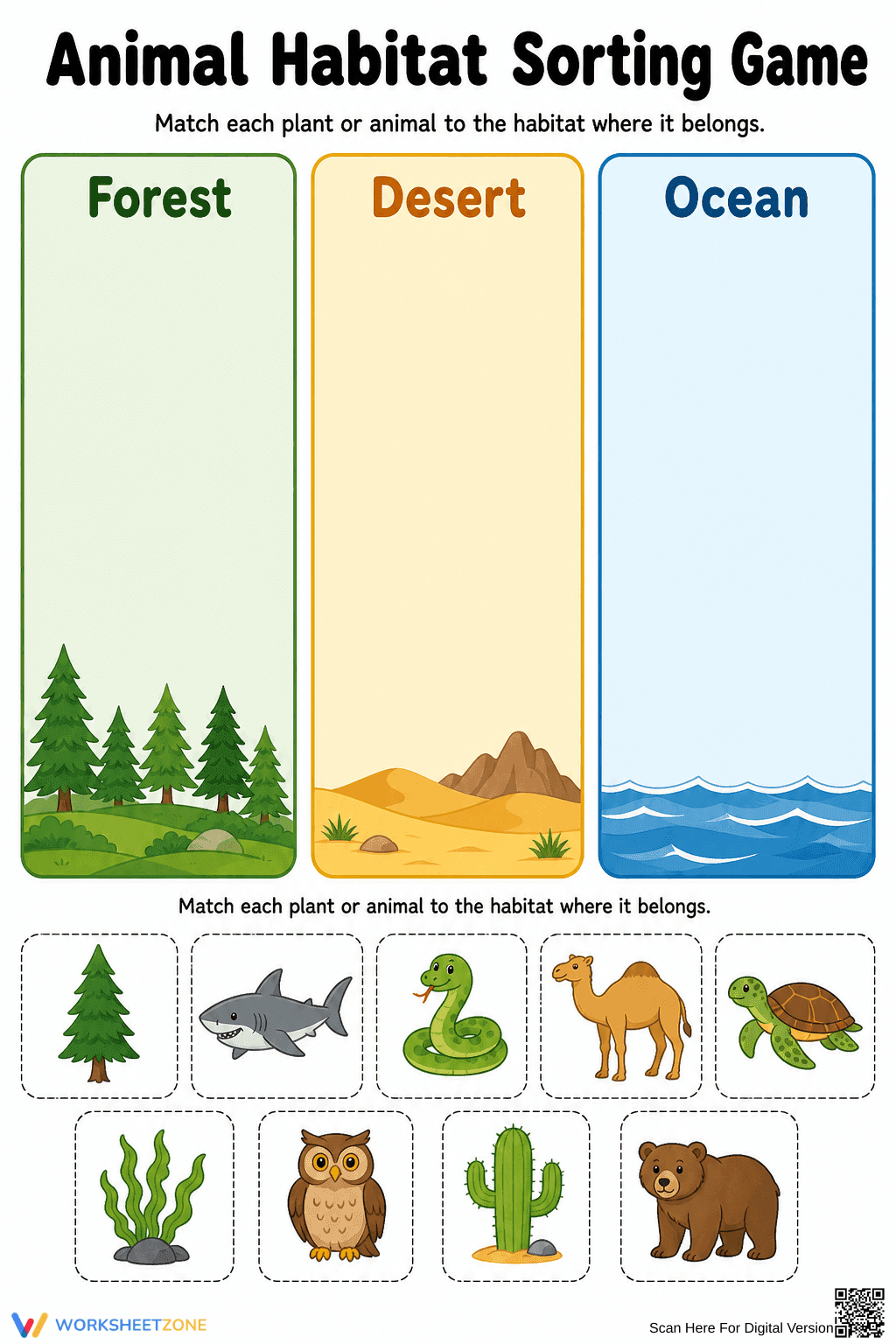
This Kindergarten science worksheet helps students identify where different plants and animals live by sorting them into their correct environments. By categorizing nine distinct organisms into forest, desert, and ocean ecosystems, early learners build foundational knowledge about biological needs and environmental relationships.
At a Glance
- Grade: Kindergarten · Subject: Science
- Standard:
K-ESS3-1— Model relationships between organisms and their environments- Skill Focus: Sorting animal habitats
- Format: 1 page · 9 problems · Answer key included · PDF
- Best For: Independent practice centers
- Time: 10–15 minutes
This single-page activity features three clearly labeled habitat columns: Forest, Desert, and Ocean. At the bottom of the page, students will find nine illustrated tiles representing various plants and animals, including a pine tree, shark, camel, and cactus. The visual design uses distinct color-coding for each environment to support early readers. A complete answer key is provided for quick verification.
Zero-Prep Workflow
This resource is designed for immediate classroom implementation with minimal teacher setup.
- Print (1 minute): Generate copies of the single-page PDF for your entire class.
- Distribute (1 minute): Hand out the worksheets along with scissors and glue sticks for the cut-and-paste sorting task.
- Review (1 minute): Display the answer key on your smartboard for rapid self-correction.
With a total teacher prep time of under three minutes, this activity functions perfectly as a reliable emergency sub plan or a quick transition activity.
Standards Alignment
This activity aligns directly with K-ESS3-1: Use a model to represent the relationship between the needs of different plants and animals and the places they live. It also supports early classification skills by requiring students to group items based on observable characteristics. Both standard codes can be copied directly into lesson plans, IEP goals, or district curriculum mapping tools.
How to Use It
Deploy this sorting game during science centers after a whole-group read-aloud about ecosystems. It also works well as an independent morning work assignment to reinforce previous instruction. As a formative assessment tip, observe students while they place the camel and cactus; hesitation here often indicates a need to review desert adaptations. Expect students to complete the sorting and pasting process within 10 to 15 minutes.
Who It's For
This worksheet is optimized for Kindergarten and Preschool students developing early life science concepts. The highly visual format provides built-in scaffolding for English Language Learners and pre-readers. For students needing a challenge, ask them to draw one additional animal for each column. Pair this activity with a classroom anchor chart displaying real photographs of the three target habitats.
Effective early science instruction relies heavily on categorization tasks to build strong cognitive frameworks. According to a 2024 report by EdReports, young learners who engage in visual sorting activities demonstrate a significantly higher retention rate of biological concepts compared to those who only receive verbal instruction. This worksheet targets K-ESS3-1, requiring students to model relationships between organisms and their specific environments. By physically moving the plant and animal tiles into the correct forest, desert, or ocean columns, children solidify their understanding of ecosystem dependencies. The tactile nature of the cut-and-paste format further reinforces fine motor development alongside essential academic content. Providing structured opportunities to classify the natural world helps Kindergarteners transition from simple observation to analytical thinking, laying the critical groundwork for more complex ecological studies in later elementary grades.


